


Bassler sign is a deep palpation manoeuvre described by Anthony Bassler in 1913 to elicit tenderness in patients with suspected chronic appendicitis.
The examiner applies deep pressure to the right lower abdomen with the thumb, followed by lateral displacement towards the patient’s right side. Bassler proposed that this compressed the appendix against the underlying iliacus muscle, producing localised pain or tenderness.
The diagnostic accuracy of the sign has not been established.
Examination technique
Bassler originally recommended identifying the lateral border of the right rectus abdominis muscle and, where possible, determining the position of the caecum by percussion.
The examiner places the thumb vertically over the right lower abdomen, with its tip directed towards the xiphisternum, and presses directly posteriorly. The thumb is then displaced laterally towards the patient’s right side, approximately perpendicular to the initial direction of pressure.
If tenderness is not elicited, the manoeuvre is repeated progressively lower towards the pelvic brim. Bassler recommended examination of the corresponding left-sided region as a control.
Diagnostic accuracy
Bassler sign was developed for the examination of suspected chronic appendicitis rather than acute appendicitis.
No diagnostic accuracy studies have been identified and the sensitivity, specificity and clinical utility remain undetermined. A positive result cannot be regarded as specific for appendiceal inflammation.
History of the Bassler Sign
1913 – Anthony Bassler (1874-1959) published Pinching the appendix in diagnosis of chronic appendicitis in the American Journal of the Medical Sciences.
Bassler stated that tenderness associated with chronic appendicitis might occur away from McBurney point because of variations in the anatomical position of the caecum and appendix. He proposed deep posterior pressure followed by lateral thumb movement to elicit tenderness by compressing the appendix against the iliacus muscle.
Bassler found the manoeuvre most useful when the position of the caecum could not be established by percussion.
When the thumb has been sunk about half-way down to the back of the abdominal cavity, it is swung to the right of the patient at a right angle to the downward pressure line. This pinches the appendix against the iliacus muscle and unyielding structures under and at the side of it, and usually elicits pain or tenderness. It is well, having done this in the mid-distance between the anterior superior spine and the umbilicus and not having obtained tenderness, to move the thumb down about one-half inch, performing it again, and so on downward until one has reached almost to the brim of the pelvis.
The same procedure on the left side serves as a control. By means of this method of downward and then right lateral pressure it is possible to elicit tenderness in the average case of chronic appendicitis.
Bassler 1913
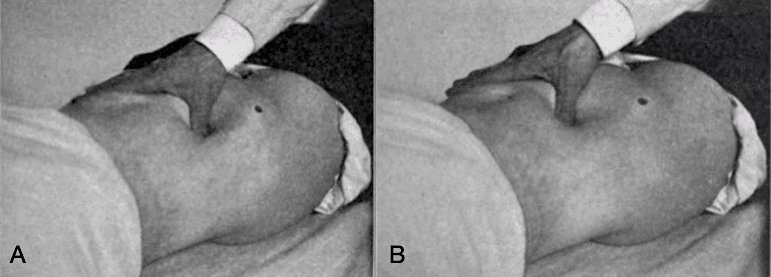
1915 – John Chalmers Da Costa Jr. described Bassler’s examination in the third edition of Principles and practice of physical diagnosis (p. 537). He published the characteristic posterior and lateral thumb movements, referring to the manoeuvre as Bassler’s method.
2018 – Rastogi et al included Bassler sign in their historical review of abdominal examination manoeuvres. They summarised its performance and reported that no studies evaluating its sensitivity or specificity were known to the authors.
Eponymythology
Bassler’s original technique was more elaborate than many later summaries suggest. It involved anatomical localisation, deep posterior pressure, lateral thumb displacement, repeated examination at progressively lower levels and comparison with the opposite side.
Modern descriptions commonly specify a seated patient, however Bassler recommended sitting position initially to assist with the identification of the rectus border.
References
Original references
- Bassler A. Pinching the appendix in diagnosis of chronic appendicitis. American Journal of the Medical Sciences. 1913; 146(2): 204-208.
- Da Costa JC. Principles and practice of physical diagnosis. 1915: 537
Review articles
- Rastogi V, Singh D, Tekiner H, Ye F, Mazza JJ, Yale SH. Abdominal Physical Signs and Medical Eponyms: Movements and Compression. Clin Med Res. 2018 Dec;16(3-4):76-82.
- Cadogan M. Eponymous clinical signs in appendicitis. LITFL
eponymictionary
the names behind the name

BA MA (Oxon) MBChB (Edin) FACEM FFSEM. Emergency physician, Sir Charles Gairdner Hospital. Passion for rugby, medical history, medical education, and asynchronous learning #FOAMed evangelist. Editor-in-Chief and Webmaster of Life in the Fast lane, LITFL | On Call 4e| Eponyms | Books | Horology |