

Fidel Pagés
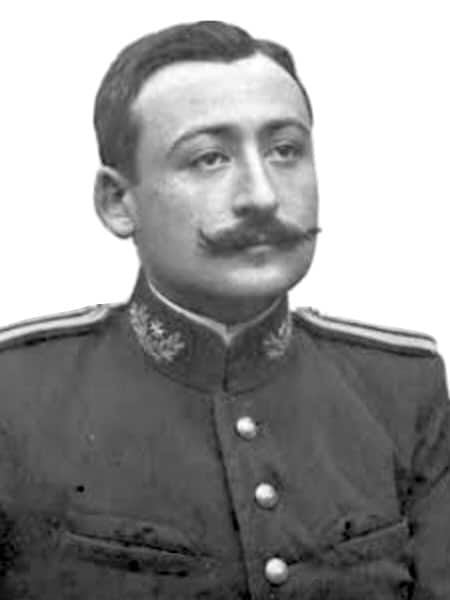
Fidel Pagés Miravé (1886-1923) was a Spanish military surgeon
Fidel Pagés career spanned Madrid hospital practice and frontline service in North Africa. He trained through the Academia Médico-Militar, developed a reputation for practical surgery under austere conditions, and helped shape Spanish military medical publishing and professional life in the years surrounding World War I.
Pagés’ enduring place in anaesthesia history rests on his 1921 paper describing “anestesia metamérica”, a lumbar epidural technique aimed at segmental blockade. He set out a reproducible method with clear anatomical reasoning, procedural detail, drug choice (procaine with adrenaline), and operative experience. Importantly, he framed the epidural target as a distinct space and technique, separate in intent and execution from spinal anaesthesia, supported by explanatory figures and stepwise technical advice.
His work was published in Spanish military medical literature and, for years, remained less visible internationally than later “rediscoveries” and refinements elsewhere. Modern historical accounts consistently recognise Pagés as an early, clear exemplar of lumbar epidural anaesthesia. His career ended abruptly in 1923 after a motor-vehicle accident, leaving his neuraxial contribution as a concentrated but highly influential legacy.
Biographical Timeline
- Born January 26, 1886 in Huesca, Spain (family: Juan Pagés Marqué and Concepción Miravé Sesé). Pagés = paternal surname; Miravé = maternal surname.
- 1896–1901 – Secondary schooling at the Instituto de Huesca
- 1901–1908 – Medical studies, University of Zaragoza; graduated June 12, 1908; awarded Premio Extraordinario.
- 1908 – Entered the Cuerpo de Sanidad Militar; posted to Hospital Militar de Carabanchel (Médico Segundo).
- 1909–1910 – Commissioned to Melilla as surgical assistant; later returned again to Carabanchel
- 1912 – Awarded Doctor of Medicine with thesis “Patogenia de las Bradicardias.”
- 1918 – Became secretary of the editorial staff of Revista de Sanidad Militar (1918)
- 1918 – Co-founded Revista Española de Cirugía (1919).
- March 1921 – Published “Anestesia metamérica” in Revista Española de Cirugía (later reproduced in Revista de Sanidad Militar), describing what is now recognised as epidural anaesthesia with a segmental (“metameric”) concept.
- Died on September 21, 1923 aged 37 in a motor vehicle accident at Quintanapalla near Burgos while returning to Madrid with his family from summer holiday in Cestona (near San Sebastián).
Key Medical Contributions
“Anestesia metamérica” — lumbar epidural anaesthesia (1921)
1921 – Pagés published “anestesia metamérica” describing a reproducible lumbar epidural (perimeningeal) technique intended to produce segmental blockade. He described needle positioning short of dural puncture, provided an anatomical rationale for spread, and gave practical procedural details. He used procaine (novocaine) with adrenaline and reported a substantial clinical series, including abdominal and hernia surgery. The paper is one of the earliest clear presentations of epidural anaesthesia as a surgical technique distinct from spinal anaesthesia.
A technical point he emphasised was bevel orientation. Pagés recommended turning the bevel laterally to run more parallel to ligamentum flavum fibres. This improved the tactile sense of ligament perforation, reducing the likelihood of dural puncture by “sliding” on the convex dura, and avoiding incomplete deposition if part of the bevel lies outside the target space.
Original
English
Teniendo en cuenta que los ligamentos amarillos están orientados de atrás adelante y de dentro afuera, procuraremos que la parte puntiaguda del bisel esté hacia afuera… Este detalle técnico… hace que se aprecie más fácilmente la perforación ligamentosa… y, aun cuando toquemos la duramadre… resbalaremos sobre su superficie convexa sin atravesarla. Anestesia metamérica, 1921
Given that the ligamenta flava are oriented from posterior to anterior and from medial to lateral, we should keep the sharp part of the bevel facing outward… This technical detail makes it easier to perceive the ligamentous perforation… and even if we touch the dura, we will slide over its convex surface without penetrating it. Anestesia metamérica, 1921
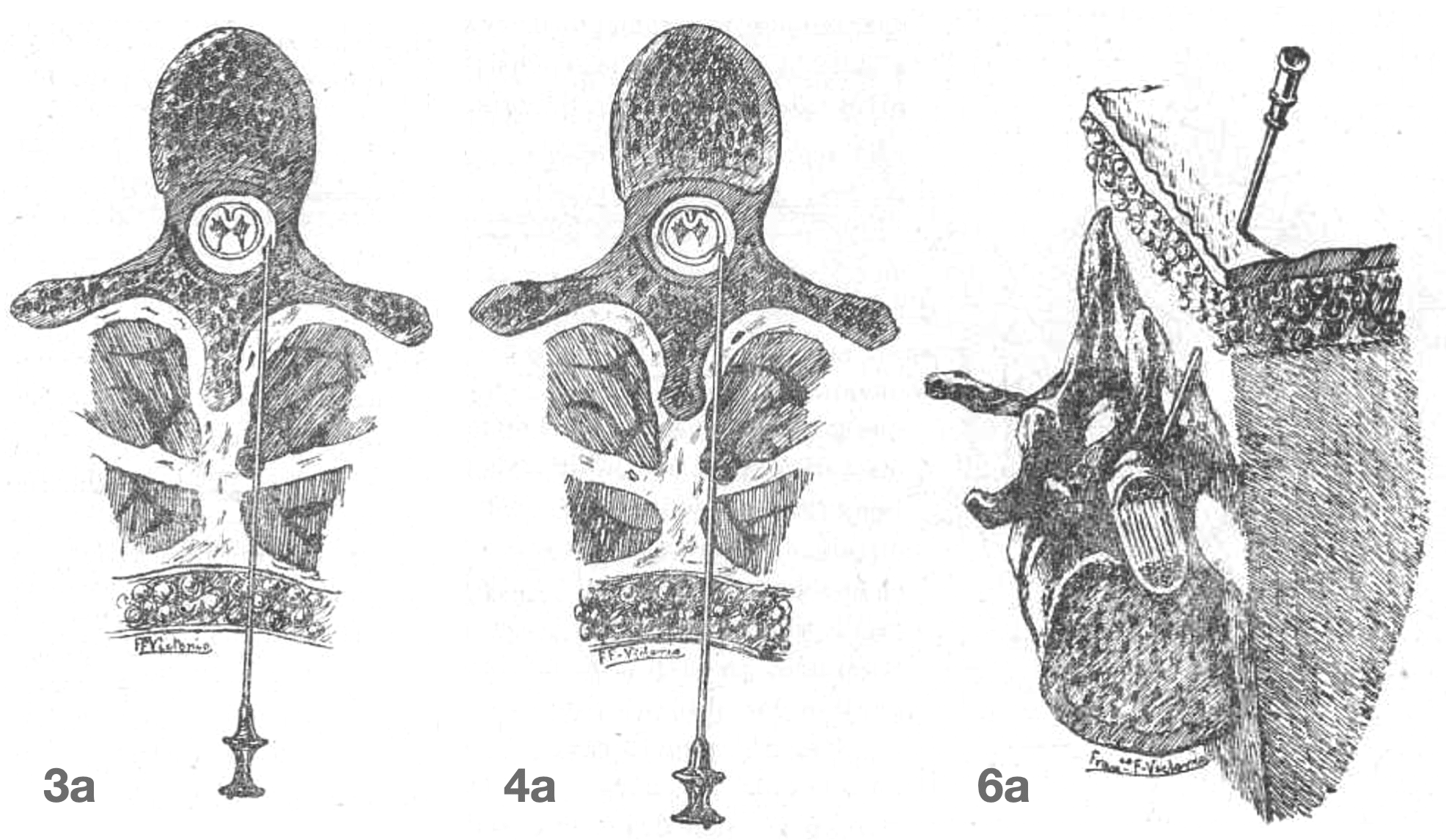
Fig. 3a: Needle in proper position. Fig. 4a: Poor trocar positioning that facilitates dural penetration. Fig. 6a: Schematic representation of the path taken by the needle during perimeningeal (epidural) puncture. Anestesia metamérica, 1921
Although later clinicians refined epidural localisation, equipment, dosing and safety, Pagés’ 1921 paper remains historically important for explicitly separating the epidural target from spinal anaesthesia, and for presenting a clinically tested, step-by-step approach intended for routine surgical use.
Controversies
Name and indexing (Pagés vs Pagés Miravé)
Spanish naming convention uses two surnames (paternal then maternal). His full name is Fidel Pagés Miravé, but many medical and historical sources shorten this to Fidel Pagés (or Fidel Pages, without the accent). For consistency on LITFL, use Fidel Pagés Miravé at first mention (with accent), then Fidel Pagés thereafter.
Date of birth
We use the date January 26, 1886 rather than January 28, 1886. It is supported by cemetery/grave records from his burial site (Real Sacramental de San Lorenzo y San José, Madrid), which list Fecha de Nacimiento: 26 de enero de 1886 and Fecha Defunción: 21 de septiembre de 1923.
Major Publications
- Pagés F. Sobre un caso de estrangulación retrógrada de epiplón. Revista Española de Cirugía. 1919; 1: 1-11
- Pagés F. Contribución al estudio de la cirugía plástica de la mejilla. Revista de sanidad militar (Madrid) 1920; 3,4,5: 201-205, 232-236, 267-303.
- Pagés F. Sobre algunos casos de utilización de las fascias. Revista de sanidad militar (Madrid) 1921; 2,3: 33-43, 75-110
- Pagés F. Anestesia metamérica. Revista de sanidad militar (Madrid) 1921; 11(12): 351-365, 385-396
- Pagés F. Sobre la existencia de un espacio paravertebral hipersonoro en los pneumotórax de tensión. Revista Española de Cirugía. 1921; 12: 426-436
- Pagés F. La gastroenterostomía con collar epiploico. Revista Española de Cirugía. 1922; 13: 1-6
- Pagés F. Heridas abdominales de guerra. Mi experiencia personal. Revista Española de Cirugía. 1922; 10-12: 419-477.
References
Biography
- de Lange JJ, Cuesta MA, Cuesta de Pedro A. Fidel Pagés Miravé (1886-1923). The pioneer of lumbar epidural anaesthesia. Anaesthesia. 1994 May;49(5):429-31.
- Herrera A, de las Mulas M. En memoria de Fidel Pagés Miravé (1886-1923) en el LXXV aniversario de la publicación de “Anestesia metamérica” [In memoriam Fidel Pagés Miravé (1886-1923) on the 75th anniversary of the publication of “Anesthesia metamérica”]. Rev Esp Anestesiol Reanim. 1996 Feb;43(2):59-66
- Sanid. mil. 2011; 67 Suplemento (1)
- Velázquez Rivera I. Aproximación a la obra científica del Comandante médico Fidel Pagés Miravé. Sanid. mil. 2011; 67 Suplemento (1)
- Beleña JM, Núñez M. Fidel Pagés, el auténtico descubridor de la anestesia epidural, en el centenario de su publicación Anestesia metamérica (1921-2021). Revista mexicana de anestesiología 2023; 46(1)
- Chinn GA, Gray AT, Larson MD. Overcoming Obstacles: The Legacy of Fidel Pagés, Founder of the Epidural, 100 Years After His Passing. Anesth Analg. 2024 Feb 1;138(2):475-479.
- Fidel Pagés Miravé (1886-1923). Sacramental de San Lorenzo y San José Memorials, Madrid
Eponymous terms
- Pagés F. Anestesia metamérica [Metameric anesthesia. 1921]. Rev Esp Anestesiol Reanim. 1991 Sep-Oct;38(5):318-26.
- López Álvarez S, Casas Reza P, Del Río Fernández S. Centenary of epidural anaesthesia. Rev Esp Anestesiol Reanim (Engl Ed). 2022 Jan;69(1):4-11
Eponym
the person behind the name

BSc MD University of Western Australia. Interested in all things critical care and completing side quests along the way

BA MA (Oxon) MBChB (Edin) FACEM FFSEM. Emergency physician, Sir Charles Gairdner Hospital. Passion for rugby; medical history; medical education; and asynchronous learning #FOAMed evangelist. Co-founder and CTO of Life in the Fast lane | On Call: Principles and Protocol 4e| Eponyms | Books |