


von Rosen splint
Von Rosen splint is a malleable aluminium abduction splint developed by Sophus von Rosen (1898–1996) for the immediate treatment of unstable, dislocatable or dislocated hips in newborn infants.
The splint was designed to keep the femoral head continuously reduced within the acetabulum while permitting limited hip movement and allowing routine nursing care. Unlike removable pillows and earlier abduction devices, the treatment principle was not simply to hold the legs apart. The von Rosen split was designed to maintain reduction continuously until the neonatal hip became stable.

Von Rosen introduced the splint in Malmö in 1956 as part of a neonatal programme combining early clinical diagnosis, radiographic confirmation and immediate treatment.
The von Rosen splint was developed to abduct the newborn hips and maintain a newly reduced unstable hip continuously while allowing limited movement. Long-term Malmö follow-up showed excellent anatomical outcomes. Later comparative studies supported its effectiveness, and modern follow-up suggests a very low risk of clinically significant AVN when treatment is started early and the device is correctly applied.
History
1952 – Sophus von Rosen (1898–1996) and paediatrician Per Selander began systematic examination of newborn hips in Malmö. Infants with lax, dislocatable or dislocated hips were referred for immediate orthopaedic treatment.
Early patients were treated with abduction cushions, plaster and other splints. A key problem was that these devices were removed for feeding, washing or nursing, allowing an unstable femoral head repeatedly to slip out of and back into the acetabulum. Von Rosen concluded that successful early treatment required continuous maintenance of reduction.
1956 – Von Rosen described his new splint in Early Diagnosis and Treatment of Congenital Dislocation of the Hip Joint. The original device was made from 1.5-mm malleable aluminium sheet, individually shaped to the infant, lacquered with celluloid and padded. Its covering could be changed and the splint cleaned without removing the child from treatment.
The important innovation was not abduction treatment, but devising a splint that could maintain the femoral head reduced continuously while still permitting some movement and practical nursing care.
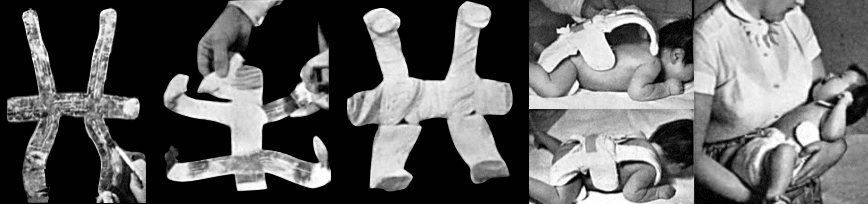
1958 – Andrén and von Rosen reported the final eight newborns in their series treated with the aluminium splint. When treatment was started immediately after birth, they considered that several weeks of immobilisation might be sufficient. In one case, hips that had been dislocatable at birth could no longer be dislocated after 16 days in the splint
1962 – von Rosen published Diagnosis and treatment of congenital dislocation of the hip joint in the new-born. He described the splint as thin malleable aluminium strips with a rubber covering. The hips were maintained in abduction and lateral rotation, a position in which the femoral head remained reduced.
Infants were reviewed every two or three weeks. Once reduction was judged stable, temporary removal for bathing and care was permitted, usually after four to eight weeks. Splintage was generally discontinued before the end of the third month. Von Rosen reported no redislocation after this treatment protocol.
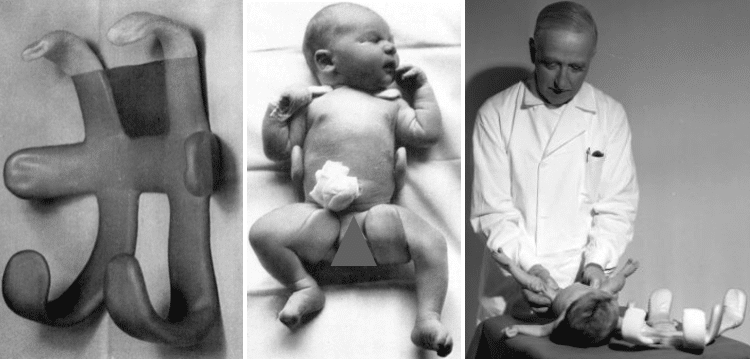
1976 – Nils Fredensborg published The results of early treatment of typical congenital dislocation of the hip in Malmö. He reviewed 111 children treated in Malmö between 1956 and 1964. Treatment had begun within the first few days of life and lasted an average of 10 weeks. At follow-up the children were aged 8–16 years, mean approximately 10 years.
There were two failures of initial splintage, but both ultimately had good outcomes. At late follow-up 109 of 111 children had hips radiographically indistinguishable from normal controls. One had minor residual acetabular dysplasia and one had slight enlargement of the femoral head and neck after earlier changes suggestive of avascular necrosis.
1988 – Heikkilä published a Comparison of the Frejka pillow and the von Rosen splint in treatment of congenital dislocation of the hip. In southern Finland, 920 newborns had previously been treated with a removable Frejka pillow and treatment failed in 55. After the unit changed to the von Rosen splint, 180 infants were treated and initial treatment failed in one patient. One boy later showed slight features of avascular necrosis. Skin irritation occurred in approximately 19%, although usually transiently.
Heikkilä concluded that a device which could be removed by parents between outpatient visits was undesirable, reinforcing von Rosen’s original principle of continuous maintained reduction.
1992 – Hinderaker, Rygh and Udén compared 307 Malmö children treated with the von Rosen splint for three months with 101 children in Tromsø treated with a Frejka pillow for 4.5 months. Acetabular index values were similar between groups. None of the von Rosen group (0/307) required supplementary treatment, whereas four children in the Frejka group (4/101) required further treatment for residual dysplasia or subluxation.
The authors concluded that the Frejka pillow appeared to carry a greater risk of failure, possibly because removal for routine care allowed a very unstable hip to redislocate.
2002 – Wilkinson, Sherlock and Murray retrospectively compared treatment of 134 Graf III–IV hips in 96 infants using no splint, Craig splint, Pavlik harness or von Rosen splint.
The von Rosen group showed significantly greater improvement in ultrasound grading at 12–20 weeks. No hip treated with the von Rosen splint required subsequent plaster treatment or surgery, compared with 10 hips treated with the Pavlik harness, three with the Craig splint and eight without splintage. No avascular necrosis or femoral-head deformity was identified in the von Rosen group.
However, the study was retrospective, small and non-randomised, and infants treated with the von Rosen splint were treated at an earlier mean age. The authors therefore called for a large prospective randomised trial rather than claiming definitive superiority.
2016 – Wenger et al. reviewed the modern Malmö programme in 229 children treated within the first week of life. The mean treatment start was three days. Dislocated or clinically dislocatable hips were treated for 12 weeks. Ultrasonographically unstable hips were treated for six weeks, with the splint worn continuously.
Two children developed grade-1 avascular necrosis (0.9%; 95% CI 0.1–3.1). Both abnormalities resolved spontaneously and both children remained asymptomatic at six and eight years. Mean observation was 6.5 years. The authors concluded that early treatment with the von Rosen splint was safe with regard to avascular necrosis.
Safety: an important qualification
The von Rosen splint should not be understood as a device for forcing the hips into maximal abduction. Von Rosen’s original method allowed some movement while maintaining reduction. Later reports associated excessive abduction, excessive tightness and poorly constructed copies with pressure deformity or avascular necrosis. Wilkinson specifically noted that von Rosen’s original description warned against excessive abduction.
Von Rosen’s obituary made the same distinction: copies bearing his name could be ineffective or harmful when strapped too tightly; the original device was regarded as an “ideal compromise” because it permitted motion while maintaining reduction.
Eponymythology
Abduction splints pre-dated von Rosen. His contribution was the combination of immediate neonatal treatment, continuous reduction and controlled mobility in a device that could remain in place during routine care.
The Malmö method was not simply “put the hips in abduction” but to emphasised the correct positioning, early treatment, continuous use and avoidance of excessive force were integral to the technique.
Von Rosen never patented the splint and the eponymous term has since become attached to copies of varying design and fit.
Associated Persons
- Erik Sophus von Rosen (1898-1996)
References
Historical references
- Von Rosen S. Early Diagnosis and Treatment of Congenital Dislocation of the Hip Joint. Acta Orthopaedica, 1956; 26(2): 136–155.
- Andrén L, Von Rosen S. The diagnosis of dislocation of the hip in newborns and the primary results of immediate treatment. Acta Radiol (Stockh). 1958 Feb;49(2):89-95.
- von Rosen. Diagnosis and treatment of congenital dislocation of the hip joint in the new-born. J Bone Joint Surg Br. 1962 May;44-B:284-91.
Eponymous term review
- Fredensborg N. The results of early treatment of typical congenital dislocation of the hip in Malmö. J Bone Joint Surg Br. 1976 Aug;58(3):272-8.
- Hansson G, Nachemson A, Palmén K. Screening of children with congenital dislocation of the hip joint on the maternity wards in Sweden. J Pediatr Orthop. 1983 Jul;3(3):271-9.
- Heikkilä E. Comparison of the Frejka pillow and the von Rosen splint in treatment of congenital dislocation of the hip. J Pediatr Orthop. 1988 Jan-Feb;8(1):20-1.
- Hinderaker T, Rygh M, Udén A. The von Rosen splint compared with the Frejka pillow. A study of 408 neonatally unstable hips. Acta Orthop Scand. 1992 Aug;63(4):389-92.
- Wilkinson AG, Sherlock DA, Murray GD. The efficacy of the Pavlik harness, the Craig splint and the von Rosen splint in the management of neonatal dysplasia of the hip. A comparative study. J Bone Joint Surg Br. 2002 Jul;84(5):716-9.
- Wenger D, Samuelsson H, Düppe H, Tiderius CJ. Early treatment with the von Rosen splint for neonatal instability of the hip is safe regarding avascular necrosis of the femoral head: 229 consecutive children observed for 6.5 years. Acta Orthop. 2016;87(2):169-75.
eponymictionary
the names behind the name

Studying for Bachelor of Science (Occupational Therapy) at Curtin University

BA MA (Oxon) MBChB (Edin) FACEM FFSEM. Emergency physician, Sir Charles Gairdner Hospital. Passion for rugby, medical history, medical education, and asynchronous learning #FOAMed evangelist. Editor-in-Chief and Webmaster of Life in the Fast lane, LITFL | On Call 4e| Eponyms | Books | Horology |