

Walter Stoeckel
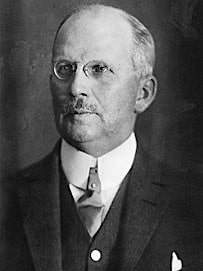
Walter Stoeckel (1871–1961) was a German obstetrician–gynaecologist
Stoeckel’s career spanned Imperial Germany, the Weimar period, National Socialism, post-war Berlin, and the DDR. He held chairs at Greifswald, Marburg, Kiel, and Leipzig. In Berlin he led the university women’s clinic for 25 years.
In 1909 he published a major series on sacral (caudal) anaesthesia in labour using Novokain, describing striking analgesia while uterine activity continued. He also advanced operative gynaecology and oncologic technique, including refinement of radical vaginal surgery for cervical cancer (Schauta–Stoeckel operation).
Close examination of the Berlin clinic during 1933–1945 places his leadership within an era of coercive reproductive policy, professional “coordination” (Gleichschaltung), and proximity to the Nazi state.
Biographical Timeline
- Born March 14, 1871 in Stobingen, East Prussia (Deutsches Reich / Ostpreußen)
- 1890 – Completed Abitur (Gymnasium, Insterburg).
- 1890-1892 – Medical studies, Leipzig, Munich and Jena
- 1892–1895 – Medical studies and promotion phase, Königsberg (Albertus-Universität).
- 1896 – Military service in Königsberg. Dissertation: Dreissig Fälle von vaginaler Totalexstirpation des Uterus… (Königsberg).
- 1896–1897 – Ship’s doctor (Norddeutscher Lloyd).
- 1897–1898 – Voluntary assistant (Volontärassistent), Bonn Women’s Clinic.
- 1898–1903 – Scientific assistant (wiss. Assistent), Gynaecology, University of Bonn.
- 1903 – Habilitation: Die Cystoskopie in ihrer Bedeutung (Erlangen-Nürnberg).
- 1903–1904 – Senior physician (Oberarzt), Gynaecology, Erlangen-Nürnberg.
- 1904–1905 – Privatdozent, Berlin.
- 1905–1907 – Associate professor (außerord. Professor), Berlin.
- 1907 – Full professor (ord. Professor), University Women’s Clinic Greifswald.
- 1907–1910 – Full professor, Philipps University Marburg.
- 1910–1922 – Full professor and Director, University Women’s Clinic Kiel. Member, Medizinalkollegium Schleswig-Holstein, Kiel.
- 1920–1921 – Dean, Faculty of Medicine, Kiel. Appointed Geheimer Medizinalrat (Privy Medical Councillor).
- 1922–1926 – Full professor, University of Leipzig.
- 1926–1951 – Full professor and Director, Berlin (University Women’s Clinic).
- 1933–1935 – President, Deutsche Gesellschaft für Gynäkologie und Geburtshilfe.
- 1941 – Honours: Ehrenbürger, Christian-Albrechts-Universität Kiel; Goethe-Medaille für Kunst und Wissenschaft.
- 1942–1944 – Berlin period controversial coercive sterilisation practices
- 1944–1945 – Listed as corresponding member, Sanitäts- und Gesundheitswesen Karl Brandt
- 1946 – Ehrensenator, Christian-Albrechts-Universität Kiel.
- 1951 – Retired from Berlin chair/directorship.
- 1960 – Honours: Paracelsus-Medaille, Nationalpreis der DDR, title Hervorragender Wissenschaftler des Volkes.
- Died February 12, 1961 in Berlin.
Medical Eponyms
Schauta–Stoeckel operation (1908, 1931)
Radical vaginal hysterectomy for cervical cancer based on the Schauta approach, further developed and modified by Stoeckel. Wide resection of the cervix and adjacent parametrial tissues through a vaginal route, with ureteric identification and dissection of the bladder pillar to permit radical excision of the paracervical tissues.
As pelvic lymph node assessment became integral to cervical cancer staging, radical vaginal hysterectomy declined in favour of the abdominal Wertheim-type procedures. However, with the emergence of laparoscopic lymphadenectomy, the Schauta–Stoeckel concept was revived as a combined approach (“laparoscopy-assisted radical vaginal hysterectomy modified according to Schauta–Stoeckel”), and proposed as a potential alternative to conventional radical abdominal hysterectomy.
Key Medical Contributions
Caudal epidural analgesia in labour (1909)
1909 – While at Marburg, Stoeckel published Über sakrale Anästhesie describing 141 cases of obstetric epidural analgesia via the caudal route. The first large obstetric series of caudal (sacral) epidural analgesia.
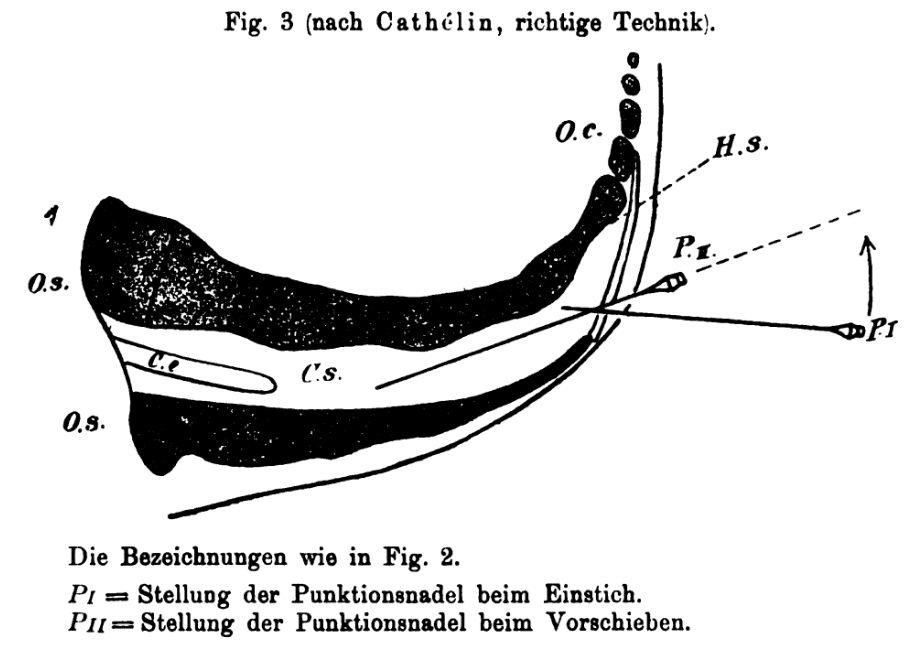
Stoeckel’s diagram (after Cathelin) showing correct needle position through the sacral hiatus:
PI during initial puncture, PII during advancement into the sacral canal.
Stoeckel adapted caudal epidural injection for parturition following the work of Cathelin (1901) and Sicard (1901). Using Novokain, he reported that ‘labour pains disappeared while uterine activity remained unaffected‘
Original
English
Die Wirkung übertraf meine Erwartungen: die Wehenschmerzen verschwanden, während die Wehentätigkeit unbeeinflußt blieb: der Durchtritt des Kindes vollzog sich so schmerzlos, daß die Gebärende nichts davon merkte.
…das mir vorschwebende Ideal der schmerzlosen Geburtsleitung: die temporäre Ausschaltung der die Wehenschmerzen vermittelnden Nervenbahnen ohne nennenswerte Allgemeinwirkung. – Stoeckel 1909
The effect exceeded my expectations: labour pains disappeared while uterine activity remained unaffected; delivery occurred so painlessly that the woman noticed nothing.
My ideal of painless childbirth management: the temporary elimination of the nerve pathways that transmit labor pains without any significant adverse effects. – Stoeckel 1909
Unfortunately this work was largely ignored internationally, and Stoeckel himself did not continue to develop the technique.
Controversies and historical context (1933–1945)
National Socialism, eugenics, and institutional power
Archival studies place Stoeckel’s long directorship of the I. Berliner Universitätsfrauenklinik within an institutional environment in which National Socialist reproductive policy was implemented, including coercive sterilisation. Clinic-era records indicate forced sterilisation occurred in Berlin during 1940–1944, reported at lower rates than some comparator university clinics, but nonetheless present.
As president of the German Society for Gynaecology in 1933, Stoeckel accepted and facilitated the Gleichschaltung (“coordination”) of the society. His opening address in Berlin (October 1933) remains controversial. He endorsed the regime’s “hardness” narrative, and justified the exclusion of Jewish colleagues. He read out a “Huldigungstelegramm” (tribute telegram) to Hitler at the end of the address and asked the delegates to approve sending it. One source notes the response was “long-lasting lively applause.” Later accounts note that this address was omitted from his post-war published speech collections.
Historical accounts also report that Stoeckel was closely known to Magda Goebbels, delivered the Goebbels children in his private clinic (Ida-Simon-Bau), and invoked these connections in disputes over maternity policy (clinic birth vs home birth) within the health administration.
Major Publications
- Stoeckel W. Dreissig Fälle von vaginaler Totalexstirpation des Uterus aus der königlichen Universitäts-Frauenklinik zu Königsberg in Preußen. (Medizin) Albertus-Universität Königsberg 1896
- Stoeckel W. Die Cystoskopie in ihrer Bedeutung für den Gynäkologen (Teil I und II). Habilitationsschrift. Friedrich-Alexander-Universität Erlangen-Nürnberg. 1903.
- Stoeckel W. Atlas der gynakologischen Cystoskopie 1908
- Stoeckel W. Über sakrale Anästhesie. Zentralblatt für Gynäkologie. 1909; 33: 1–15.
- Stoeckel W. Lehrbuch der Gynäkologie. 1924
- Stoeckel W. Zur Technik der vaginalen Radikaloperation beim Kollumkarzinom. Zentralblatt für Gynäkologie 1931; 55: 53-64
- Stoeckel W. Gynäkologische Urologie. 3 Bände, München 1938
- Stoeckel W. Ansprachen. 1952
References
Biography
- Bayer H. Walter Stoeckel 1871 -1961. Band 6 1986, edited by Jürgen Großer, Berlin, Boston: De Gruyter, 1987, pp. 336-339
- David M, Ebert A. „Ich war Kaiser geworden.” Walter Stoeckel (1871-1961) zum 40. Todestag. Walter Stoeckel (1871-1961) on the Occasion of his 40th Death Anniversary. Zentralbl Gynakol 2002; 124(6): 338-341
- Schagen U. Walter Stoeckel (1871-1961) als (un)politischer Lehrer- Kaiser der deutschen Gynäkologen?, in: Geschichte der Berliner Frauenkliniken, hrsg. von Matthias David und Andreas Ebert, Berlin 2010, S. 73-88.
- Doetz S. Alltag und Praxis der Zwangssterilisation. Die Berliner Universitätsfrauenklinik unter Walter Stoeckel 1942–1944, Berlin 2011.
- Baskett TF. Walter Stoeckel (1871–1961) In: Eponyms and Names in Obstetrics and Gynaecology. 3e. 2019: 414
Eponymous terms
- Schauta F. Die erweiterte vaginale Totalexstirpation des Uterus beim Kollumkarzinom. Wien: Verlag von J, Safar, 1908.
- Doughty A. Walter Stoeckel (1871-1961). A pioneer of regional analgesia in obstetrics. Anaesthesia. 1990 Jun;45(6):468-71.
- Schneider A, Possover M, Kamprath S, Endisch U, Krause N, Nöschel H. Laparoscopy-assisted radical vaginal hysterectomy modified according to Schauta-Stoeckel. Obstet Gynecol. 1996 Dec;88(6):1057-60.
- Possover M. The Modified Schauta-Stoeckel Procedure. J Minim Invasive Gynecol. 2021 Mar;28(3):391.
Eponym
the person behind the name

BA MA (Oxon) MBChB (Edin) FACEM FFSEM. Emergency physician, Sir Charles Gairdner Hospital. Passion for rugby; medical history; medical education; and asynchronous learning #FOAMed evangelist. Co-founder and CTO of Life in the Fast lane | On Call: Principles and Protocol 4e| Eponyms | Books |