


AI for Academic Research
From search to systematic review: Consensus and Silvi
Artificial intelligence is being used in academic research with a growing collection of specialised tools. Some help researchers find and interrogate papers. Others support the repetitive work of deduplication, screening, data extraction and review management.
A tool that generates a rapid answer from academic literature is not necessarily suitable for conducting a systematic review. Equally, software that manages a review workflow may not provide a sufficiently comprehensive search of the literature.
Two recent Medmastery webinars demonstrate the use of AI in different parts of the research pathway. Daniel D’Souza presented Consensus, an AI-assisted academic search platform. Mushtaq Bilal demonstrated Silvi, a platform designed to support literature reviews and evidence synthesis.
Editorial note: Here we summarise product demonstrations delivered by representatives of Consensus and Silvi. This article describes the functions demonstrated during two free webinars and does not constitute independent validation or endorsement of either platform.
Two AI tools with two different functions
| Research task | Consensus | Silvi |
|---|---|---|
| Exploring a question | Primary use | Limited |
| Finding related papers | Primary use | Imports searches and libraries |
| Rapid evidence overview | Yes | Not principal role |
| Title and abstract screening | Not principal role | Yes |
| Full-text review | Paper interrogation | Structured screening workflow |
| Data extraction | Study summaries and comparisons | Review-specific extraction fields |
| Decision log and reviewer workflow | Limited | Yes |
| PRISMA flow diagram | No | Yes |
| Critical appraisal and final interpretation | Human responsibility | Human responsibility |
Both platforms continue to add functions but it is useful to think of Consensus primarily as a discovery and interrogation tool, and Silvi as a review-management and extraction tool.
Why is a literature focused AI tool different?
A large language model (LLM) can produce a convincing answer without showing where its claims came from. A research-focused system can limit the field of review by retrieving scholarly material and generating an answer from only those sources.
Consensus uses semantic and keyword searching. Semantic search can retrieve papers that discuss the same concept without using precisely the same terminology. Keyword search relies on specific terms. Papers retrieved by these searches are ranked and used to synthesise a generated response.
This enhances traceability, but does not make the synthesis automatically correct. The retrieval process can still miss relevant studies and ranking can prioritise recent or highly cited work. The AI model can still simplify, omit or misinterpret what a paper reports.
Using Consensus to research a question
Consensus accepts conventional keywords as well as natural language questions. A clinician or academic researcher might ask:
Does early mobilisation improve outcomes after acute myocardial infarction?
Consensus AI searches and returns a selection of relevant papers with an AI-generated summary and inline citations. It can identify study characteristics, organise papers into a library and allow follow-up questions across selected full-text documents.
This is useful for:
- identifying landmark or recent papers;
- developing a preliminary research question;
- finding competing explanations;
- preparing for a more formal database search.
This should not be described as a systematic search. A standard systematic review would require a documented strategy across databases, well defined eligibility criteria and transparent handling of the records retrieved.
Reading the Consensus Meter
For some yes-or-no questions, Consensus displays a visual summary of whether retrieved papers appear to support, oppose or provide mixed answers to the question.
The Consensus Meter can be useful to determine if the literature is divided, however it should be used with caution. A paper may be classified as supportive despite reporting a small, clinically unimportant association. Another may appear negative because it was underpowered rather than because it demonstrated equivalence.
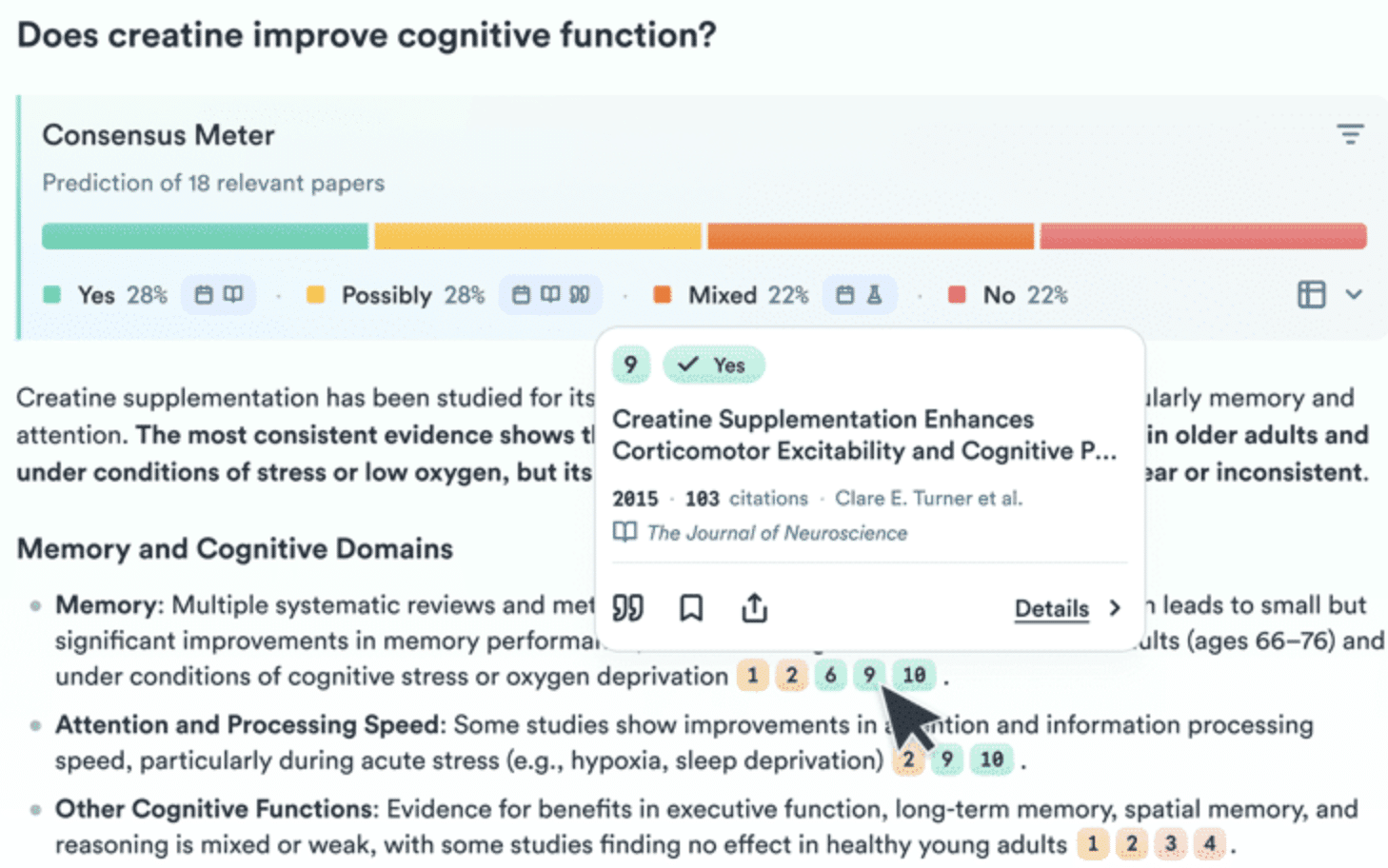
The Meter can be useful as a navigation aid to determine which studies appear to disagree, and why. Then to inspect differences in population, exposure, intervention, comparator, outcome, follow-up and study design.
Abstracts are not full papers
Consensus can analyse full text when it has access through an open-access source, publisher arrangement or user-supplied document. When full text is unavailable, it may rely on the abstract and associated metadata. That distinction should guide how much confidence is placed in the answer.
A summary grounded in abstracts may be useful to triage the literature but not a substitute for reading the paper when the methodological detail matters.
Systematic review
Once a research question and protocol have been developed, the task changes. Rather than asking AI to compose an answer to a research question, the researcher asks it to assist with repetitive steps within a predefined methodology.
Silvi is designed to assist with this structured workflow. It supports study import, title and abstract screening, full-text review, data extraction, collaborative decisions and the analysis of extracted data. It can also link extracted values to highlighted passages in the source PDF.
AI-assisted screening
In the Silvi webinar demonstration, the researcher first screened a group of papers so that the system could learn how the eligibility criteria were being applied. Silvi then suggested inclusion or exclusion decisions for the remaining records.
The important word here is suggested. Eligibility criteria that appear simple to a human may be difficult for an LLM to generate an algorithm and to operationalise. A study may mention the target population without reporting separate results for it. An abstract may use an unexpected name for the intervention. An apparently irrelevant paper may contain an eligible subgroup deep within the full text.
In tis case AI can help to prioritise records and act as an additional reviewer but still requires human interaction to determine the evidence base.
Traceable data extraction
Silvi allows researchers to define extraction fields as text, numerical or categorical variables. AI generated values can be linked to the passage from which they were extracted, allowing the researcher to accept, correct or reject each suggestion.
This very useful safeguard preserves provenance allowing the researcher to not only see the value, but identify where the system found it. Such traceability does not establish correctness and every important variable still requires human verification.
Paywalls
Silvi can retrieve open-access papers, but paywalled full texts generally still need to be obtained through the researcher’s institutional access and uploaded to the project.
This can be an inconvenience. Missing full texts can introduce selection bias if easily accessible studies are processed while inaccessible papers are delayed or omitted. Researchers should track unavailable reports rather than treating them as automatically excluded.
The PRISMA diagram
PRISMA (Preferred Reporting Items for Systematic reviews and Meta-Analyses) is a guideline designed to improve the reporting of systematic reviews. PRISMA provides authors with guidance and examples of how to completely report why a systematic review was done, what methods were used, and what results were found
PRISMA 2020
Silvi can maintain records of identified, screened, excluded and included studies and use them to generate a PRISMA-style flow diagram. This automation can reduce clerical errors and make changes easier to track. However, having a PRISMA-style diagram does not demonstrate that the review itself was methodologically sound and a perfectly drawn diagram can still describe an inadequate search.
What neither tool can decide
AI can compress the mechanical work surrounding evidence synthesis but cannot accept responsibility for the scientific argument. Neither Consensus nor Silvi can determine, without human judgement whether:
- the research question is important;
- the protocol is appropriate;
- the search is sufficiently comprehensive;
- an outcome is clinically meaningful;
- a study is at high risk of bias;
- an apparent association is causal;
- the final conclusion is justified.
A practical combined workflow
A researcher might use the two platforms sequentially:
- Explore the field in Consensus. Identify terminology, major papers, disputed findings and gaps in the literature.
- Formulate the research question and protocol. Define databases, eligibility criteria, outcomes and analysis before screening.
- Run reproducible searches in the databases.
- Import the results into Silvi. Deduplicate records and establish the workflow.
- Trial eligibility criteria manually. Resolve ambiguities before asking AI to make recommendations.
- Use AI to prioritise, not conceal, decisions. This retains human review and allows an auditable decision trail.
- Extract data with source links. Verify each important field against the full paper.
- Critically appraise and synthesise the evidence. Do not allow automatically generated tables or summaries to determine the conclusion.
Bottom line
Consensus and Silvi address different bottlenecks in academic research.
Consensus can accelerate literature discovery and help researchers interrogate a collection of papers. Its cited summaries and visualisations are a great starting point for investigation, but do not replace search or critical appraisal.
Silvi can help organise the systematic review workflow and assist with screening and data extraction. Its transparency makes AI suggestions easier to audit, but human reviewers remain responsible for every inclusion, exclusion and extracted result.
References
- Wiesbauer F. AI for Teaching and Research Medmastery Free Webinar
- Wiesbauer F. Trustworthy AI in Cardiology LITFL
- Elshahati N. AI Scribes for Clinical Practice. LITFL
- Wiesbauer F. ChatGPT Essentials for Clinicians. Medmastery
- Guilleminot S. AI in Healthcare. LITFL
- Consensus AI. Website
- Silvi AI. Website
AI in HEALTHCARE

Internist at the Medical University of Vienna and founder of Medmastery. Master’s degree in public health at Johns Hopkins University as a Fulbright student. Passionate about teaching. | Medmastery | LinkedIn | Twitter |

Trained in medicine at the University of Szeged and developed an early interest in public health and clinical research. She now works with Medmastery as a Webinar Specialist and In-House Teacher, creating practical educational content for healthcare professionals.