


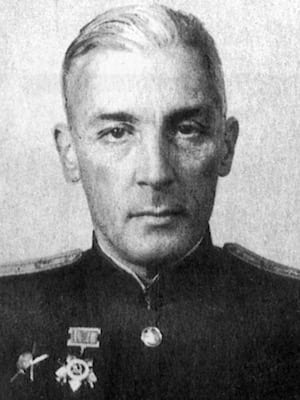
Dmitry Alekseyevich Arapov (Дмитрий Алексеевич Арапов) (1897-1984) was a Soviet military surgeon, Lieutenant General of the Medical Service and corresponding member of the USSR Academy of Medical Sciences.
Arapov specialised in emergency and military surgery, particularly the management of anaerobic wound infections. During the Second World War, he directed surgical services for the Soviet Northern Fleet and helped develop systems for treating and evacuating casualties in Arctic conditions. He subsequently served as Chief Surgeon of the Soviet Navy and contributed to developments in inhalational anaesthesia, emergency tracheostomy and surgical education.
He is associated with Arapov contracture, described in secondary sources as a pain-induced reflex flexion of the right hip in acute appendicitis. The original description and date of introduction remain to be established.
Biography
- 1897 – Born in Moscow, Russian Empire. Alternate sources cite 6, 7 and 21 November.
- 1916 – Entered medical studies at Moscow University and began working in a military hospital.
- 1919–1920 – Worked as a paramedic during the typhus epidemic.
- 1920–1922 – Served in the Red Army during the Russian Civil War and continued medical studies in Petrograd.
- 1925 – Graduated from the Second Moscow State University. Subsequently worked in surgery at the Krasny Bogatyr factory hospital.
- 1929 – Joined the N. V. Sklifosovsky Institute for Emergency Medicine in Moscow, where he subsequently worked under Sergei Sergeyevich Yudin (1891–1954).
- 1936 – Awarded the degree of Candidate of Medical Sciences for work involving anaerobic infection and endocrine surgery.
- 1939–1940 – Served as senior surgeon of a forward mobile field hospital on the Kola Peninsula during the Soviet–Finnish War.
- 1940 – Published Gas Gangrene (Газовая гангрена)
- 1941–1945 – Directed surgical services for the Soviet Northern Fleet, organising treatment, triage and evacuation of casualties.
- 1949 – Awarded the degree of Doctor of Medical Sciences. Published Inhalational Anaesthesia (Ингаляционный наркоз). Stalin Prize, second degree with N. G. Belenky for development of an animal-serum-based blood substitute.
- 1950 – Appointed Chief Surgeon of the Soviet Navy.
- 1953 – Elected corresponding member of the USSR Academy of Medical Sciences.
- 1955 – Resumed the position of Chief Surgeon of the Soviet Navy, serving until 1968.
- 1959 – Awarded the title Honoured Scientist of the Russian SFSR.
- 1962 – Promoted to Lieutenant General of the Medical Service.
- 1964 – Co-authored Tracheostomy as a Therapeutic Method in Emergency Conditions with Yu. V. Isakov.
- 1968 – Co-authored Paradoxes of Acute Appendicitis with K. S. Simonyan and B. S. Kaplan.
- 1972 – Awarded Pirogov Prize for work on anaerobic gas infection, not an Order of Pirogov.
- 1977 – Awarded the Hero of Socialist Labor Gold Star.
- Other awards include: two Orders of Lenin (1973, 1977), Orders of the Red Star (1942), Order of the Red Banner (1944), Order of the Patriotic War of the 1st degree (1943), two Orders of the Red Banner of Labor (1952, 1968) and the Order of the Badge of Honor.
- Died June 14, 1984 in Moscow, aged 86. Buried at Kuntsevo Cemetery.
Medical Eponyms
Arapov Contracture (1968)
Reflex contraction of the right hip joint in acute appendicitis. Pain induced reflex contraction of the right hip joint in acute appendicitis
Arapov’s sign
Deep palpation at McBurney’s point produces an initial tendency towards right hip flexion.
Arapov’s contracture
Persistent contraction or flexion of the right hip develops.
2020 – Marek, Záhorec and Durdík described Arapov’s sign as an initial reflex flexion of the right hip elicited by deep palpation at McBurney’s point. They distinguished this from Arapov’s contracture, characterised by persistent right hip flexion, and associated the latter with localised peritonitis.
Key medical contributions
Anaerobic infection and military surgery/ Arapov investigated anaerobic wound infections, particularly gas gangrene associated with penetrating injuries. His 1940 monograph Gas Gangrene addressed the recognition and management of these infections. During the Second World War, he organised surgical treatment, casualty triage and evacuation for the Soviet Northern Fleet.
Anaesthesia and emergency airway management. Arapov contributed to the development of inhalational anaesthesia and advocated nitrous oxide administration in prehospital emergency care. His publications included Inhalational Anaesthesia (1949) and, with Yu. V. Isakov, Tracheostomy as a Therapeutic Method in Emergency Conditions (1964).
Oesophageal reconstruction. Working within Sergei Yudin’s surgical school, Arapov contributed to the development of oesophageal reconstruction using small-bowel grafts. In 1949, he observed spontaneous elongation of a subcutaneous intestinal graft and applied this finding to staged presternal oesophagoplasty. He subsequently performed more than 250 oesophageal reconstruction procedures for malignant and cicatricial strictures.
Surgical education and research. At the Sklifosovsky Institute, Arapov contributed to research in emergency abdominal surgery, wound infection, burns and endocrine surgery. He supervised postgraduate research and helped train military and civilian surgeons.
Major Publications
- Arapov DA. Газовая гангрена [Gas gangrene]. Moscow–Leningrad: Medgiz; 1940.
- Arapov DA. Ингаляционный наркоз [Inhalational anaesthesia]. Moscow: Medgiz; 1949.
- Arapov DA, Isakov IuV. Pokazaniia i protivopokazaniia k trakheostomii pri nekotorykh vidakh rasstroistv dykhaniia [Indications and contraindications for tracheostomy in some types of respiratory disorders: Clinical and experimental data]. Grudn Khir. 1961;(3):105–111.
- Arapov DA, Isakov IuV. Трахеостомия как лечебный метод при неотложных состояниях [Tracheostomy as a therapeutic method in emergency conditions]. Moscow: Meditsina; 1964.
- Arapov DA, Simonian KS, Kaplan BS. Paradoksy ostrogo appenditsita [Paradoxes of acute appendicitis]. Vestnik khirurgii imeni I. I. Grekova. 1968; 101(11): 22-26.
- Arapov DA, Potemkin NT, Tsarev NI, Bratanchuk BF, Pugachev AF. K voprosu ob ostrom appenditsite [Acute appendicitis]. Voen Med Zh. 1973 Mar;3:33-6.
References
Biography
- Kabanova SA, Goldfarb YuS, Bogopolsky PM, et al. Outstanding Surgeon and Scientist Dmitry Alekseevich Arapov. Russian Sklifosovsky Journal of Emergency Medical Care. 2022;11(4):725–735
- Арапов Д. А., БМЭ [Arapov D.A., GRME]
- Ветераны НИИ Склифосовского: Арапов Д.А. [Veterans of the Sklifosovsky Research Institute: Arapov D.A.]
- Bibliography. Arapov, Dmitrij Alekseevič. WorldCat Identities
Eponymous terms
- PO povodu stat’i D. A. Arapova Ostryi appenditsit [Discussion on D. A. Arapov’s article, Acute appendicitis]. Khirurgiia (Mosk). 1953 Jan;27(1):66-8.
- Korabel’nikov ID. “Paradoksy ostrogo appenditsita” istinnye i kazhushchiesia [True and seeming “paradoxes of acute appendicitis”]. Vestn Khir Im I I Grek. 1970 Mar;104(3):46-8.
- Marek V, Záhorec R, Durdík S. Acute appendicitis: Clinical anatomy of the new palpation sign. Clinical Anatomy. 2021; 34: 218–223
- Arapov Sign. 2026
- Eponymythology: Appendicitis eponymous signs. LITFL
Eponym
the person behind the name

Russian Emergency Physician

BA MA (Oxon) MBChB (Edin) FACEM FFSEM. Emergency physician, Sir Charles Gairdner Hospital. Passion for rugby, medical history, medical education, and asynchronous learning #FOAMed evangelist. Editor-in-Chief and Webmaster of Life in the Fast lane, LITFL | On Call 4e| Eponyms | Books | Horology |