
Adrenaline or epinephrine?
Today, adrenaline and epinephrine are alternative names for the same molecule. The split between them, however, came from an untidy early history of adrenal extracts, disputed claims of purification, trademark politics, and disciplinary preference.
The extract before the argument
The story begins with a physiological effect, not with a name.
In 1894 at University College London, physician George Oliver and physiologist Edward Albert Schäfer began reporting the physiological effects of extracts of the suprarenal capsules. Before anyone had isolated the active principle, they demonstrated that these extracts caused a significant rise in blood pressure through contraction of the arterioles, and argued that the active material resided in the medulla rather than the cortex.
The physiological action was therefore recognised before the chemistry, purification, and naming dispute had been settled.
Competing claimants to the active principle
The naming split grew out of a messy purification story, not from geography alone
At Johns Hopkins University, John Jacob Abel, working with Albert Cornelius Crawford, set out to isolate what they called the “blood-pressure-raising constituent of the suprarenal capsule.” In their 1897 paper they described a crystalline product derived from the gland that appeared to reproduce the cardiovascular effects already demonstrated by Oliver and Schäfer.
Abel attempted to separate a definite active compound that might become therapeutically useful and, in 1899, named the substance epinephrin.
Acting on Hyrtl’s suggestion that epinephris would be the best name for the suprarenal capsule, the author has given the name Epinephrin to the active principle as isolated by him.
Abel 1899
The name therefore entered the literature not as a later generic compromise, but as Abel’s own label for the compound he believed he had isolated. Though that claim would soon be challenged…
In 1900, Otto von Fürth (Strasbourg) argued that Abel’s epinephrin was not the true active principle of the gland. Instead, he applied the name suprarenin to the physiologically active chromogenic substance he isolated which, in its native state, was not precipitable by ammonia
Abel’s 1901 reply conceded that the native active principle was indeed not precipitable by ammonia, but argued that what von Fürth called suprarenin was simply native or unaltered epinephrin.
The real breakthrough came with Jokichi Takamine. In 1901, Takamine reviewed the work of Abel and von Fürth, arguing that neither had yet obtained the active principle in pure form. He then announced that he had succeeded in isolating the active principle in “a pure, stable, crystalline form, the base itself”, and he named the substance “Adrenalin“
I have succeeded in isolating the active principle in a pure, stable, crystalline form, the base itself…no previous authors have obtained the active principle in a pure form, and that there may exist some room for controversy, I have termed my substance, as I isolated, “Adrenalin.”
Takamine 1901
This was the decisive step. The name Adrenalin was attached not to a partially modified preparation, but to the claimed isolation of the active principle in pure crystalline form.
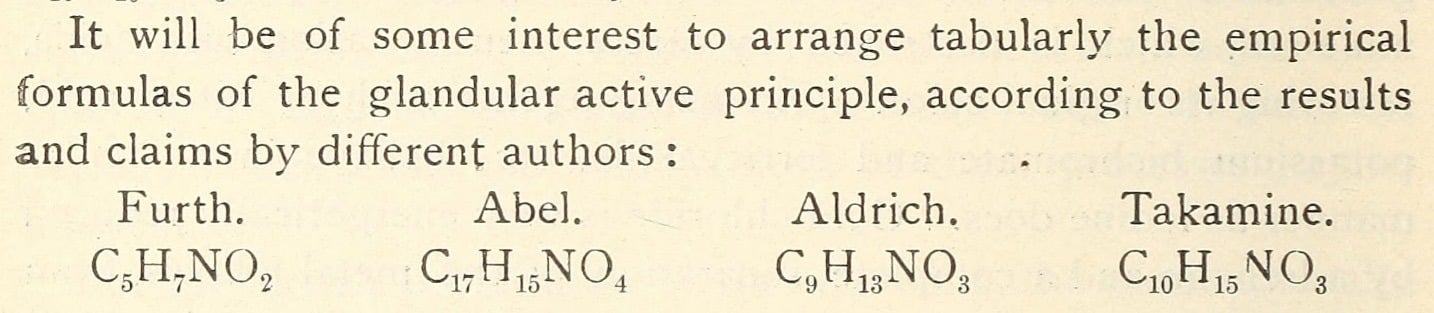
Thomas B. Aldrich, a chemist at Parke, Davis & Co., provided the key chemical confirmation. In his 1901 report on the active principle of the suprarenal gland he acknowledged Takamine’s priority, compared Takamine’s substance with his own independently prepared crystalline material, and concluded that the two were identical. Using analytical data from both preparations, Aldrich proposed the empirical formula C9H13NO3, a result closer to Takamine’s than to either Abel’s or von Fürth’s earlier formulae.
The argument was no longer simply over who had named the active principle, but over who had actually isolated it. The differing empirical formulae proposed by Fürth, Abel, Takamine and Aldrich show just how unsettled the chemistry still was, until Aldrich’s analysis brought the crystalline Parke-Davis/Takamine material closer to the accepted composition.
At this point the purification dispute had not entirely vanished, but the weight of evidence proclaimed Adrenalin, not epinephrin or suprarenin, was the crystalline active principle.
The trade name becomes a scientific name
By the early twentieth century, the chemistry was still being argued, but the naming problem had already escaped the laboratory. Takamine’s purified crystalline product was patented and marketed by Parke, Davis & Co. under the proprietary name Adrenalin, while Abel’s epinephrin remained in circulation as a competing scientific term for what many physiologists regarded as a different or less active preparation.
The nomenclature war that followed was not a mere quibble over spelling, but a clash between physiologists and chemists, scientific usage and commercial law, trademarks, and national usage.
In Britain, the crucial figure was Henry Hallett Dale, then a young physiologist and pharmacologist working in the Wellcome Physiological Research Laboratories. In 1906, when Dale prepared a paper for publication using the word adrenaline. His employer, Henry Wellcome, the American-born pharmacist and co-founder of Burroughs, Wellcome & Co., objected because Adrenalin was a registered trade name of the rival firm Parke, Davis & Co. Challenging the chemical case against Dale was Hooper Jowett, a chemist within the Wellcome organisation, who argued that epinephrine was the scientifically correct term.
Dale’s defence of adrenaline was blunt. In his view, the decisive authority lay with those who had established the physiological action of the substance, not with chemists defending Abel’s nomenclature. As he wrote in 1906:
In physiological literature the terminology is settled by those who describe the physiological action … [No] physiologists owed anything to Abel’s work or could make use of his inactive substances.
Why the names stayed split
The split persisted because later naming bodies inherited an already unstable situation rather than creating one from scratch. In the United States, epinephrine remained attached to the Abel tradition and became the official generic term in regulatory and product labelling. In Britain and much of Europe, adrenaline prevailed because it was the term physiologists had already adopted for the active principle, and because Henry Dale successfully defended that usage against both chemical counter-arguments and commercial caution within the Wellcome organisation.
Aronson (2000) argued that the case for adrenaline rested on usage, history, etymology, and, most importantly, safety. In countries where clinicians and patients overwhelmingly recognised the word adrenaline, forcing a change to epinephrine risked confusion in emergencies. He accepted that dual labelling could be managed, but thought the danger of medication error outweighed the supposed benefits of strict international uniformity.
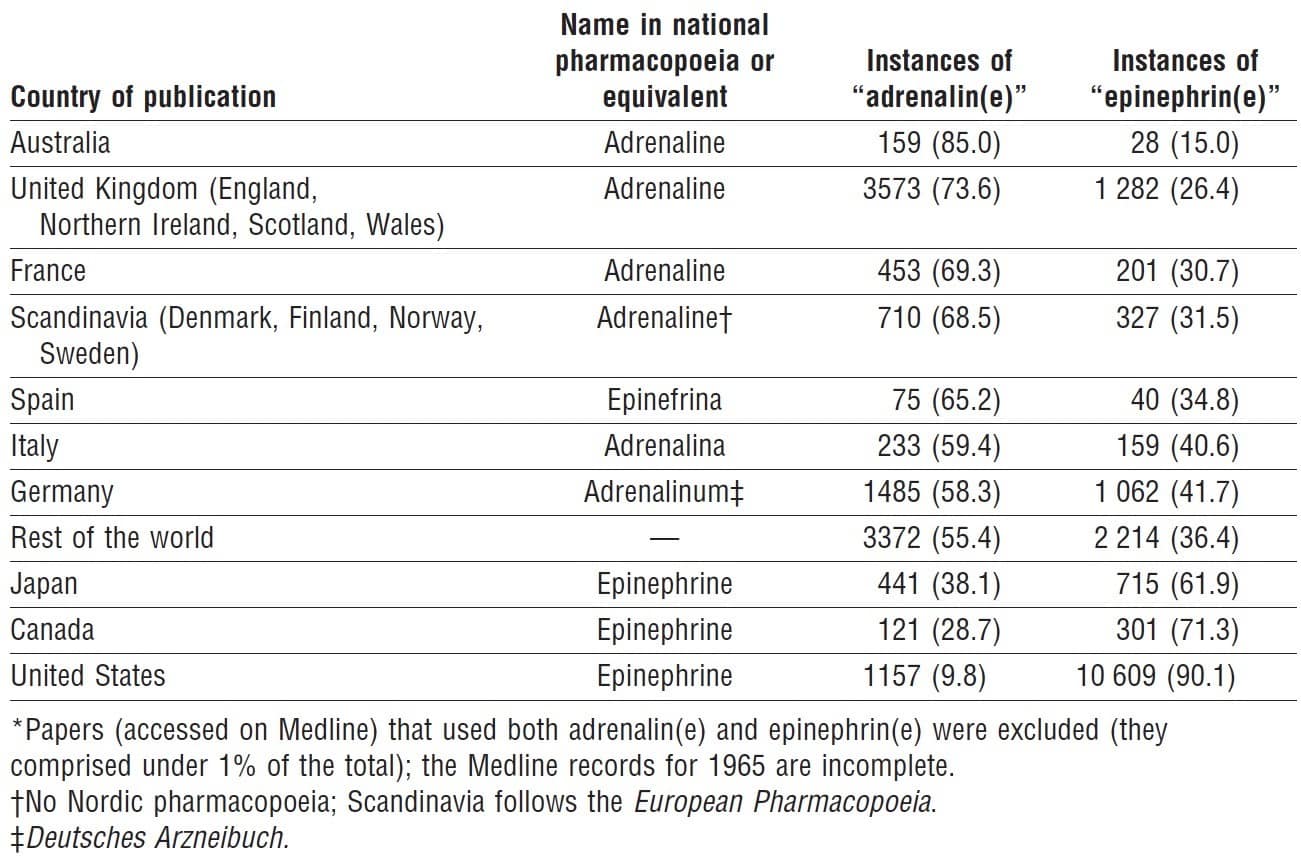
The irony is that Aronson lost the international naming argument but largely won the descriptive one. The WHO still uses epinephrine as the International Nonproprietary Name (INN), noting adrenaline as a synonym. The US FDA labelling continues to use epinephrine as the generic name. The current UK MHRA communications routinely write “adrenaline (epinephrine)”, which is probably the most honest modern reflection of the drug’s divided history.
| Term / status | Current form |
|---|---|
| Chemical name | (R)-1-(3,4-dihydroxyphenyl)-2-(methylamino)ethanol |
| INN International Nonproprietary Name | epinephrine |
| US official / generic name | epinephrine |
| UK common clinical usage | adrenaline |
| Historical trade name Parke, Davis & Co | Adrenalin |
| Historical rival scientific names | epinephrin (Abel) suprarenin (von Fürth) |
What should we really call it?
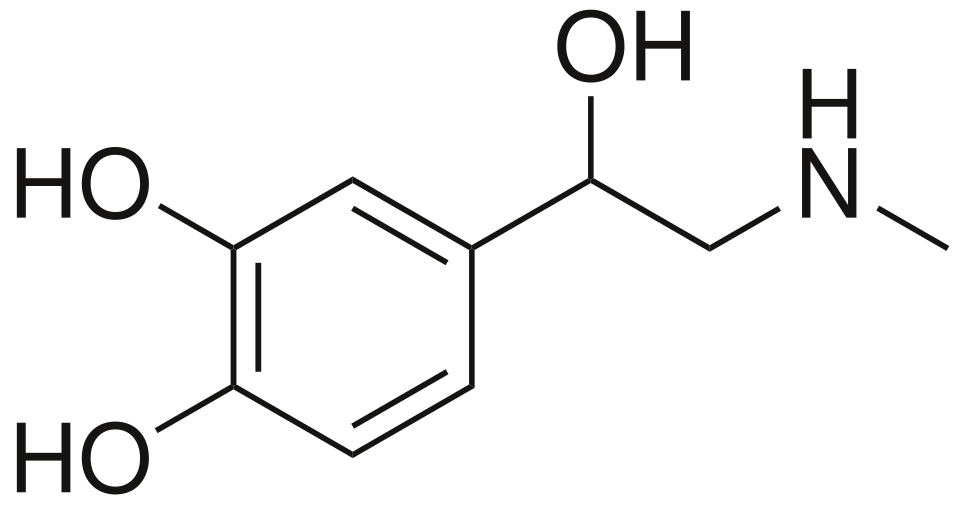
Chemically: (R)-1-(3,4-dihydroxyphenyl)-2-(methylamino)ethanol
The INN and in US official usage: epinephrine
In UK and much international clinical practice: adrenaline
For LITFL: adrenaline (epinephrine) on first mention, then adrenaline
Associated persons
- George Oliver (1841-1915) – English physician who, with Schäfer, demonstrated the powerful cardiovascular effects of suprarenal extract and helped open the modern study of adrenal physiology.
- Sir Edward Sharpey-Schafer (1850-1935) – English physiologist who, with George Oliver, established the pressor action of suprarenal extract and later became one of the key founders of endocrinology.
- John Jacob Abel (1854-1938) – American pharmacologist and physiological chemist at Johns Hopkins who, with Crawford, isolated and named epinephrin, although his preparation was later judged not to be the native active principle in pure form
- Albert Cornelius Crawford (1869–1921) – American pharmacologist and later botanist; Abel’s co-author on the 1897 Johns Hopkins paper on the blood-pressure-raising constituent of the suprarenal capsule
- Otto von Fürth (1867–1938) – Austrian physician, biochemist and medical chemist who challenged Abel’s interpretation and proposed the rival name suprarenin for the active principle.
- Jokichi Takamine (1854-1922) – Japanese chemist working in the United States who announced the isolation of the active principle in pure, stable, crystalline form and named it Adrenalin.
- Thomas Bell Aldrich (1861–1938) – American chemist associated with Parke, Davis & Co. who confirmed the identity of Takamine’s crystalline product with his own preparation and determined the formula that brought the chemistry much closer to the accepted structure
- Sir Henry Hallett Dale (1875-1978) – English physiologist and pharmacologist who, in 1906, defended adrenaline as the physiologists’ term for the active principle and helped secure its long-term British and European usage
References
Historical articles
- Oliver G, Schäfer EA. The Physiological Effects of Extracts of the Suprarenal Capsules. J Physiol. 1895 Jul 18;18(3):230-76
- Abel J, Crawford A. On the blood-pressure-raising constituent of the suprarenal capsule. Johns Hopkins Hospital Bulletin. 1897; 8: 151-157
- Abel JJ. On epinephrin, the active constituent of the suprarenal capsule and its compounds. In: Proceedings of the American Physiological Society. American Journal of Physiology. 1899; 2(5): iii-xxi
- Solomon SC. The use of adrenal substance in the treatment of asthma. JAMA 1900; XXXIV(19): 1164-1166
- von Fürth O. Zur Kenntnis der brenzcatechinähnliche Substanz der Nebennieren. Hoppe-Seyler’s Zeitschrift für physiologische Chemie 1900; 29: 105-123
- Abel JJ. Further observations on epinephrin. Johns Hopkins Hospital Bulletin. 1901; 8: 151-157
- Takamine J. Adrenalin, the active principle of the suprarenal glands, and its mode of preparation. American Journal of Pharmacy. 1901; 73: 523-531
- Aldrich T. A preliminary report on the active principle of the suprarenal gland. Am J Physiol. 1901; 5(7): 457-461
- Bullowa JJM, Kaplan DM. On the hypodermic use adrenaline chloride in the treatment of asthmatic attacks. Medical News (New York) 1903; 83(17): 783-787
Review articles
- Tansey EM. What’s in a name? Henry Dale and adrenaline, 1906. Med Hist. 1995 Oct; 39(4): 459-476.
- Aronson JK. “Where name and image meet”–the argument for “adrenaline”. BMJ. 2000 Feb 19;320(7233):506-9
- McFadden ER Jr. A Century of Asthma. American Journal of Respiratory and Critical Care Medicine. 2004; 170(3): 215-221
- Parascandola J. Abel, Takamine, and the isolation of epinephrine. J Allergy Clin Immunol. 2010 Feb; 125(2): 514-7.
- Greer A. Epinephrine: a short history. The Lancet Respiratory Medicine 2015; 3(5): 350-351
Hello, my name is…
[etymologically]

Junior doctor at Royal Perth Hospital. Interested in physiology, procedures, medical history and fiction. Always careful to check my blind spot when merging into the fast lane.

BA MA (Oxon) MBChB (Edin) FACEM FFSEM. Emergency physician, Sir Charles Gairdner Hospital. Passion for rugby; medical history; medical education; and asynchronous learning #FOAMed evangelist. Co-founder and CTO of Life in the Fast lane | On Call: Principles and Protocol 4e| Eponyms | Books |