


Huber-point needle
The Huber point needle is a non-coring hypodermic needle characterised by a curved, deflected tip with a lateral opening rather than a terminal bevel. The design allows the needle to separate rather than cut tissue fibres, reducing tissue coring, pain, and obstruction of the needle lumen compared with conventional straight-bevel needles.
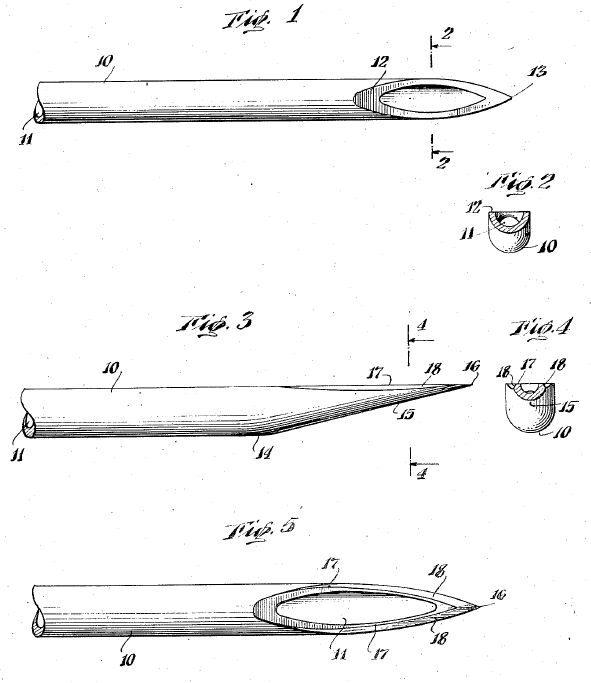
The needle was invented and patented by Ralph Lee Huber (1889-1953), a Seattle dentist, during the Second World War. Huber developed the needle initially for dental local anaesthetic injection, where repeated puncture of dense mucosa frequently caused pain, bleeding, and lumen blockage. His design incorporated a transversely curved wall, a side orifice near the tip, and a long, sharp, curved point, allowing smooth penetration while maintaining injectate flow even if the tip abutted tissue.
1943 – Huber first developed the needle and was granted a definitive patent in 1946, describing its ability to avoid cutting a core of tissue (“plug cutting”) and to permit both injection and aspiration without obstruction. Despite the significance of the design, Huber did not publish clinical papers describing its use, and dissemination occurred primarily through patents, military channels, and device manufacture.
It is an object of the invention to provide a hypodermic needle embodying a construction such that only minor pain will be experienced by the patient as the needle penetrates the tissue. An additional object of the invention is that of providing a hypodermic needle in which plug cutting, with resultant danger of embolism, will, in effect, be eliminated.
Huber 1943
Adoption in neuraxial anaesthesia and attribution controversy
1945 – Edward Boyce Tuohy (1908–1959) adopted a needle with a Huber-type curved point and side orifice for the placement of spinal and epidural catheters, recognising that the non-coring tip reduced the risk of catheter damage and dural puncture. Tuohy published descriptions of the technique before Huber’s 1946 patent became widely known, and the needle subsequently entered anaesthetic practice under the name “Tuohy needle”.
This sequence led to longstanding misattribution.
While Tuohy was responsible for the clinical application of the Huber-point design to neuraxial catheterisation, the needle geometry itself was Huber’s invention. One plausible explanation is that Tuohy encountered Huber’s designs through US military channels during the war, as several of Huber’s inventions were offered to the armed forces. Regardless of the pathway, modern neuraxial needles with curved, non-coring tips are direct descendants of Huber’s original design.
Associated Persons
- Edward Boyce Tuohy (1908-1959)
- Ralph Lee Huber (1889-1953)
Alternative names
References
Original articles
- Huber RL. Hypodermic needle. US patent 2 409 979. October 22, 1946
- Curbello MM. Continuous Peridural Segmental Anesthesia by Means of a Ureteral Catheter. Curr Res Anesth Analg. 1949 Jan-Feb;28(1):13-23.
Review articles
- Lubisich JW. Ralph L. Huber, DMD: forgotten inventor of the “Tuohy” needle. J Hist Dent. 2004 Jul;52(2):75-9.
- Frölich MA, Caton D. Pioneers in epidural needle design. Anesth Analg. 2001; 93(1): 215-20
eponymictionary
the names behind the name

Lowri Bowen. Mwynhau fy mhrofiad Awstralia, ond rwyf yn caru cymru yn fwy | LinkedIn |

BA MA (Oxon) MBChB (Edin) FACEM FFSEM. Emergency physician, Sir Charles Gairdner Hospital. Passion for rugby, medical history, medical education, and asynchronous learning #FOAMed evangelist. Editor-in-Chief and Webmaster of Life in the Fast lane, LITFL | On Call 4e| Eponyms | Books | Horology |