


Jacques Forestier

Jacques Forestier (1890-1978) was a French physician and rheumatologist
Described as the doyen of French rheumatology and of international renown. Forestier is remembered for scientific achievements such as the introduction of lipiodol for imaging the airways; introduction of gold for arthritis; description (with Certoncin in 1953) of polymyalgia; and depiction of hyperostosis (1959) later called Forestier’s disease.
Known as “Doctor Lipiodol” for his accidental discovery of spinal myelography, which he later extrapolated for use in many body cavities and their pathologies.
An avid sportsman, Forrestier played rugby union was an avid skier and swimmer, and an accomplished mountain climber. He continued into his late 70s, to row his skiff on Lake le Bourget in the Savoyan Alps.
Biography
- Born on July 27, 1890 in Aix-les-Bains, France. His father, Henri Forestier, was a third-generation physician and director of the thermal spa, which he used to treat patients with conditions such as gout, RA, osteoarthritis, and neuralgia.
- 1912-1914 Forestier played rugby union at a professional level. He represented France in 1912, playing loosehead prop against Wales in the 5 nations championship. He was a finalist in the 1912-1913 French Rugby Union Championship, playing as a member of the Sporting Club Universitaire de France.
- 1914-1918 During the First World War, Forestier served as a battalion physician in one of the French Zouave regiments. These were a class of light infantry.
Forestier distinguished himself on the battlefield, as a battalion physician, he alone captured 150 enemy soldiers. As a result of the courage and bravery he had shown throughout World War I, he was made the Commander of the Legion of Honour, the highest honour that could be bestowed on French military personnel. Forestier was also awarded the Croix de Guerre, which was typically given to soldiers for acts of heroism in combat against the enemy.
- 1919 – Completed his medical education in Paris and obtained a position in Cochin Hospital, Paris.
- 1920 – Member of the French rugby union team who took home a silver medal at the 1920 Summer Olympics in in Antwerp, Belgium.
- 1927 – One of the founding members of the International League Against Rheumatism
- 1928 – Returned to Aix-les-Bains to take over the spa from his father.
- 1947 – Founding member of the European League Against Rheumatism; president from 1957 to 1959.
- Died aged 87 on March 17, 1978 following a meeting in Paris, France held in his honour and to which he notably contributed.
- His son, Francois, continued his father’s legacy at the thermal spa, and Forestier’s family continues there to this day.
Medical Eponyms
Forestier disease (1950)
Diffuse idiopathic skeletal hyperostosis (DISH), the now more generally accepted name for Forestier disease; is a poorly understood, systemic condition characterised by progressive calcification and ossification of ligaments and entheses. Mainly affecting the thoracic spine, peripheral joints and adjacent entheses can also be involved.
Jacques Forestier and Jaume Rotés-Quérol (1921-2008) presented their paper Senile Ankylosing Hyperostosis of the spine at the joint meeting between Ligue Française contre le rhumatisme and the Heberden Society, held in Paris, June 1950.
We consider that we have laid down clinical, radiological, and pathological criteria which differentiate a new ankylosing condition of the spine from ankylosing spondylitis. We propose to call this condition “senile ankylosing hyperostosis of the spine“. This name emphasizes: (a) the hyperostosis, a most striking pathological element, and (b) two constant clinical features: spinal rigidity and advanced age. It is certainly not a rare disease, but most often either goes unnoticed or is mistaken for some other form of vertebral ossification.
Forestier and Rotés-Quérol 1950

B. “Candle-flame” hyperostosis. At the level of L3 and L4 the base of the hyperostosis covers the anterior side of the vertebral body.
C. Anterior outgrowth covering the disks and vertebral bodies. It is interrupted at the level of several disks.
D. Anterior hyperostosis covering the disks and vertebral bodies.
Forestier and Rotés-Quérol 1950
The Bowstring Sign of Forestier (1951)
Forestier’s bowstring sign (signe de la “corde de l’arc”) in ankylosing spondylitis (AS) was described by him in his 1951 book “La spondylarthrite ankylosante, clinique, radiologie, anatomie pathologique, traitement“.
In free lateral bending, the early AS patient has palpably firm, contracted dorsolumbar muscles on the concave side, opposite to the findings in normals. Forestier described this sign as a common and characteristic finding in early AS.
- The patient stands with his/her back turned toward the examiner.
- He/she is asked to bend directly laterally to one side, then to the other.
- In early AS patients, muscles are palpably tensed in the inclined concavity.
- Muscle tension is greater in the inclined concavity than on the stretched side.
- In normals, delicate palpation senses relaxed, soft muscles in the concavity.
- The findings of muscle firmness vs softness are opposite in AS vs normals.
- In AS, dorsolumbar muscles show greater EMG activity on the concave side.
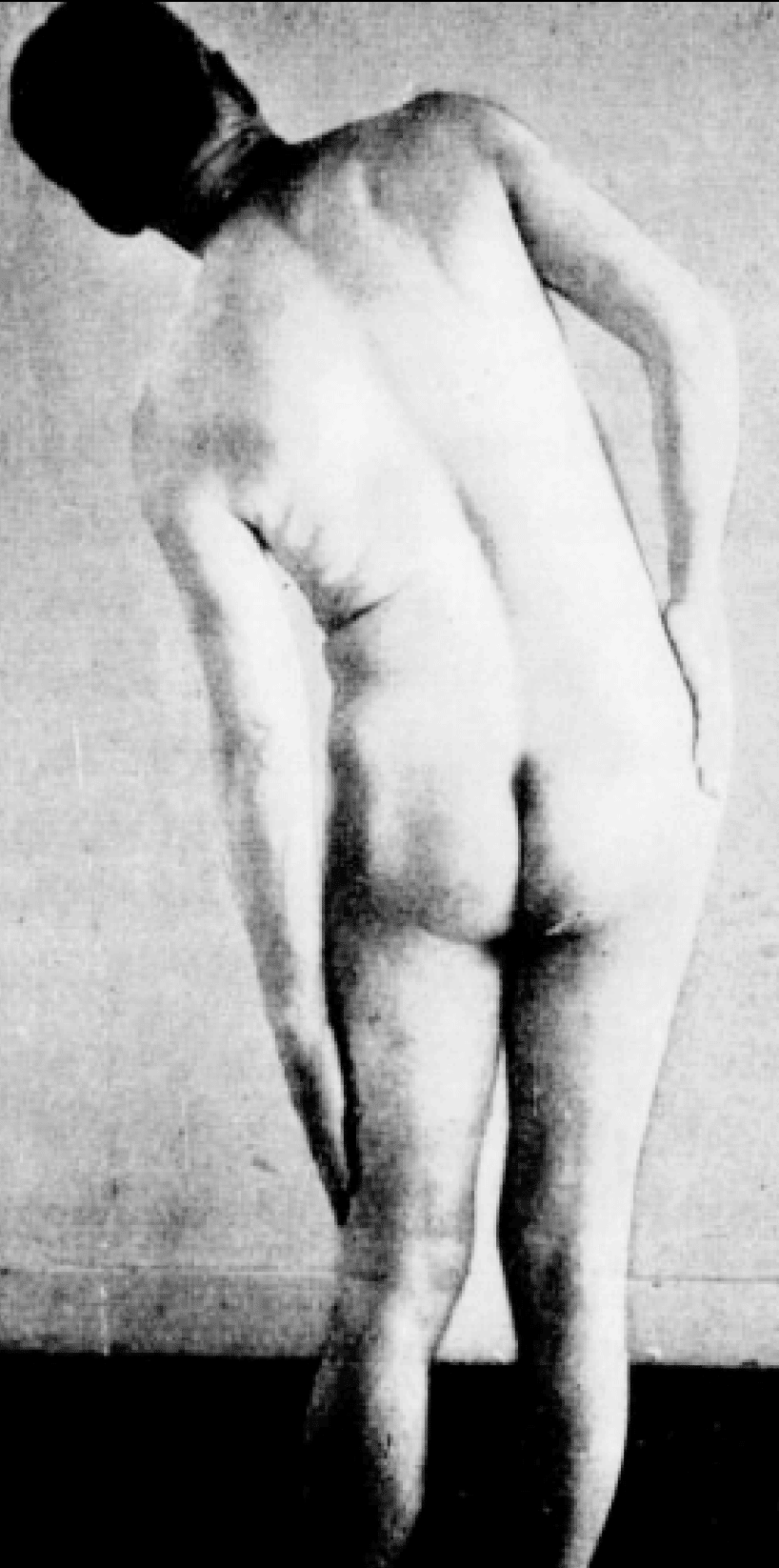
Forestier’s bowstring sign may serve as a useful clinical examination test of dorsolumbar muscle changes in the early stages of AS, and help in the diagnosis. The diagnostic utility of this sign was supported by EMG studies demonstrating greater activity of the dorsolumbar muscles on the inclined vs. extended side, in free lateral bending of AS patients.
Forestier-Certonciny syndrome (1953)
A syndrome affecting mostly the elderly characterized by proximal joint and muscle pain, high erythrocyte sedimentation rate, and a self-limiting course. Patients present with pain and stiffness of the shoulder an hip girdle without joint deformity which can be severe and incapacitating.
Usually associated symptoms of fatigue, anorexia, weight loss, muscular stiffness and tenderness, and fever. Frequently associated with Horton’s syndrome.
Key Contributions
Lipiodol and Contrast Myelography (1922)
After medical training, Forestier undertook postgraduate neurology under Jean-Athanase Sicard (1872-1929). Forestier helped develop contrast myelography using lipiodol (iodised poppy-seed oil) to visualise the spinal canal and identify compressive lesions.
Lipiodol was already familiar as a therapeutic agent and used in a range of conditions. Sicard already employed injections in the lumbosacral region for sciatica and neuralgia. The precise sequence that led from therapeutic injection to diagnostic myelography is uncertain, and later accounts differ. One version describes inadvertent entry into the subarachnoid space during a lumbar injection (recognised on aspiration of CSF), with fluoroscopy showing lipiodol pooling dependently. Another suggests accidental dural puncture during an intended epidural injection. In both tellings, the key observation was that lipiodol could be seen within the thecal sac and would move rostrally with patient positioning, immediately suggesting diagnostic value.
Sicard and Forestier reported their initial findings in 1922. Forestier later expanded the work into a comprehensive method culminating (with Sicard) in the 1932 text Diagnostic et thérapeutique par le lipiodol; clinique et radiologie. Lipiodol myelography spread rapidly in Europe; uptake in the United States was slower, largely because the oil was slow to resorb and could provoke chronic meningeal irritation, but the method’s diagnostic power for spinal cord and root compression ultimately drove wider adoption through the 1930s.
Technically, lipiodol could be introduced lumbar or via cisternal (suboccipital) puncture, and positioning was used to distribute contrast along the spinal axis. It proved particularly useful for detecting space-occupying lesions and other causes of cord/root compression.
However, oil-based contrast later fell out of favour due to irritant effects and risk of arachnoiditis, and was replaced by safer water-soluble agents. Although now largely superseded (and later eclipsed by MRI), lipiodol myelography was a crucial stepping stone. It established the principle of contrast mapping of the subarachnoid space, shaping the development of modern myelographic practice and neuroradiology.
Gold therapy in rheumatoid arthritis (1929)
In the 20th century following the observations of Forestier, injectable gold compounds were successfully used for the treatment of rheumatoid arthritis. The modern use of gold treatment for arthritis and related conditions began in the latter half of the first 30 years of the 20th century.
In 1929 Forestier hypothesised that since the manifestations of rheumatoid arthritis were similar to those of tuberculosis, gold compounds (shown to be of benefit against the tubercle bacillus) could be effectively employed against chronic rheumatoid arthritis in his paper L’Aurothérapie dans les rhumatisme chronique
Forestier treated 11 women and four men of mean age 42 years, with 250mg of gold thiopropanol sodium sulphonate given as weekly intramuscular injections. Five patients had an excellent response, five patients were much improved and two were recorded as having a minimal response. For three other patients insufficient data was available to determine their clinical responses but according to the author, none of them was worse. Significant improvement was thus recorded for the local and general clinical features of a recognised, progressive and destructive disease.
In 1930 Forestier supported his initial findings by reporting a study with a further 33 patients with symmetrical inflammatory polyarthritis, consistent with rheumatoid arthritis [Le traitement des polyarthrites chroniques par les sels d’or]. The outcome of this second study confirmed the efficacy and toxicity data of the first but also showed that using 100mg of gold thiopropanol sodium sulphonate weekly was probably less toxic and equally effective as using the original higher dose of 250mg weekly
In the Hunterian address Rheumatoid arthritis and its treatment by gold salts, Forestier presented the results of 50 patients with rheumatoid arthritis treated with gold compounds, recording a 70 to 80% success rate. He stated that 50% of patients treated early in the disease state were permanently improved compared to only 25% of patients with disease of two or more years’ duration.
Today, this premise for early treatment of rheumatoid disease by disease modifying agents and/or biologic agents still holds. In his discussion of gold compounds, Forestier stated that gold sodium thiomalate and gold thioglucose were the most useful agents. In this publication, Forestier also recorded a fatal case of agranulocytosis, his first reported death due to gold therapy
Chemotherapy has always appeared to me likely to be of great help in treating rheumatoid arthritis (RA), since it is efficient in infective diseases, such as syphilis or tuberculosis. A certain amount of similarity between the latter disease and RA – i.e., impairment of the general condition, anaemia, leucocytosis, and temperature – led me to believe that some forms of treatment which had proved valuable for tuberculosis could help in the treatment of RA.
Forestier 1932
This initial and apparently successful clinical experiment was the seed which led researchers over the next 70 years to investigate both the beneficial and the toxic effects of anti-arthritic gold complexes.
Major Publications
- Sicard J-A, Forestier J. Méthode radiographique d’exploration de la cavité épidurale par la lipiodol. Revue neurologique, Paris, 1921, 28(12): 1264-1266
- Sicard J-A, Forestier J. Méthode générale d’exploration radiologique par l’huile iodée (lipiodol). Bulletins et Mémoires de la Société médicale des hôpitaux de Paris 1922; 46(1): 463-469
- Forestier J. Le trou de conjugasion vertébral et l’espace épidural. Étude anatomique et clinique. Essai de pathologie de l’espace épidural. 1922
- Forestier J. The X-Ray examination of respiratory cavities with iodized oil (lipiodol). Annals of clinical medicine 1926; 4: 1-11.
- Forestier J. Diabète – goutte – obésité – oxalémie – rhumatismes chroniques. 1926
- Sicard J-A, Forestier J. Diagnostic et thérapeutique par le lipiodol; clinique et radiologie. 1928 [English translation: 1932]
- Forestier J. L’Aurothérapie dans les rhumatisme chronique. Bulletins et mémoires de la Société Médicale des Hôpitaux de Paris, 1929; 53(1): 323-327
- Forestier J. Le traitement des polyarthrites chroniques par les sels d’or. Resultants, clinique et controles hematologiques. Bulletins et mémoires de la Société Médicale des Hôpitaux de Paris 1930; 54(1): 272-280
- Forestier J. The treatment of rheumatoid arthritis with gold salts injections. Lancet. 1932; 219(5661): 441-444
- Forestier J. Rheumatoid arthritis and its treatment by gold salts. Lancet. 1934; 224(5795): 646-648
- Forestier J. Le traitement des rhumatismes chroniques. 1934
- Forestier J. La spondylarthrite ankylosante; diagnostic précoce, évolution, traitement. 1949
- Forestier J, Rotes-Querol J. Senile ankylosing hyperostosis of the spine. Ann Rheum Dis. 1950 Dec;9(4):321-30.
- Forestier J, Jacqueline F, Rotés Querol J. La spondylarthrite ankylosante, clinique, radiologie, anatomie pathologique, traitement. 1951
- Forestier J, Certonciny A. Pseudo-polyarthrite rhizomélique [Rhizomelic pseudo-polarythritis]. Rev Rhum Mal Osteoartic. 1953 Dec;20(12):854-62. [Forestier-Certonciny syndrome]
- Forestier J. Ankylosing spondylitis at the beginning of the century–illustrations. Rheumatism. 1964 jul;20:52-3
- Forestier J, Lagier R. Vertebral ankylosing hyperostosis. Morphological basis, clinical manifestations, situation and diagnosis. Mod Trends Rheumatol. 1971;2:323-37.
- Forestier J, Lagier R. Ankylosing hyperostosis of the spine. Clin Orthop Relat Res. 1971 Jan;74:65-83.

References
Biography
- Kersley GD. Obituary, Dr. Jacques Forestier. Ann Rheum Dis. 1978 Aug;37(4):388.
- Rakic M. Dr. Jacques Forestier July 27, 1890-March 15, 1978. Arthritis Rheum. 1978 Nov-Dec;21(8):989-90.
- Arlet J. Jacques Forestier, des stades aux thermes. Vie d’un grand rhumatologue. National Public Productions: Aix-lesBains, France. 1988.
- Bywaters EGL. Jacques Forestier des Stades aux Thermes. Review. Ann Rheum Dis. 1988 Nov; 47(11): 968.
- Jayson MI, Menkes CJ. Jacques Forestier. Spine (Phila Pa 1976). 1995 Jan 1;20(1):111-5.
- Dougados M. Jacques FORESTIER, a visionary of the clinical epidemiology in rheumatology. Ann Rheum Dis. 2018 Aug;77(8):1097-1098.
- Ashraf O, Channapatna Suresh S, Raju B, Jumah F, Sun H, Gupta G, Nanda A. Jacques Forestier: Forgotten Contributions of a Rheumatologist to Spine Surgery. World Neurosurg. 2021 Apr;148:136-140.
- Auquier L. JACQUES FORESTIER (1890-1978). AAIHP
- Bibliography. Forestier, Jacques. WorldCat Identities
Eponymous terms
- Masi AT, Sierakowski S, Kim JM. Jacques Forestier’s vanished bowstring sign in ankylosing spondylitis: a call to test its validity and possible relation to spinal myofascial hypertonicity. Clin Exp Rheumatol. 2005 Nov-Dec;23(6):760-6.
- Kean WF, Kean IR. Clinical pharmacology of gold. Inflammopharmacology. 2008 Jun;16(3):112-25
- Ashraf O, Channapatna Suresh S, Raju B, Jumah F, Sun H, Gupta G, Nanda A. Jacques Forestier: Forgotten Contributions of a Rheumatologist to Spine Surgery. World Neurosurg. 2021 Apr;148:136-140.
- Harms R, Cadogan M. History of Neuraxial Anaesthesia. LITFL
Eponym
the person behind the name


BA MA (Oxon) MBChB (Edin) FACEM FFSEM. Emergency physician, Sir Charles Gairdner Hospital. Passion for rugby, medical history, medical education, and asynchronous learning #FOAMed evangelist. Co-founder and CTO of Life in the Fast lane | On Call: Principles and Protocols 4e| Eponyms | Books | Horology