


John Durkan

John A Durkan is an American Orthopedic Surgeon.
Durkan trained at Boston University School of Medicine, Kaiser Foundation Hospital San Francisco, and St Mary’s Hospital and Medical Center, and has practised in general orthopaedics and sports medicine.
Durkan is eponymously associated with the Durkan test, or carpal compression test, introduced in 1991 as a provocative manoeuvre for the diagnosis of carpal tunnel syndrome. He later described the Durkan CTS gauge, an instrument designed to standardise the pressure applied during carpal compression testing.
Biographical timeline
- Born July 5, 1955
- 1979 – Awarded MD from Boston University School of Medicine
- 1979–1981 – Completed surgical residency training at Kaiser Foundation Hospital, San Francisco.
- 1982–1986 – Completed orthopaedic surgery residency at St Mary’s Hospital and Medical Center
- 1988 – Certified by the American Board of Orthopaedic Surgery
- 1991 – Practising as an orthopaedic surgeon in Hood River, Oregon. Published A new diagnostic test for carpal tunnel syndrome
- 1994 – Published The carpal-compression test. An instrumented device for diagnosing carpal tunnel syndrome, describing the Durkan CTS gauge
- 1998 – Served as physician with the U.S. Snowboarding team at the Nagano Winter Olympic
- Current – Orthopaedic surgeon based in Hood River, Oregon, affiliated with Providence Specialty Clinic
Medical Eponyms
Durkan test / carpal compression test (1991)
The Durkan test, or carpal compression test, is a provocative test for carpal tunnel syndrome. Direct pressure is applied over the carpal tunnel and underlying median nerve for up to 30 seconds. A positive test reproduces numbness, pain, or paraesthesia in the distal median nerve distribution.
A new test, called the carpal compression test, consists of application of direct pressure on the carpal tunnel and the underlying median nerve
Durkan described two ways to apply compression: either with a pressure device constructed from a rubber atomiser bulb and sphygmomanometer manometer, applying 150 mmHg / 20 kPa, or manually with both examiner thumbs over the carpal tunnel. In the original study, both methods produced identical response rates and time-to-symptom onset.
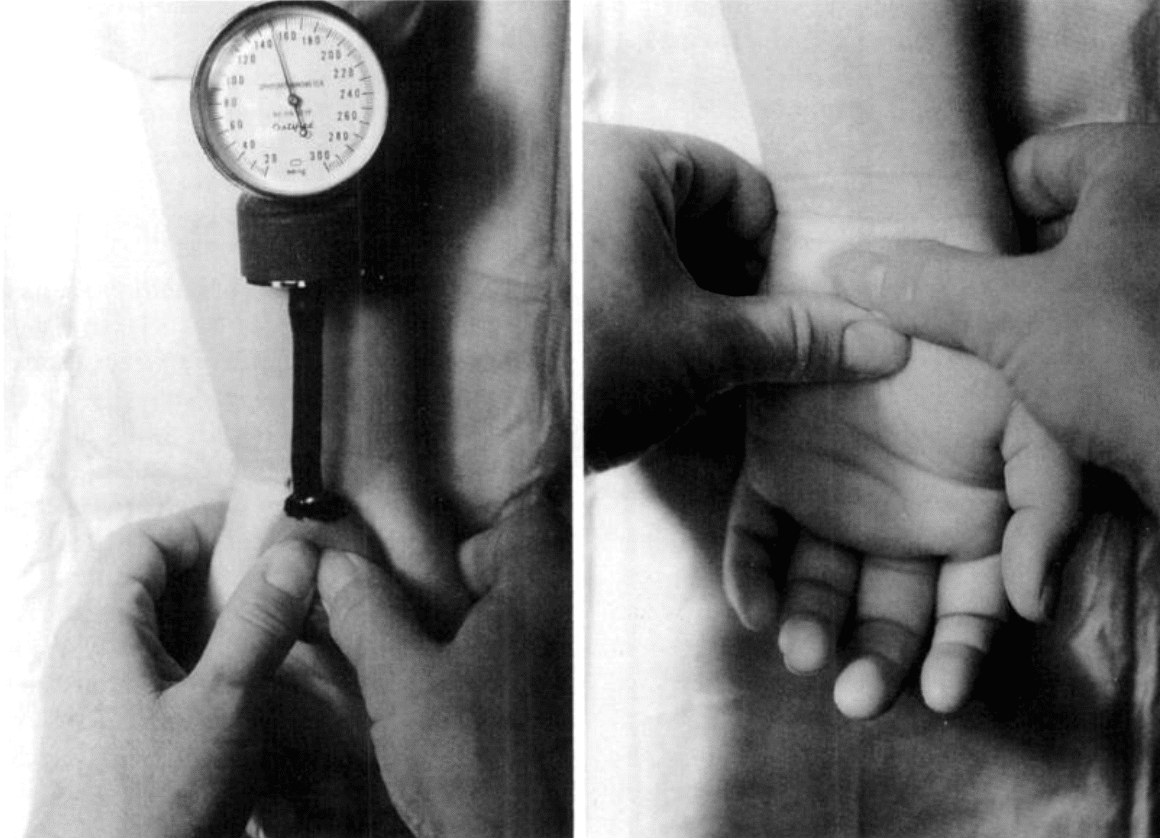
Right: The carpal compression test performed by the examiner exerting even pressure, with both thumbs, to the median nerve in the carpal tunnel. Durkan 1991
Durkan tested 31 patients with electrodiagnostically confirmed idiopathic CTS, involving 46 hands, and compared the carpal compression test with Phalen and Tinel tests against 50 asymptomatic controls. The carpal compression test was positive in 40/46 CTS hands and 5/50 control hands, giving sensitivity 87% and specificity 90%. Mean time to symptom onset was 16 seconds. In comparison, Phalen test was positive in 32/46 hands and Tinel test in 26/46 hands.
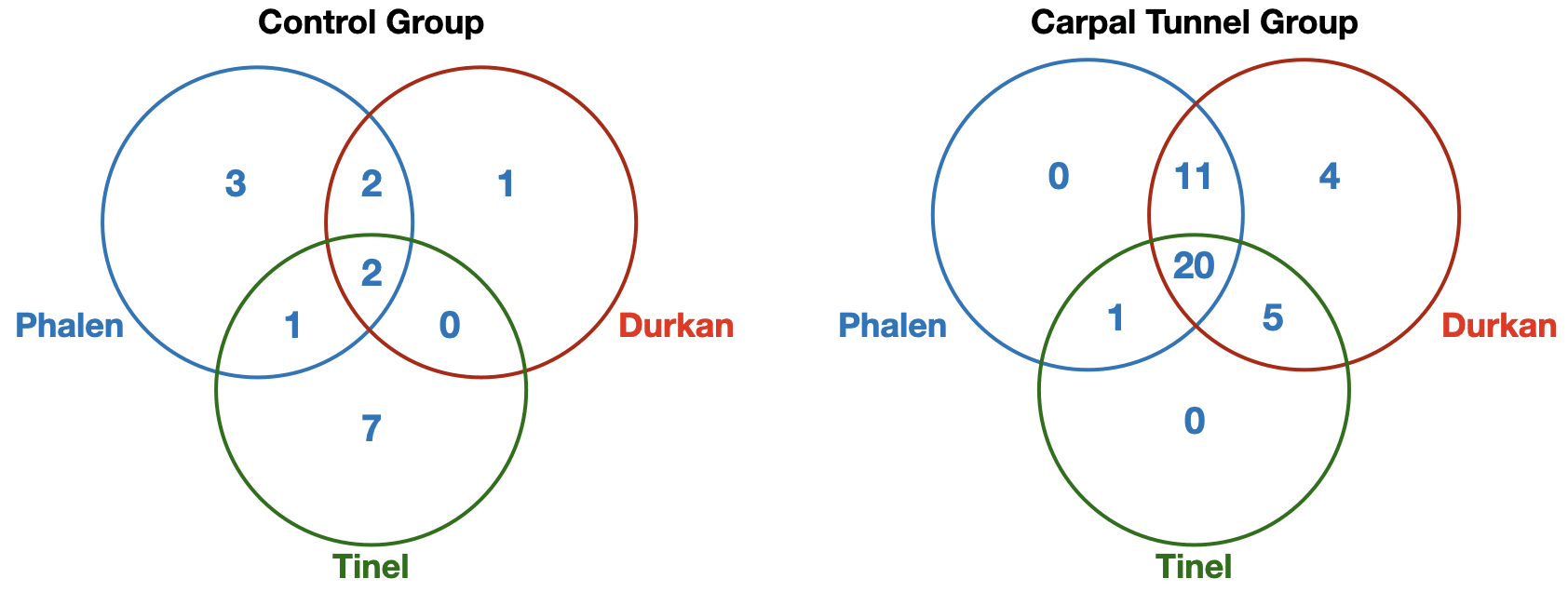
Control group: Of the five control subjects for whom the carpal compression test was positive, four had a positive Phalen test and two had a positive Tinel test
Carpal Tunnel Group: Of the forty hands for which the carpal compression test was positive. thirty-one had a positive Phalen test and twenty-five had a positive Tinel test.
Durkan Gauge: instrumented carpal compression test (1994)
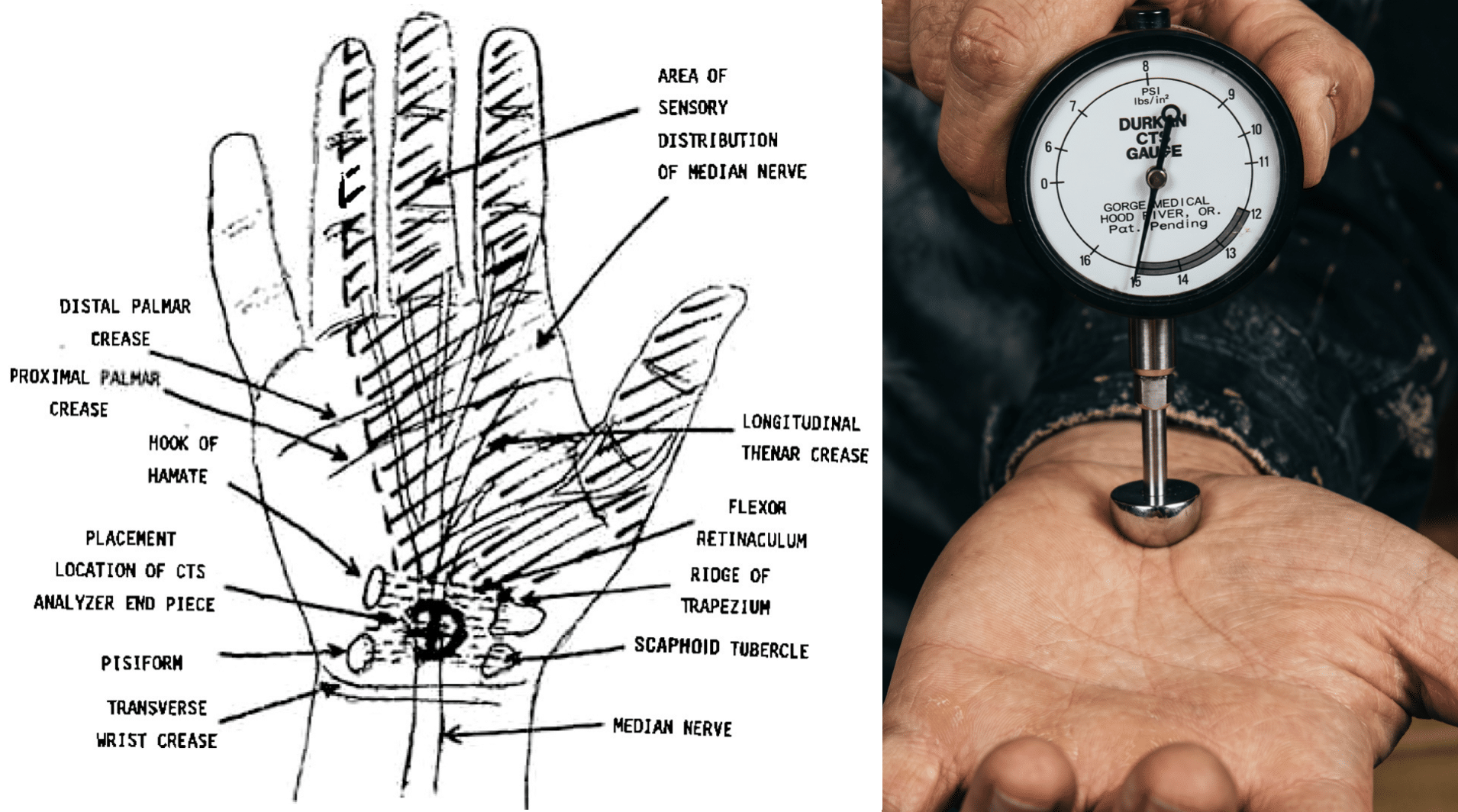
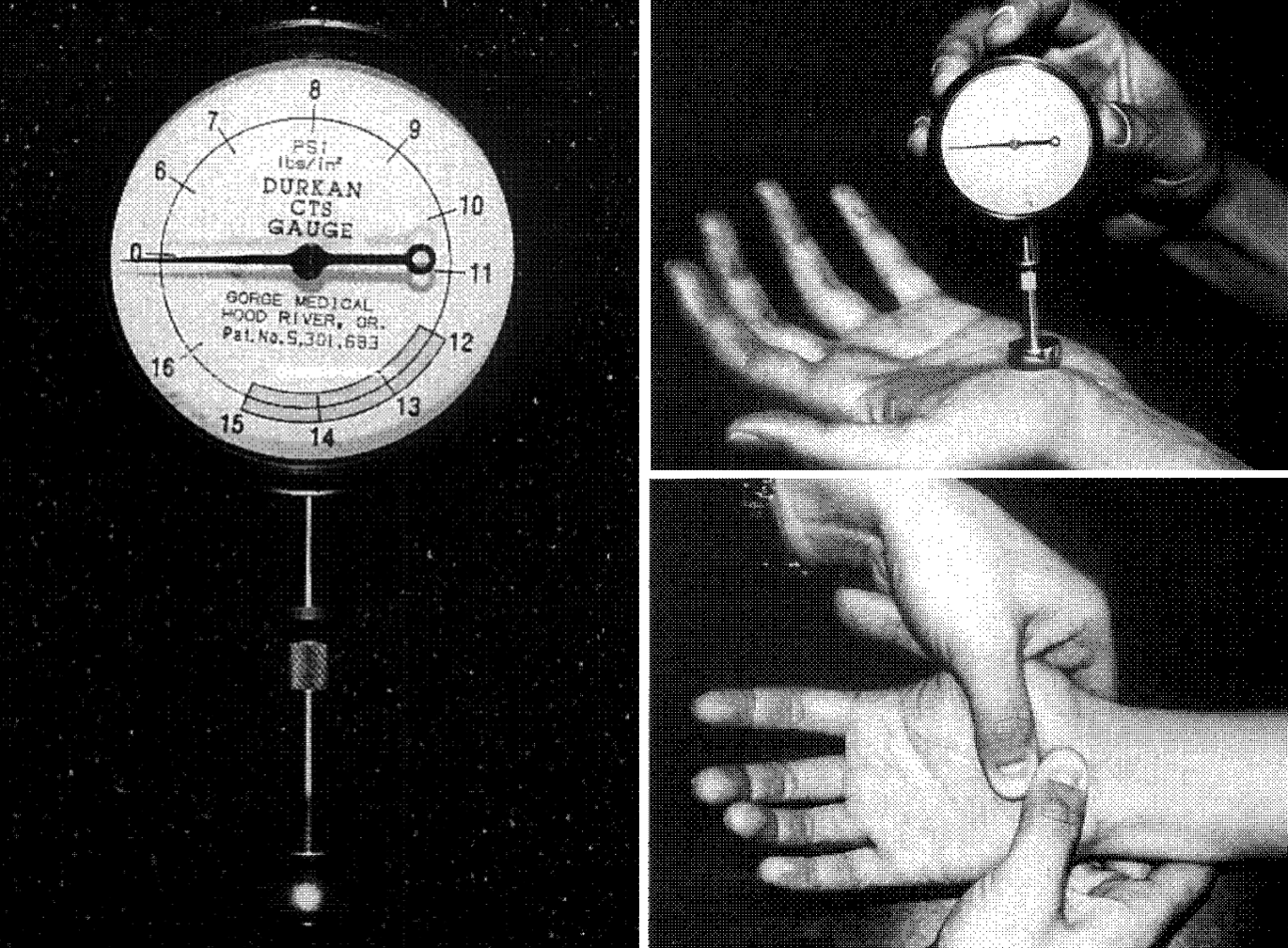
In 1994, Durkan described the Durkan CTS gauge designed to standardise pressure during carpal compression testing. The gauge used a spring-loaded plunger with a circular footplate placed over the transverse carpal ligament, allowing the examiner to apply a measured force to the carpal tunnel region.
Durkan trialled different pressures and found that 12–15 psi was most likely to reproduce symptoms of carpal tunnel syndrome. Pressures below 12 psi often failed to recreate symptoms, while pressures above 15 psi did not shorten symptom onset and tended to cause mild local palmar discomfort. He therefore selected 15 psi for up to 30 seconds for use in both study and control groups.
The 1994 study included 30 patients with idiopathic CTS involving 48 hands and 25 asymptomatic controls involving 50 hands. The instrumented test reproduced symptoms in 43/48 CTS hands and 2/50 control hands, giving sensitivity 89% and specificity 96%; mean time to symptom onset was 17 seconds.
Durkan warned that the carpal compression test is not recommended when there is a painful condition of the volar wrist or palm, such as recent wrist fracture or acute flexor tenosynovitis. He also noted that in severe CTS with marked sensory loss, the test may fail to reproduce typical median-distribution paraesthesia, and threshold sensory testing may be more informative.
Right: A specially calibrated, dial-type gauge provides accurate measurement of the amount of applied pressure to the carpal tunnel area. Durkan 1994
A Korean study (1996) of the instrumented carpal compression test reported a sensitivity 85%, specificity 95%, and accuracy 90%, outperforming Tinel, tourniquet, Phalen and two-point discrimination tests in that cohort.
Wainner et al (2000) found that the gauge measured force accurately but reported much lower diagnostic performance, with sensitivity 36% and specificity 57%. They noted that the gauge reading reflected examiner-applied force, not actual pressure within the carpal canal.
Major Publications
- Durkan JA. A new diagnostic test for carpal tunnel syndrome. J Bone Joint Surg Am. 1991 Apr;73(4):535-8. Erratum in: J Bone Joint Surg Am 1992 Feb;74(2):311. [Durkan test]
- Durkan JA, Wynne GF, Haggerty JF. Extraarticular reconstruction of the anterior cruciate ligament insufficient knee. A long-term analysis of the Ellison procedure. Am J Sports Med. 1989 Jan-Feb;17(1):112-7.
- Durkan JA. Knee Injuries in Sailboarding. Phys Sportsmed. 1990 Jul;18(7):54-62.
- Durkan JA. The carpal-compression test. An instrumented device for diagnosing carpal tunnel syndrome. Orthop Rev. 1994 Jun;23(6):522-5. [Durkan gauge]
References
Biography
- John A. Durkan, MD. Providence Specialty Clinic Orthopedics-Hood River
Eponymous terms
- Kim ID, Kim PT, Park BJ. The Carpal compression Test for Diagnosing Carpal Tunnel Syndrome. J Korean Orthop Assoc. 1996 Jun;31(3):434-439.
- Wainner RS, Boninger ML, Balu G, Burdett R, Helkowski W. Durkan gauge and carpal compression test: accuracy and diagnostic test properties. J Orthop Sports Phys Ther. 2000 Nov;30(11):676-82.
- Fowler JR, Cipolli W, Hanson T. A Comparison of Three Diagnostic Tests for Carpal Tunnel Syndrome Using Latent Class Analysis. J Bone Joint Surg Am. 2015 Dec 2;97(23):1958-61.
- Almasi-Doghaee M, Boostani R, Saeedi M, Ebrahimzadeh S, Moghadam-Ahmadi A, Saeedi-Borujeni MJ. Carpal compression, Phalen’s and Tinel’s test: Which one is more suitable for carpal tunnel syndrome? Iran J Neurol. 2016 Jul 6;15(3):173-4.
- Carpal Tunnel Exam. Stanford Medicine 25
- Cadogan O. Clinical Signs in Carpal Tunnel Syndrome. LITFL
Eponym
the person behind the name

Studying for Bachelor of Science (Occupational Therapy) at Curtin University

BA MA (Oxon) MBChB (Edin) FACEM FFSEM. Emergency physician, Sir Charles Gairdner Hospital. Passion for rugby, medical history, medical education, and asynchronous learning #FOAMed evangelist. Editor-in-Chief and Webmaster of Life in the Fast lane, LITFL | On Call 4e| Eponyms | Books | Horology |