


John Snow
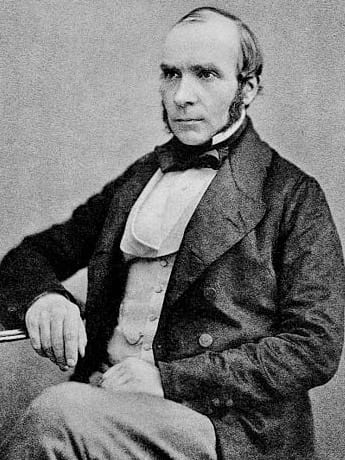
John Snow (1813-1858) was an English physician, anaesthetist and epidemiologist
Snow was a pioneer of anaesthesia and one of the fathers of modern epidemiology. Remembered as the “cholera cartographer,” he combined clinical observation, physiological reasoning, and quantitative analysis in a way that was unusual for his time. His work linked bedside medicine with population health, and helped shape later ideas of medical hygiene, public health, and disease prevention.
In anaesthesia, Snow was among the first to study ether and chloroform systematically rather than empirically. He described the five stages of etherization in 1847, generally regarded as the first formal staging of general anaesthesia, and designed inhalers intended to regulate vapour concentration and improve safety. His work on dose, apparatus, and observation helped establish anaesthesia as a scientific discipline, and his administration of chloroform to Queen Victoria advanced its acceptance in obstetric practice.
In epidemiology, Snow challenged the prevailing miasma theory by arguing that cholera was spread through contaminated water. In On the Mode of Communication of Cholera (1849; 1855), and in his investigations of the Broad Street outbreak and the South London water companies, he used mapping, case tracing, and comparative mortality analysis to show how disease could be studied through patterns of transmission. Although his conclusions were disputed in his lifetime, they later came to be recognised as seminal contributions to epidemiology and public health.
Biography
- Born March 15, 1813 on North Street, York, England; baptised the same day at All Saints, North Street.
- 1819–1827 – Educated at Dodsworth School, Bishop Hill, York; completed his early schooling by age 14.
- 1827 – Apprenticed to William Hardcastle, surgeon-apothecary, in Newcastle-upon-Tyne; the first of his three medical apprenticeships.
- 1827–1836 – Apprenticed to William Hardcastle, surgeon-apothecary, in Newcastle-upon-Tyne; the first of three apprenticeships.
- 1836–1838 – Studied at the Hunterian School of Medicine in London; continued clinical training at Westminster Hospital. His first publication, a letter to The Lancet, appeared in 1838.
- 1843 – Awarded Bachelor of Medicine (M.B.) from the University of London.
- 1844 – Awarded Doctor of Medicine (M.D.) from the University of London.
- 1846–1847 – Start of Snow’s hospital anaesthetic work at St George’s Hospital and University College Hospital; lecturer in forensic medicine at the Aldersgate School of Medicine.
- 1847 – Published On the Inhalation of the Vapour of Ether in Surgical Operations, based on nearly 80 ether cases; established himself as a leading authority on anaesthesia.
- 1848 – Constructed an inhaler for chloroform.
- 1849 – Published the first edition of On the mode of communication of cholera.
- 1850 – Admitted licentiate of the Royal College of Physicians of London (LRCP). A founding member of the Epidemiological Society of London.
- 1851 – Appointed physician to the Hospital for Consumption and Diseases of the Chest, Brompton.
- 1852 – Moved to 18 Sackville Street, London, his final home and research base.
- 1853 – Administered chloroform to Queen Victoria during the birth of Prince Leopold on April 7.
- 1854–1855 – Investigated the Soho cholera outbreak, linked cases to the Broad Street pump, urged removal of the pump handle, and conducted the South London water-supply “grand experiment.”
- 1855 – Published the expanded second edition of On the Mode of Communication of Cholera; elected President of the Medical Society of London.
- 1857 – Again administered chloroform to Queen Victoria, this time for the birth of Princess Beatrice on April 14.
- Died in London on June 16, 1858 aged 45, after a stroke/apoplexy; buried in Brompton Cemetery. His major anaesthesia text, On chloroform and other anaesthetics, was published posthumously.
Medical Eponyms
John Snow Silver Medal (1946)
The John Snow Silver Medal was originally given to anaesthetists who had distinguished themselves and received awards for gallantry in the Second World War.
In 1946 the first three recipients were the founder of the Association of Anaesthetists, Henry W Featherstone OBE; Leslie G Morrison MC; and Professor Edgar Alexander Pask OBE.
Now awarded to UK and Irish anaesthetists who have held high office in, and provided exceptional service to the Association; or eminent UK and Irish anaesthetists of great distinction
Key Medical Attributions
Anaesthesia
Snow was one of the first physicians to study anaesthesia scientifically. After the introduction of ether into British practice in 1846, Snow proposed the first classification system for general anaesthesia as the 5 stages of etherization (narcotism) in 1847. This was furthered by Francis Plomley in the Lancet in the same year and unchanged until the better-known Guedel four-stage classification to assess the depth of general anaesthesia was introduced in 1937.
Snow described the stages of etherization, emphasised careful titration and clinical observation, and helped establish anaesthesia as a distinct field of practice rather than a crude surgical expedient. His reputation became such that he was called to administer chloroform to Queen Victoria at the births of Prince Leopold in 1853 and Princess Beatrice in 1857, an association that greatly advanced the social acceptance of obstetric anaesthesia.
Snow’s anaestheisa delivery system
Snow’s importance in anaesthesia lay not simply in using ether and chloroform, but in making their administration safer, more precise, and more reproducible. Dissatisfied with the crude open-drop method of giving chloroform on a handkerchief or sponge, he designed inhalers intended to regulate the proportion of vapour and air during inhalation, and to control the effect of temperature on vapour concentration.
1848 – His chloroform inhaler combined a moulded face-piece, adjustable air valve, and double-cylinder vaporising chamber with a water-bath to deliver a more controlled dose. Snow’s design drew on and refined contemporary face-piece innovations by Hawkesley and Sibson, and was adapted by practitioners such as Robinson and Coxeter.
In his paper Snow stated his ether inhaler supplied “the means of regulating the proportions of ether vapour and of air during inhalation,” and argued that failures with ether were due to “inefficient means of administering the vapour,” not patient peculiarity.
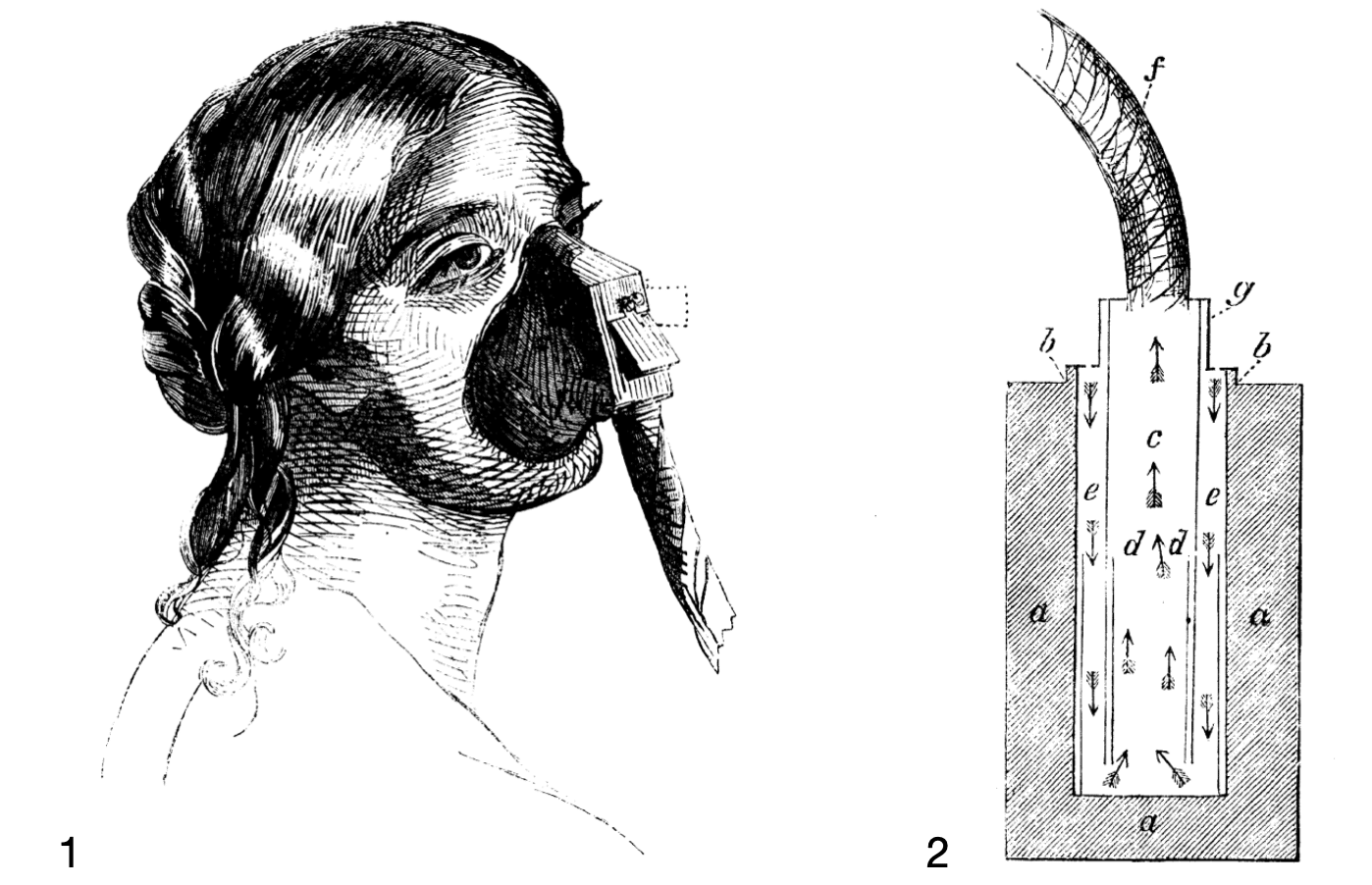
Fig 2: Perpendicular section of inhaler on a scale of one-half the dimensions. a. Water-bath. b. Point at which the water-bath is screwed to the inhaler. c. Inner cylinder. d. Point at which the inner cylinder terminates in wire, round which bibulous paper is coiled, the outer cylinder being lined with the same to this height. e. Outer cylinder. f. Elastic tube. g. Screw attaching tube to apparatus
Epidemiology
Snow’s enduring epidemiological achievement was to challenge the prevailing miasma theory by arguing that cholera was communicated by ingestion of contaminated water. In On the Mode of Communication of Cholera (1849; expanded 1855), he proposed that the disease could be “checked and kept at bay by simple measures,” especially hand hygiene and protection of drinking water from sewage contamination.
Snow tested this hypothesis in two classic investigations: the Broad Street outbreak, where he found that deaths had occurred “within a short distance of the pump,” and the South London water-supply comparison, which he described as an inquiry conducted “on the grandest scale.”
These studies helped lay the foundations of modern epidemiology, although Snow’s conclusions were fiercely contested in his lifetime.
The Lancet was the first to infer ‘you know nothing John Snow…‘ and dismissed his theory in 1855
In 2013, more than 150 years after publishing this scathing editorial (1855) and dismissive obituary for John Snow (1858), The Lancet reflected and acknowledged it had not recognised the epidemiological significance of Snow’s water-borne transmission theory…
- Lancet scathing editorial attack: June 23, 1855 [Dr Snow’s evidence]
- John Snow died: June 16, 1858
- Lancet Obituary – minimising epidemiology: June 26, 1858 [Obituary: John Snow]
- Lancet reflection/correction: April 13, 2013 [John Snow]
The Lancet wishes to correct, after an unduly prolonged period of reflection, an impression that it may have given in its obituary of Dr John Snow on June 26, 1858. The obituary briefly stated:
“Dr John Snow: This well-known physician died at noon, on the 16th instant, at his house in Sackville Street, from an attack of apoplexy. His researches on chloroform and other anaesthetics were appreciated by the profession.”
The journal accepts that some readers may wrongly have inferred that The Lancet failed to recognise Dr Snow’s remarkable achievements in the field of epidemiology and, in particular, his visionary work in deducing the mode of transmission of epidemic cholera. The Editor would also like to add that comments such as “In riding his hobby very hard, he has fallen down through a gully-hole and has never since been able to get out again” and “Has he any facts to show in proof? No!”, published in an Editorial on Dr Snow’s theories in 1855, were perhaps somewhat overly negative in tone.
The Lancet 2013
Major Publications
Anaesthetics
- Snow J. On the inhalation of the vapours of ether. 1847
- Snow J. On the Inhalation of the Vapour of Ether in surgical operations; containing a description of the various stages of etherization, and a statement of the result of nearly eighty operations. 1847
- Snow J. On the discussion respecting chloroform. 1849
- Snow J. On the fatal cases of inhalation of chloroform. 1849
- Snow J. The alleged employment of chloroform by thieves. London Medical Gazette. 1850; 45
- Snow J. On narcotism by the inhalation of vapours. 1851 (parts 8-16) (Parts 17-28)
- Snow J. On the cause and prevention of death from chloroform. 1852
- Snow J. On chloroform and other anaesthetics: their action and administration. 1858
Epidemiology
- Snow J. On the pathology and mode of communication of cholera. London Medical Gazette. 1849; 44
- Snow J. On the mode of communication of cholera. 1849
- Snow J. On continuous molecular changes, more particularly in their relation to epidemic diseases. 1853
- Snow J. The Cholera Near Golden Square, and at Deptford Medical Times and Gazette 1854; 9: 321-22
- Snow J. On the mode of communication of cholera. 1855
- Snow J. Report on the cholera outbreak in the Parish of St. James, Westminster. 1855
- Snow J. Cholera and the water supply in the south districts of London. 1856
References
Biography
- Editorial. Dr Snow’s evidence. Lancet June 23, 1855; 65(1660): 634-637
- Obituary: Dr John Snow. Lancet June 26, 1858; 71(1817): 635
- Hempel S. John Snow. Lancet, 2013; 381(9874): 1269-1270
- Frerichs RR. Life and times of Dr. John Snow (1813-1858). UCLA
- Maltby R. John Snow. Notable Names in Anaesthesia. The Choir Press. 2013: 205-208
- John Snow Case Books
Eponymous terms
- Bynum W. In retrospect: On the Mode of Communication of Cholera. Naturev 2013; 495: 169–170
- Nickson C. Just Read the Map. LITFL
- The John Snow Silver Medal. Association of Anaesthetists
Eponym
the person behind the name

BA MA (Oxon) MBChB (Edin) FACEM FFSEM. Emergency physician, Sir Charles Gairdner Hospital. Passion for rugby, medical history, medical education, and asynchronous learning #FOAMed evangelist. Editor-in-Chief and Webmaster of Life in the Fast lane, LITFL | On Call 4e| Eponyms | Books | Horology |