


Mary Holt

Mary Clayton Holt (1924-1993) was an English cardiologist.
Holt was an early advocate for cardiac rehabilitation and championed the role of women in medicine. Her career spanned over three decades with appointments at St Mary’s Hospital, the South London Hospital for Women and Children, Croydon General, and King’s College Hospital, where she conducted her most influential research.
She worked as medical administrator and was involved in medical politics as chairperson of the medical committees at both the South London and Mayday Hospitals and consultant member of the Croydon Health Authority. Holt is eponymously remembered for her description of Holt-Oram syndrome, published in 1960
Biographical Timeline
- Born on April 20, 1924 in Eltham, Kent, England
- 1947 – Graduated MB BS from King’s College Hospital, London. MRCS and LRCP.
- 1948 – Awarded Charles Murchison Scholarship by the Royal College of Physicians.
- 1949 – Elected Member of the Royal College of Physicians (MRCP).
- 1950 – Earned Doctor of Medicine (MD) degree.
- 1951–1955 – Senior Medical Registrar at St Mary’s Hospital, Paddington.
- 1955 (age 31) – Appointed Consultant Cardiologist to the South London Hospital for Women and Children. Initially denied consultant salary due to being under the usual appointment age of 32. Research scholar in cardiology at King’s College Hospital
- 1959 – Appointed Consultant Physician to the Royal Eye Hospital and Croydon Hospitals.
- 1970 – Appointed Honorary Consultant Cardiologist to Brompton Hospital. Worked with Bill Cleland and Matt Paneth to establish a long-term link with Croydon hospitals.
- 1971 – Elected Fellow of the Royal College of Physicians (FRCP).
- 1990 – Retired and moved to Charmouth, Dorset after a career based in Croydon
- 1993 (Summer) – Underwent bilateral knee replacement surgery for severe arthritis. Sadly Mary Holt took her own life on October 20, 1993.
Medical Eponyms
Holt-Oram syndrome (1960)
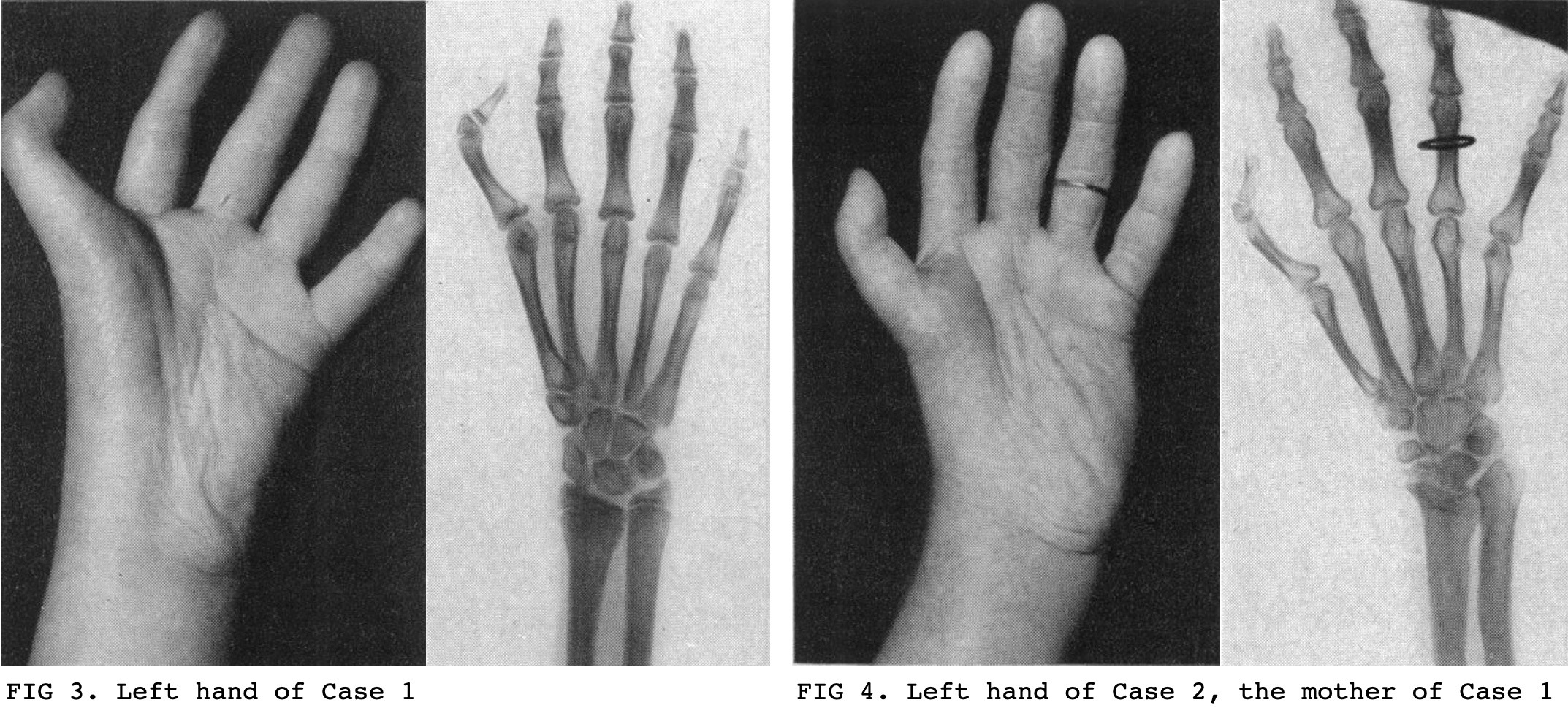
An autosomal dominant disorder characterised by congenital abnormalities of the upper limbs and shoulder girdle, typically associated with structural heart defects. The classic presentation is a triphalangeal thumb in conjunction with an ostium secundum atrial septal defect (ASD), though there is wide phenotypic variability in both the cardiac and skeletal manifestations. aka atriodigital dysplasia, heart-hand syndrome, upper limb–cardiovascular syndrome [OMIM #142900]
Cardiac abnormalities include ASDs, ventricular septal defects (VSDs), and conduction disturbances such as atrioventricular block, sinus node dysfunction, or arrhythmias. Limb anomalies commonly affect the preaxial (radial) side, with features including absent or hypoplastic thumbs, abnormal or absent radius, phocomelia, and abnormal carpal bones—sometimes identifiable only via X-ray.
The condition is caused by mutations in the TBX5 gene located on chromosome 12q24.1, which encodes a T-box transcription factor critical to cardiac and limb development. Approximately 70–85% of clinically diagnosed cases exhibit identifiable mutations in TBX5.
1960 – First described by Mary Clayton Holt and Samuel Oram (1913–1991), who reported on four generations of a family affected by both congenital heart disease and skeletal anomalies. They defined a triad of atrial septal defect (ASD), cardiac conduction abnormalities, and hand malformations in the original British Heart Journal publication.
Details are given of a family in which members of four generations were affected by both congenital heart disease and skeletal anomalies. In both systems the malformation appeared to be of similar type in all the affected members, the former being an atrial septal defect, often accompanied by bizarre arrhythmia, and the latter affecting mainly the hands…a congenital anomaly of the thumbs which lay in the same plane as the fingers, their terminal phalanges being curved inwards. There was also evidence of hypoplasia of the peripheral arteries and veins. The inheritance was of Mendelian dominant type.
Holt, Oram 1960
Major Publications
- Oram S, Holt MC. Coronary involvement in dissecting aneurysm of the aorta. Br Heart J. 1950;12(1):10-16
- Oram S, Holt M, East T. Oesophageal and other leads in posterior cardiac infarction. Br Heart J. 1951;13(4):475-484.
- Holt MC, Litchfield JW. Parathyroid adenoma with generalized osteitis fibrosa cystica. Proc R Soc Med. 1953;46(1):52.
- Holt M, Oram S. Familial heart disease with skeletal malformations. Br Heart J. 1960; 22(2): 236-242. [Holt-Oram syndrome]
- Oram S, Holt M. Innocent depression of the S-T segment and flattening of the T-wave during pregnancy. J Obstet Gynaecol Br Emp. 1961;68:765-770
- Holt M. Mothers don’t make better midwives. Nurs Mirror Midwives J. 1969;128(24):24.
- Holt M. Who’s worrying? Nurs Mirror Midwives J. 1970;131(16):23.
References
Biography
- Beighton P, Beighton G. Holt, Mary. The Man Behind the Syndrome. Springer 1991: 213
- Biography: Mary Clayton Holt. Lives of the Fellows of the Royal College of Physicians of London. Munk’s Roll: Volume IX: 243
- Inquest into doctor’s death. Croydon Advertiser. Fri, 5 Nov 1993
- Death of Dr Mary Holt. Dorset Echo, Friday 17 Dec 1993: 3
Eponymous terms
- Newbury-Ecob RA, Leanage R, Raeburn JA, Young ID. Holt-Oram syndrome: a clinical genetic study. J Med Genet. 1996 Apr;33(4):300-7.
- Mori AD, Bruneau BG. TBX5 mutations and congenital heart disease: Holt-Oram syndrome revealed. Curr Opin Cardiol. 2004 May;19(3):211-5.
- Aung TT, Roberto ES, Wase A. Absent Left Main Coronary Artery and Separate Ostia of Left Coronary System in a Patient with Holt-Oram Syndrome and Sinus Node Dysfunction. Am J Case Rep. 2016 Feb 17;17:93-6.
- C S SL, Sharma K, Manaswini M, Thakur K. Holt-Oram Syndrome With Atrial Septal Defect. Cureus. 2024 Jul 17;16(7):e64772.
- Holt-Oram syndrome (HOS) – 142900. OMIM
Eponym
the person behind the name

MBBS (Hons) FCEM. Emergency Consultant at St Mary's Hospital, Imperial College Healthcare NHS Trust

BA MA (Oxon) MBChB (Edin) FACEM FFSEM. Emergency physician, Sir Charles Gairdner Hospital. Passion for rugby, medical history, medical education, and asynchronous learning #FOAMed evangelist. Editor-in-Chief and Webmaster of Life in the Fast lane, LITFL | On Call 4e| Eponyms | Books | Horology |