

Paul Ehrlich
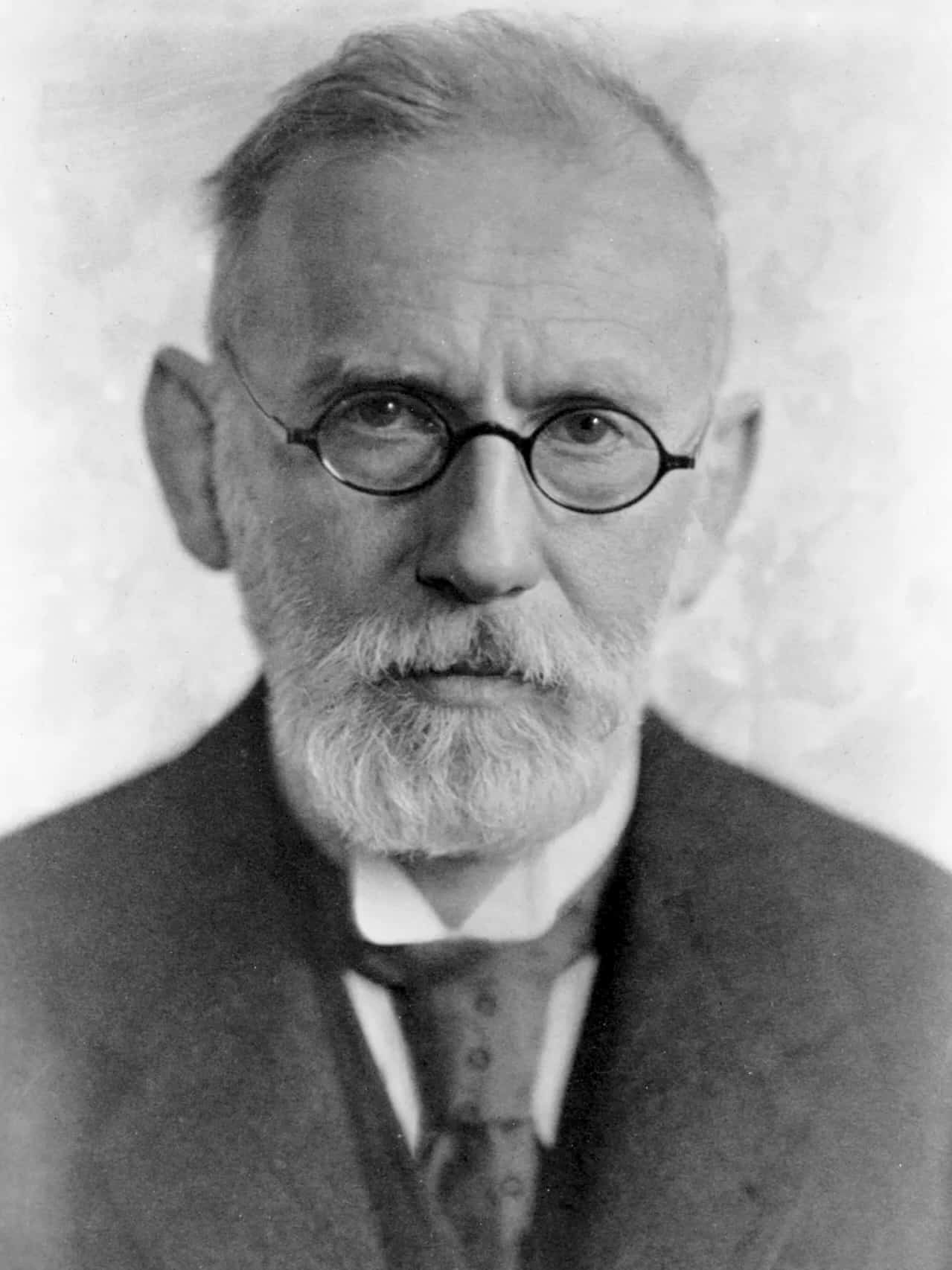
Paul Ehrlich (1854–1915) was a German physician-scientist
Ehrlich sits at the crossroads of colour chemistry and modern medicine. He made dyes do clinical work: staining blood cells into recognisable families, tracking physiology with fluorescent tracers, and using colour as a way to think about why one molecule binds here and not there (specificity or selective affinity).
Ehrlich’s greatest impact was not a single discovery but a new way to build treatments. When biological therapies were powerful but unpredictable, he helped make antitoxin therapy measurable, potency tested, standardised, and trustworthy. He argued that immunity and therapy could be understood as chemical interactions, laying the groundwork for receptor-based thinking. He designed agents that would seek out the pathogen in his famous “magic bullet” ideal.
His first modern antimicrobial breakthrough was compound 606 (Salvarsan/arsphenamine) for the treatment of syphilis which he developed through systematic synthesis, animal models, and iterative testing.
Biographical Timeline
- Born March 14, 1854 at Strehlen, Upper Silesia, Prussia (now Strzelin, Poland)
- 1872–1877 – Medical studies at the Universities of Breslau, Strassburg, and Freiburg.
- 1878 – Awarded MD at Leipzig; dissertation on histological staining and the theory/practice of staining animal tissues (aniline dyes).
- 1878 – Appointed assistant to Friedrich Theodor von Frerichs (1819–1885) at the Berlin Medical Clinic, enabling continued dye-staining research (including classifying dyes as basic/acid/neutral and foundational work in haematology).
- 1882 – Became Titular Professor. Conducted experiments on fluorescent phenomena in the eye (rabbit), exploring diagnostic potential of fluorescent dyes for eye disease. Published a rapid staining method for Mycobacterium tuberculosis (building on Koch’s discovery), forming the basis for later Ziehl–Neelsen acid-fast staining modifications.
- 1883–1886 – Developed clinical-laboratory diagnostic tests (including the diazo reaction as a urine test in infectious/jaundice contexts).
- 1887 – Qualified as Privatdozent (University of Berlin) with habilitation work Das Sauerstoffbedürfnis des Organismus (“The need of the organism for oxygen”).
- 1888–1889 – Travelled to Egypt and elsewhere to recover from pulmonary tuberculosis contracted in the laboratory.
- 1890 – Appointed (extraordinary) professor/academic advancement in Berlin; also began close work in immunity/serum fields.
- 1890–1895 – Collaborated with Emil von Behring (1854–1917) in serum therapy; developed effective immunisation protocols and quantitative standardisation methods for antisera, laying groundwork for modern immunology concepts.
- 1891 – Joined Robert Koch’s Institute for Infectious Diseases in Berlin. Worked on diphtheria serum extraction, potency/valency measurement, and developed an internationally acknowledged unit standard. Landmark chemotherapy milestone: therapeutic trial of methylene blue against malaria (a model for targeted anti-infective testing).
- 1896 – Appointed founding head of the Institute for Sera Research and Serum Testing (Steglitz, near Berlin).
- 1897 – Appointed Privy Medical Officer of Health; published key work on diphtheria serum “valency” (often linked with the maturation of his side-chain theory).
- 1899 – Institute moved to Frankfurt am Main, becoming the Royal Institute of Experimental Therapy; Ehrlich served as director.
- 1900 – In haemolysin studies with Julius Morgenroth (1871–1924), introduced the term “receptor” in his immunological framework.
- 1904 – Appointed Honorary Professor, University of Göttingen. Honorary doctorate, University of Chicago
- 1906 – Became head of the Georg-Speyer-House for chemotherapy research, Frankfurt
- 1908 – Awarded the Nobel Prize in Physiology or Medicine ,shared with Élie Metchnikoff (1845–1916), for contributions to immunology and serum research/measurement concepts.
- 1909 – Discovery of Salvarsan (compound “606”, arsphenamine) with Sahachiro Hata (1873–1938), pioneering an effective treatment for syphilis and a practical model for antimicrobial chemotherapy.
- 1911 – Appointed “Real Privy Councillor” with title “Excellency”.
- 1912 – Made honorary citizen of Frankfurt and Strehlen.
- Died August 20, 1915 at Bad Homburg vor der Höhe, Germany.
Key Medical Contributions
Chemotherapy (the experimental programme for “specific” anti-infective treatment)
Ehrlich was at the forefront of antimicrobial chemotherapy. He tested large numbers of compounds and used cures in infected mice (e.g., with trypan red) as proof that a chemotherapeutic strategy could work. Once reliable animal infection models became available, he and Kiyoshi Shiga (1871–1957), launched a systematic screening programme. He found compounds with selective affinity while minimising host toxicity (“organotropism”), then improved them through biological testing.
He used synthetic dyes as candidate therapeutics, and his early trial of methylene blue against malaria helped establish the principle that a man-made chemical could act as a specific anti-infective agent rather than merely a symptomatic remedy.
Syphilis (Salvarsan / compound 606): first modern antimicrobial breakthrough
This work became a proof-of-concept for selective toxicity and modern drug development with screening, toxicity testing, controlled release, and post-market controversy/iteration.
At the Georg-Speyer-Haus, with dedicated chemical synthesis capability, this approach matured into a modern drug-development process with synthesis → screening → chemical modification to improve efficacy and reduce toxicity
Ehrlich’s systematic arsenical programme culminated in compound 606 (arsphenamine; Salvarsan). This was the first widely successful “targeted” antimicrobial treatment for syphilis. He demonstrated efficacy in syphilitic rabbit models, followed by clinical rollout and large-scale distribution for trials.
The idea of a Zauberkugeln or magic bullet, a treatment that would target a specific agent responsible for an infectious disease was first described by Ehrlich on June 5, 1907 in his Harben Lecture
The discovery of antitoxins by von Behring, fundamental in itself, has opened to pharmacology and therapeutics this new field in which the principle of distribution is exemplified in an ideal manner: for antitoxins and antibacterial substances are, so to speak, charmed bullets which strike only those objects for whose destruction they have been produced by the organism
Ehrlich, 1907
So Ehrlich first described the ‘charmed bullet‘ in 1907, and in his German publications „Zauberkugeln“, die unter allen Umständen ein ganz bestimmtes Ziel mit Unfehlbarkeit treffen. The English term ‘magic bullet‘ was first published by pharmacologist Henry Dale published in 1924:
The investigation of these natural antagonists to infection produced a new therapeutic ideal. Not only had they shown themselves to have an intensely specific affinity for the infecting organism of the toxin which caused their production; they were also perfectly harmless to the patient, behaving, in relation to his organism, as normal constituents of his body fluids and tissues. Ehrlich aptly compared them to magic bullets, constrained by a charm to fly straight to their specific objective, and to turn aside from anything else in their path
Dale, 1924
Fluorescein contribution
1882 – Ehrlich published Ueber provocirte Fluorescenzerscheinungen am Auge (based on a Charité lecture, March 10, 1881), describing provoked ocular fluorescence after fluorescein in rabbit experiments. He used fluorescein as a physiological tracer, showing that fluorescence could appear as a distinct corneal “line” even when the cornea looked otherwise colourless, and emphasised that visibility depended on dye concentration and optical path length
Ehrlich described his “Fluorescein method” (Fluoresceinmethode) noting that the secreted intraocular fluid was relatively poor in fluorescein, limiting early anterior segment staining. He demonstrated that, after corneal puncture, subsequent fluorescein dosing allowed visualisation of fluid movement from the posterior chamber into the anterior chamber. He recomended further work on corneal absorption, and stated that the method’s chief advantage was its applicability in humans, proposing subcutaneous or oral administration.
Antitoxin therapy (diphtheria): making serum treatment measurable and standardised
Ehrlich’s developed diphtheria serum therapy from a promising but variable biological product to quantifiable, regulatable treatment. From the mid-1890s he focused on assay and standardisation and practical methods to value (titrate) antitoxin potency against toxin using animal models. He argued for state oversight to guarantee that each batch released for clinical use met consistent standards. This became a prototype for biological standardisation and his theoretical thinking about toxin–antitoxin interactions.
Immunology (toxins/antitoxins; “side-chain” thinking and quantitative specificity)
Ehrlich proposed that immunity could be studied as a specific, measurable chemical interaction between toxins/antigens and binding structures on cells. From his serum and toxin work he developed the side-chain (receptor) theory, proposing that cells carry specific “side-chains” capable of binding foreign substances. Overstimulation would drive overproduction and release of these binding groups into the bloodstream as circulating antibodies/antitoxins. His helped define the “active” agents of humoral immunity, receptors, complement and antibody specificity beyond diphtheria.
Major Publications
- Ehrlich P. Ueber provocirte Fluorescenzerscheinungen am Auge. Deutsche Medizinische Wochenschrift. 1882; 8: 54–55 [fluorescein]
- Ehrlich P. Über die Gewinnung, Werthbestimmung und Verwerthung des Diphtherieheilserums.
Hygienische Rundschau 1894; 4: 1140-1152. - Ehrlich P. Die staatliche Controle des Diphtherieserums. Berliner klinische Wochenschrift: 1896; 441-443.
- Ehrlich P. Observations upon the constitution of the diphtheria toxin. Transactions of the Jenner Institute of Preventive Medicine. 1899: 1-16.
- Ehrlich P. Croonian lecture: On immunity with special reference to cell life. Proceedings of the Royal Society of London 1900; 66: 424-448.
- Ehrlich P. The Harber Lectures on Experimental researches on specific therapeutics. The Lancet 1907: 169(4372): 1634-1636
- Ehrlich P. Experimental researches on specific therapeutics. The Harben Lectures for 1907 of the Royal Institute of Public Health, London: Lewis, 1908
- Ehrlich P. Die Behandlung der Syphilis mit dem Ehrlichschen Präparat 606. Deutsche medizinische Wochenschrift. 1910
- Ehrlich P. Die Behandlung der Syphilis mit dem Präparate von Ehrlich-Hata. Wiener klinische Wochenschrift. 1910: 1486-1488.
- Ehrlich P. Die Salvarsantherapie. Rückblicke und Ausblicke. Abhandlungen über Salvarsan 1911; 1: 375-402.
References
Biography
- Paul Ehrlich, eine Darstellung seines wissenschaftlichen Wirkens : Festschrift zum 60. Geburtstage des Forschers. 1914
- Dr. Ehrlich’s Magic Bullet 1940 [Video]
- Dale H. Paul Ehrlich, born March 14, 1854. Br Med J. 1954 Mar 20;1(4863):659-63.
- Paul Ehrlich, Biographical. NobelPrize.org
Eponymous terms
- Dale HH. Progress and prospects in chemotherapy. Science. 1924 Aug 29;60(1548):185-91
- Thorburn AL. Paul Ehrlich: pioneer of chemotherapy and cure by arsenic (1854-1915). Br J Vener Dis. 1983 Dec;59(6):404-5.
- Turk JL. Paul Ehrlich–the dawn of immunology. J R Soc Med. 1994 Jun;87(6):314-5.
- Prüll CR. Part of a scientific master plan? Paul Ehrlich and the origins of his receptor concept. Med Hist. 2003 Jul;47(3):332-56.
- Androutsos G. Paul Ehrlich (1854-1915): founder of chemotherapy and pioneer of haematology, immunology and oncology. J BUON. 2004 Oct-Dec;9(4):485-91.
- Valent P, etal. Paul Ehrlich (1854-1915) and His Contributions to the Foundation and Birth of Translational Medicine. J Innate Immun. 2016;8(2):111-20.
Eponym
the person behind the name

BVisSci, MD, University of Notre Dame, Fremantle. Doctor, baker, avid traveller, aspiring ophthalmologist

BA MA (Oxon) MBChB (Edin) FACEM FFSEM. Emergency physician, Sir Charles Gairdner Hospital. Passion for rugby; medical history; medical education; and asynchronous learning #FOAMed evangelist. Co-founder and CTO of Life in the Fast lane | On Call: Principles and Protocol 4e| Eponyms | Books |