


Sidney Weinstein

Sidney Weinstein (1922-2010) was and American neuropsychologist.
Weinstein was a somatosensory researcher whose work helped transform sensory examination from descriptive bedside assessment into reproducible, quantitative threshold testing. His research focused on brain injury, skin sensitivity, cognitive function, phantom pain, and the relationship between peripheral sensory thresholds and central sensory processing.
With Josephine Semmes, Weinstein developed the Semmes–Weinstein Pressure Aesthesiometer, and the Semmes–Weinstein monofilament examination. The method was first used in neuropsychological studies of somatosensory loss after penetrating brain injury and has become used in clinical assessment of peripheral sensory loss.
Weinstein maintained that monofilament pressure-threshold testing measured a more physiological aspect of cutaneous sensibility than two-point discrimination or point localisation, which were more dependent on cortical processing. In 1993 he introduced the more refined Weinstein Enhanced Sensory Test (WEST) aimed at improving standardisation, calibration, and clinical usability.
Biography
- Born April 30, 1922, New York City
- 1939 – Graduated from Townsend Harris High School, New York.
- 1943–1945 – Served in the United States Army / U.S. Army Air Forces during the Second World War and awarded four Battle Stars
- 1949 – Earned BS in Psychology from the City College of New York. Investigated human pain thresholds as an honours researcher.
- 1951 – Earned MA in Experimental Psychology from New York University with a thesis on texture gradient, field position, apparent size, and depth perception. Joined the laboratory of Hans-Lukas Teuber (1916–1977) as a research assistant while at NYU. Began work on cognitive and somatosensory testing in brain-injured men.
- 1952 – Awarded PhD in Physiological Psychology from New York University for the dissertation Time-error in somesthesis after injury to the nervous system. Developed tactile sensitivity method with Josephine Semmes (1916–1998) later known as the Semmes–Weinstein Pressure Aesthesiometer
- 1958–1966 – Director of the neuropsychology laboratory and research faculty member at Albert Einstein College of Medicine, New York. Visiting associate professor at New York University.
- 1960 – Co-authored Somatosensory Changes after Penetrating Brain Wounds in Man
- 1963 – Served as president of the Division of Physiological and Comparative Psychology of the American Psychological Association.
- 1966 – Adjunct professor at the City University of New York and lecturer at Mount Sinai School of Medicine.
- 1967–1980 – Professor in the Department of Pediatrics, New York Medical College
- 1974–1977 – President of NeuroCommunication Research Laboratories, Inc., Danbury, Connecticut.
- 1975 – Editor-in-Chief of the International Journal of Neuroscience.
- 1980–1982 – Member, Board of Governors, International Neuropsychological Society.
- 1992 – Honoured at the Gillis W. Long Hansen’s Disease Center, Carville, Louisiana, for his “gift to the world” of the Semmes–Weinstein monofilaments.
- Died November 8, 2010 in Chapel Hill, North Carolina, aged 88.
Medical Eponyms
Semmes–Weinstein monofilament examination
The Semmes–Weinstein monofilament examination is a quantitative test of cutaneous pressure threshold using calibrated nylon filaments. Weinstein developed the test with Josephine Semmes in the neuropsychology research environment of Hans-Lukas Teuber.
Originally called the “pressure test”, the method replaced von Frey-style horsehair testing with calibrated nylon monofilaments. Weinstein recognised nylon’s viscoelastic properties, low humidity absorption, and reproducibility as advantages over horsehair. The first kits were reportedly kept in a cigar box.
The technique was developed for somatosensory research in brain-injured patients and published with normative thresholds in Somatosensory Changes after Penetrating Brain Wounds in Man in 1960. It later became widely used for clinical assessment of peripheral sensory loss, including Hansen disease, diabetic neuropathy, hand sensibility testing, and entrapment neuropathies. In 1992, Weinstein was honoured at the Gillis W. Long Hansen’s Disease Center, Carville, Louisiana, for his “gift to the world” of the Semmes–Weinstein monofilaments.
Weinstein Enhanced Sensory Test / WEST
The Weinstein Enhanced Sensory Test (WEST) was introduced by Weinstein in 1993 as a refinement of the original Semmes–Weinstein monofilament examination. Weinstein designed the WEST to improve standardisation, calibration, durability, and ease of clinical use. His publication emphasises that monofilament testing should be reproducible and that every monofilament should be calibrated and certified to deliver its specified force.
Like the Semmes–Weinstein monofilament examination, WEST is used to assess cutaneous pressure threshold. Its purpose is not to provoke symptoms, but to quantify sensory loss and recovery. A set of graded monofilaments is mounted within a compact handheld device, allowing sequential application of calibrated filaments to the skin while reducing handling variability.
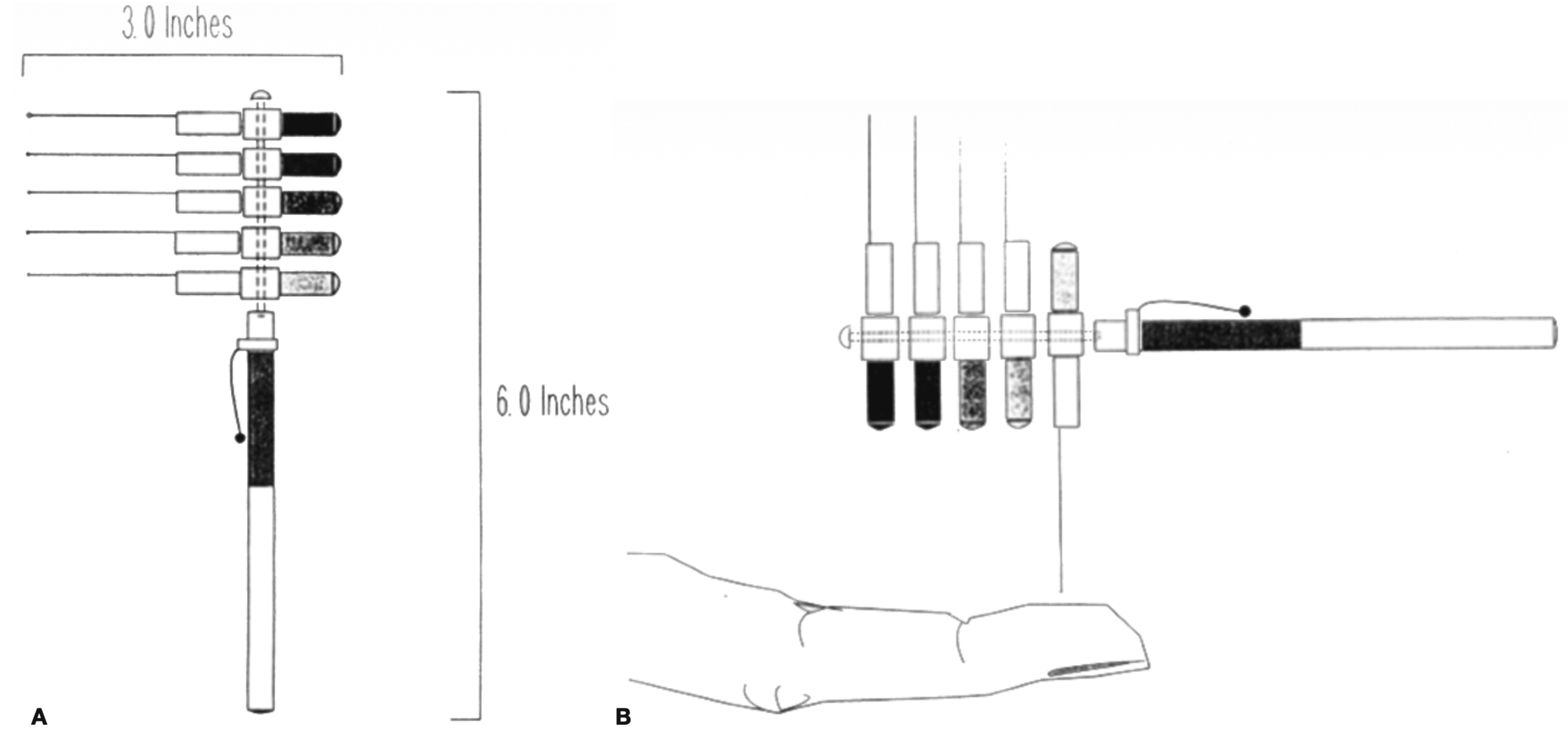
A. Device in storage position.
B. One calibrated monofilament is applied to the finger to determine cutaneous pressure threshold.
Controversies
Date of birth: Some secondary sources give April 27, 1922, including the World Biographical Encyclopedia entry and Sandyk’s 1992 tribute, which states that Weinstein celebrated his 70th birthday on April 27.
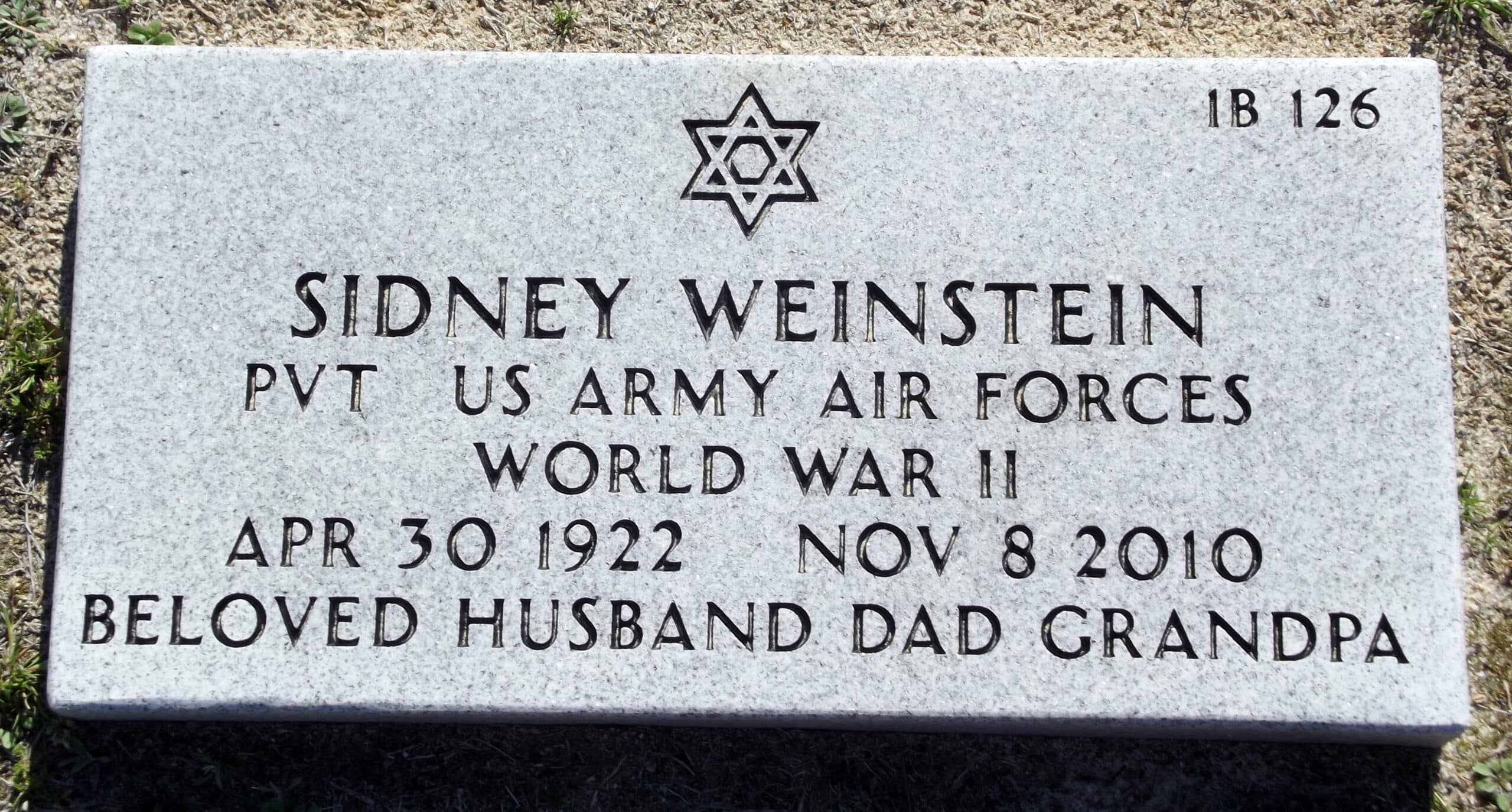
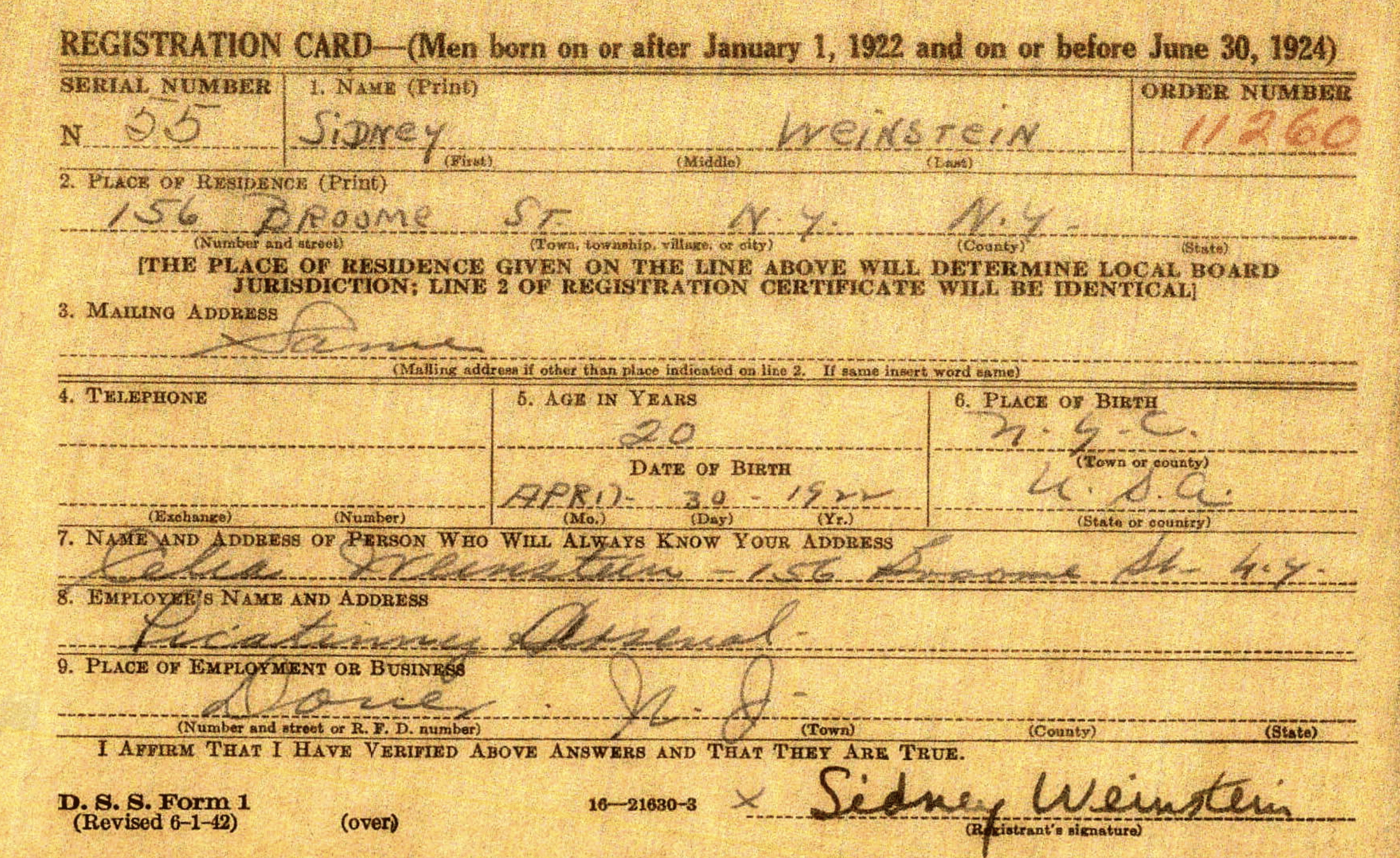
However, two stronger identity records support April 30, 1922. Weinstein’s WWII draft registration card records and his military headstone April 30 has therefore been used in this biography.
Major Publications
- Ghent L, Weinstein S, Semmes J, Teuber HL. Effect of unilateral brain injury in man on learning of a tactual discrimination. J Comp Physiol Psychol. 1955 Dec;48(6):478-81.
- Semmes J, Weinstein S, Ghent L, Teuber HL. Somatosensory Changes after Penetrating Brain Wounds in Man. Harvard University Press. 1960
- Weinstein S. Intensive and Extensive Aspects of Tactile Sensitivity as a Function of Body Part, Sex, and Laterality. In Kenshalo DR (Ed.), The Skin Senses. 1968: 195-222
- Weinstein S. The influence of Hans-Lukas Teuber and the psychophysiological laboratory on the establishment and development of neuropsychology. International Journal of Neuroscience, 1985; 25: 277-288.
- Weinstein S. Fifty years of somatosensory research: from the Semmes-Weinstein monofilaments to the Weinstein Enhanced Sensory Test. J Hand Ther. 1993 Jan-Mar;6(1):11-22; discussion 50.
References
Biography
- Sandyk R. A tribute to Professor Sidney Weinstein on his 70th birthday. Int J Neurosci. 1992 May-Jun;64(1-4):1-6.
Eponymous terms
- Bell-Krotoski J, Tomancik E. The repeatability of testing with Semmes-Weinstein monofilaments. J Hand Surg Am. 1987 Jan;12(1):155-61.
- Weinstein S. Fifty years of somatosensory research: from the Semmes-Weinstein monofilaments to the Weinstein Enhanced Sensory Test. J Hand Ther. 1993 Jan-Mar;6(1):11-22; discussion 50.
- Meirte J, Moortgat P, Truijen S, et al. Interrater and intrarater reliability of the Semmes Weinstein aesthesiometer to assess touch pressure threshold in burn scars. Burns. 2015;41(6):1261-1267.
Eponym
the person behind the name

Studying for Bachelor of Science (Occupational Therapy) at Curtin University

BA MA (Oxon) MBChB (Edin) FACEM FFSEM. Emergency physician, Sir Charles Gairdner Hospital. Passion for rugby, medical history, medical education, and asynchronous learning #FOAMed evangelist. Editor-in-Chief and Webmaster of Life in the Fast lane, LITFL | On Call 4e| Eponyms | Books | Horology |