

Theodore Obrig
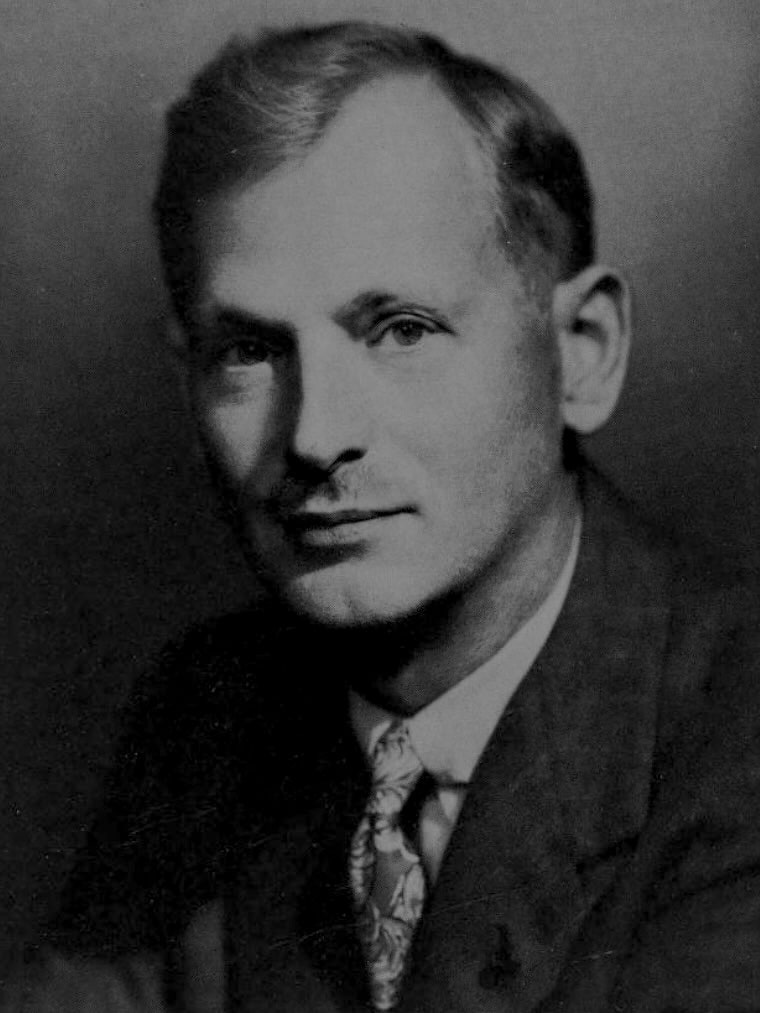
Theodore Ernst Obrig (1894–1967) was an American optician
Obrig was an optician–inventor who helped turn contact lenses from curiosities into something practical and useful. Following wartime medical service in France he returned to New York optical work. He became a prolific problem-solver building a small industrial ecosystem around contact lens materials, moulding methods, and training.
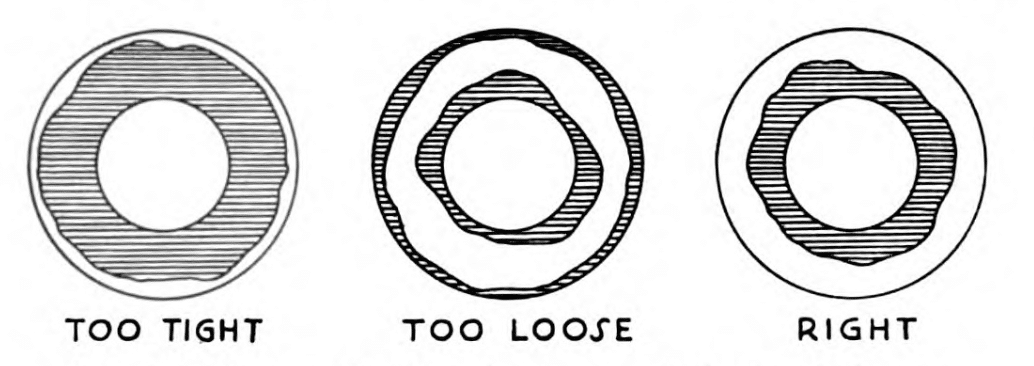
Obrig is the missing link in the fluorescein story and is the person who made fluorescein behave like modern fluorescein medical practice. In 1938 he described using a cobalt-blue filter with fluorescein to read lens fit as an immediate visual map – bright yellow-green where there is clearance, dark where there is touch. This simple optical trick became foundational to contact lens fitting and surface assessment.
Biographical Timeline
- Born May 10, 1894 in Brooklyn, New York, son of Jacob August Theodore Obrig and Josephine (Henderson) Obrig.
- 1914 – Apprenticed in his father’s optical firm Gall & Lembke (New York City).
- 1917-1919 – World War I: left college to serve as a driver with the French Army Ambulance Corps in France. Served with the U.S. Army Medical Department in France as a bacteriologist and physiological chemist.
- 1919 – Graduated A.B., Columbia University; returned to Gall & Lembke.
- 1929 – Began experimental work on contact lens devices.
- Early 1930s – Fitting ground glass scleral lenses; contact lens practice/experimentation intensifies.
- 1930s–1960s – Operated ham radio station W4JIT for ~35 years
- 1935 – Published Modern Ophthalmic Lenses and Optical Glass.
- 1937 – Designed and introduced an early all-plastic contact lens with Ernest Mullen.
- 1938 – Published the classic clinical note: “A Cobalt Blue Filter for Observation of the Fit of Contact Lenses”. Described the “accidental” breakthrough moment: fluorescein viewed under cobalt-blue illumination shows green where there is clearance and dark where there is touch.
- 1938 – Founded Obrig Laboratories, Inc. (later Obrig Chemical Corp.).
- 1942 – Published Contact Lenses.
- 1952 – Retired as president of Obrig Laboratories; continued as consultant.
- 1957 – Published Contact Lenses (3rd ed.), with Philip L. Salvatori as co-author.
- Died February 22, 1967 in Sarasota, Florida.
Key Medical Contributions
Cobalt-blue and fluorescein (contact lens fitting)
Obrig manufactured and designed contact lenses, but fitting was an issue. He used fluorescein but found that when evaluating the fit the intense white beam of slit illumination created reflections near the limbus that made accurate judgement of clearance “practically impossible.”
The breakthrough came as an accident in early summer 1938. Obrig was using fluorescein in routine lens checks (orange colour marking loose areas) with a hand lamp that could switch from white to cobalt-blue (originally intended for viewing conjunctival/scleral blood vessels). With the room dim and “quite by mistake” the blue beam selected while diluted fluorescein had run into the corneal portion of the lens. He saw the pattern instantly:
A brilliant yellow-green will be observed wherever the contact lens is not in contact… and a dark area will be observed where the cornea touches the lens.
Obrig, 1938
He formalised the technique in his 1938 npaper, A Cobalt Blue Filter for Observation of the Fit of Contact Lenses. Place a dense cobalt-blue filter between light source and eye, add a buffer solution with one drop of fluorescein before insertion, and read the sign. Fluorescein glows brilliantly in blue light while background glare is suppressed so yellow-green indicates non-contact, dark indicates contact. He also noted that minute corneal abrasions become easy to see marking a turning point for the use of fluorescein in broader corneal surface assessment.
Major Publications
- Obng TE. Fitting of contact lenses for persons with ametropia. Evolution and modern technic. Arch. Ophthalmol., 1937;17;(6):1089-1120.
- Obng TE. Molded contact lenses. Arch. Ophthalmol., 1938;19;(5):735-758.
- Obrig TE. A Cobalt Blue Filter for Observation of the Fit of Contact Lenses. Arch. Ophthalmol. 1938;20;(4):657-658
- Obrig TE. Contact lenses. 1942
- Obng TE. A new ophthalmic impression material. Arch. Ophthalmol., 1943;30;(5):626-630
- Obrig TE. Modern Ophthalmic Lenses and Optical Glass 1937 (2e), 1944(3e)
- Obrig TE. Evolution of the plastic contact lens. Australasian Journal of Optometry. 1945; 28(2)
References
Biography
- OBRIG, Theo(dore) Ernst. The National cyclopaedia of American biography. 1973: 220
- Knoll HA. Obrig and contact lenses. Newsletter Optometric Historical Society. 1976;7:35-36.
- Theodore Obrig and the Discovery of Fluorescein. 2023
- Goss DA. Authors of the First Contact Lens Textbooks: Beacher, Feinbloom, and Obrig. Journal of Optometry History. 2015; 46(2): 27-3
Eponym
the person behind the name

BVisSci, MD, University of Notre Dame, Fremantle. Doctor, baker, avid traveller, aspiring ophthalmologist

BA MA (Oxon) MBChB (Edin) FACEM FFSEM. Emergency physician, Sir Charles Gairdner Hospital. Passion for rugby; medical history; medical education; and asynchronous learning #FOAMed evangelist. Co-founder and CTO of Life in the Fast lane | On Call: Principles and Protocol 4e| Eponyms | Books |