


Tuohy Needle
The Tuohy needle is a directional, non-coring neuraxial needle characterised by a curved, deflected tip with a lateral opening, allowing controlled redirection of catheters during spinal and epidural placement.
Unlike conventional cutting needles, the orifice is positioned on the side of the needle rather than at the terminal tip, permitting the catheter to exit cephalad or caudad depending on needle orientation.
Although widely associated with Edward Boyce Tuohy (1908–1959), the defining geometry of the needle tip was invented and patented by Ralph Lee Huber (1889–1953). Tuohy’s contribution lay in the clinical application and dissemination of the Huber-point needle for continuous spinal and epidural catheter techniques, which led to its widespread adoption in anaesthetic practice.
History of the Tuohy Needle
1906 – Henry Percy Dean (1864-1931) described lumbar intraspinal injection as an alternative to general anaesthesia for acute abdominal surgery, emphasising haemodynamic stability and reduced physiological stress. His work represents one of the earliest surgical endorsements of lumbar spinal anaesthesia in the English literature.
The harmful effect of the administration of a general anaesthetic… has led to many attempts… to do without this very serious hindrance to success
Dean 1906
1940 – William T. Lemmon (1896–1974) published the first modern description of continuous spinal anaesthesia, maintaining access to the subarachnoid space using a malleable needle left in situ. While conceptually important, the technique was limited by mechanical instability, patient discomfort, and risk of needle fracture.
1941 – Building directly on Lemmon’s concept, Robert Andrew Hingson (1913–1996) (with Waldo B. Edwards) shifted the approach caudally, introducing continuous caudal epidural analgesia using a malleable needle and tubing system. This avoided many of the hazards of continuous spinal access and proved particularly suited to obstetrics.
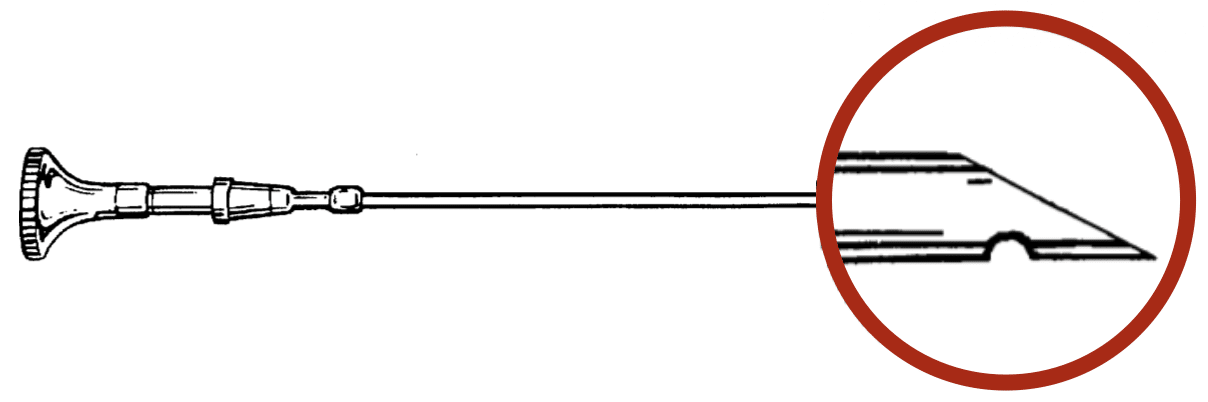
1943 – Ralph Lee Huber (1889–1953) developed a non-coring hypodermic needle featuring a transversely curved wall and side orifice, aimed at reducing pain, tissue coring, and embolic risk.
1944 – Edward Boyce Tuohy (1908–1959), described continuous spinal anaesthesia using an indwelling nylon ureteric catheter, passed through a spinal needle to allow fractional dosing. He argued that “the fractional or serial administration of spinal anesthetic agents is safer relatively than single large dose administration“. However, the problem remained that the catheter could migrate through the epidural space when introduced using a straight needle
1945 – Tuohy reported use of a 15-gauge needle with a curved, lateral-opening tip (Huber point) to direct catheters cephalad or caudad, noting that “the curved tip of the needle facilitates cephalad advancement of the catheter“
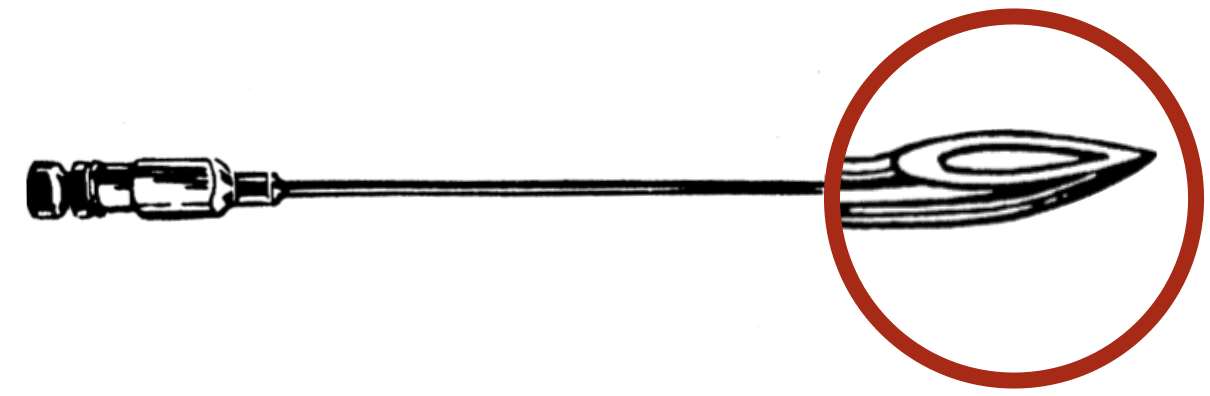
1947 – Manuel Martínez Curbelo (1906-1962) applied the Huber-point needle to continuous epidural (peridural) anaesthesia, describing catheter placement through a directional needle for segmental epidural block.
During my last visit to the Mayo Clinic, in November, 1946, I had an opportunity to see Dr. E. B. Tuohy perform continuous spinal anesthesia by means of a ureteral catheter introduced in the subarachnoid space through a needle with Huber point. I decided to use a similar procedure for continuous segmental peridural anesthesia
Curbelo MM, 1949
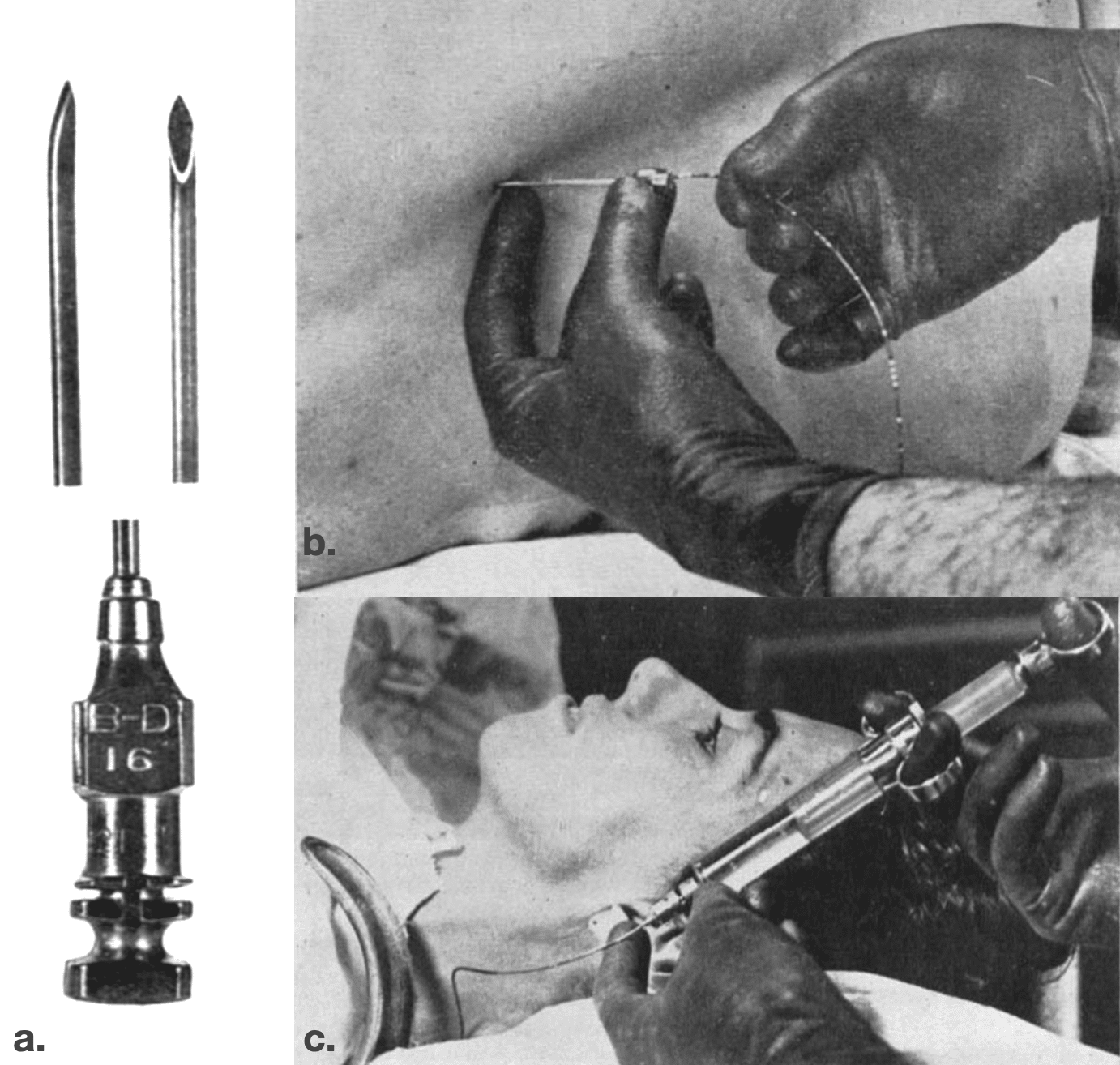
a. Tuohy needle with Huber point: Hub of needle (16 G)
b. Introduction of No. 3.5 catheter through the needle into the peridural space.
c. Fractional dose administration.
Associated Persons
- Henry Percy Dean (1864-1931)
- William T. Lemmon (1896–1974)
- Robert Andrew Hingson (1913–1996)
- Ralph Lee Huber (1889-1953)
- Edward Boyce Tuohy (1908-1959)
- Manuel Martínez Curbelo (1906-1962)
Alternative names
References
Original articles
- Dean HP. The importance of anaesthesia by lumbar injection in operations for acute abdominal diseases. Br Med J 1906; 1 :1086
- Lemmon WT. A method for continuous spinal anesthesia: A preliminary report. Annals of Surgery 1940; 111(1): 141-144
- Edwards WB, Hingson RA. Continuous Caudal Analgesia in Obstetrics – A Method for Safe, Painless Childbirth. JAMA. 1943; 121(4): 260-261
- Tuohy EB. Continuous Spinal Anaesthesia: Its usefulness and technic involved. Anesthesiology 1944;5:142-148
- Tuohy EB. Continuous Spinal Anaesthesia: A new method utilizing a ureteral catheter. Surg clin North AM 1945;25:834-840
- Curbello MM. Continuous Peridural Segmental Anesthesia by Means of a Ureteral Catheter. Curr Res Anesth Analg. 1949 Jan-Feb;28(1):13-23
Eponymous term review
- Frölich MA, Caton D. Pioneers in epidural needle design. Anesth Analg. 2001 Jul;93(1):215-20.
- Martini JA, Bacon DR, Vasdev GM. Edward Tuohy: The man, his needle, and its place in obstetric analgesia. Reg Anesth Pain Med. 2002 Sep-Oct;27(5):520-3.
- Lubisich JW. Ralph L. Huber, DMD: forgotten inventor of the “Tuohy” needle. J Hist Dent. 2004 Jul;52(2):75-9
- Ye M, Seet E, Kumar CM. Myths and mysteries surrounding continuous spinal anaesthesia, Trends in Anaesthesia and Critical Care, 2017; 17: 5-10,
Eponym
the person behind the name

Lowri Bowen. Mwynhau fy mhrofiad Awstralia, ond rwyf yn caru cymru yn fwy | LinkedIn |

BA MA (Oxon) MBChB (Edin) FACEM FFSEM. Emergency physician, Sir Charles Gairdner Hospital. Passion for rugby, medical history, medical education, and asynchronous learning #FOAMed evangelist. Editor-in-Chief and Webmaster of Life in the Fast lane, LITFL | On Call 4e| Eponyms | Books | Horology |