


Albert Henry Freiberg
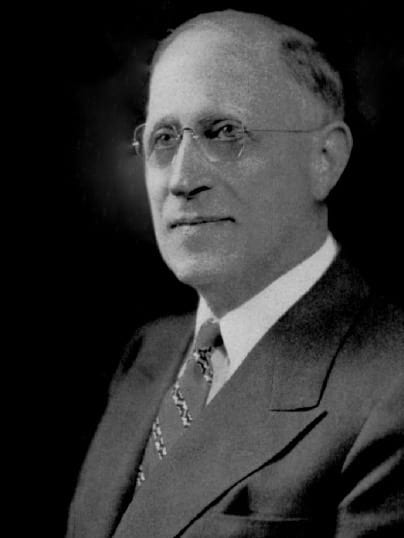
Albert Henry Freiberg (1868-1940) was an American Orthopedic Surgeon.
Freiberg was an important figure in the development of orthopaedics in Cincinnati. He served as the first head of orthopaedic surgery at the University of Cincinnati and ldirected orthopaedic services at Cincinnati General, Children’s and Jewish hospitals.
Freiberg is best remembered for his description of the disorder now known as Freiberg infraction, first encountered in 1903, presented in 1913 and published in 1914. His early interpretation emphasised traumatic “infraction” of the second metatarsal head.
He served as a Major in the US Army Medical Corps during the First World War, advocated for rehabilitation of disabled soldiers and children, and advised Franklin D. Roosevelt during the development of the Warm Springs Foundation for poliomyelitis rehabilitation.
Freiberg was active in professional leadership, serving as president of the American Orthopedic Association, the Cincinnati Academy of Medicine and the Ohio Medical Society. Outside medicine he was a skilled violinist with longstanding interests in music, art and education.
Biographical timeline
- Born on August 17, 1868 in Cincinnati, Ohio, son of Joseph and Amalia Freiberg.
- 1890 – Graduated MD from the Medical College of Ohio. Interned at Cincinnati General Hospital.
- 1890–1893 – Undertook postgraduate study in Europe including the universities of Würzburg, Strasbourg, Berlin, Vienna, Paris and London.
- 1894 – Returned to Cincinnati and entered medical practice, initially undertaking general work before increasingly specialising in orthopaedic surgery.
- 1897 – Married Jeannette Freiberg, daughter of Julius Freiberg. They had two sons, Joseph Albert Freiberg (1898–1973), who became an orthopaedic surgeon and later joined his father’s practice, and Albert Maurice Freiberg, an attorney.
- 1902 – Appointed to the orthopaedic surgery faculty at the University of Cincinnati and became the first head of its orthopaedic department.
- 1903 – Encountered the first patient in the series that would define Freiberg infraction
- 1907–1909 – Published on the physical consequences of child labour and poor posture in factory workers. Early interest in the relationship between working conditions, deformity and musculoskeletal health.
- 1910–1911 – President of the American Orthopedic Association.
- 1913 – Presented six cases of his second-metatarsal disorder to the Southern Surgical and Gynecological Association, using the concept of traumatic infraction to explain the lesion.
- 1917–1918 – First World War served as a Major in the United States Army Medical Corps, Chief of the Department of Orthopaedic Surgery at Walter Reed Hospital, Washington, DC. Chairman of the Orthopaedic Section of the American Medical Association
- 1919 – Published The Restoration of Disabled Soldiers to Industrial Service, his commitment to rehabilitation and return to productive employment following disability.
- 1923–1924 – President of the Cincinnati Academy of Medicine.
- 1926–1940 – Member of the Board of Governors of Hebrew Union College.
- 1927 onward – Closely involved with the development of the Georgia Warm Springs Foundation for poliomyelitis rehabilitation. Freiberg served on its Executive Orthopedic Council and advised Franklin D. Roosevelt (1882–1945) on the trial programme and establishment of a permanent foundation and sanitarium.
- 1920s–1930s – Worked extensively for children with physical disability. Chaired the Professional Advisory Committee on Crippled Children in Ohio and the Advisory Committee on Crippled Children of the US Children’s Bureau, and was an early medical advocate for state-supported care of disabled children.
- 1929–1930 – President of the Ohio Medical Society.
- 1938 – Retired from the Chair of Orthopaedic Surgery at the University of Cincinnati and was appointed Professor Emeritus.
- Died on July 14, 1940 in Cincinnati, Ohio after a two week illness, aged 71.
Medical Eponyms
Freiberg infraction (1914)
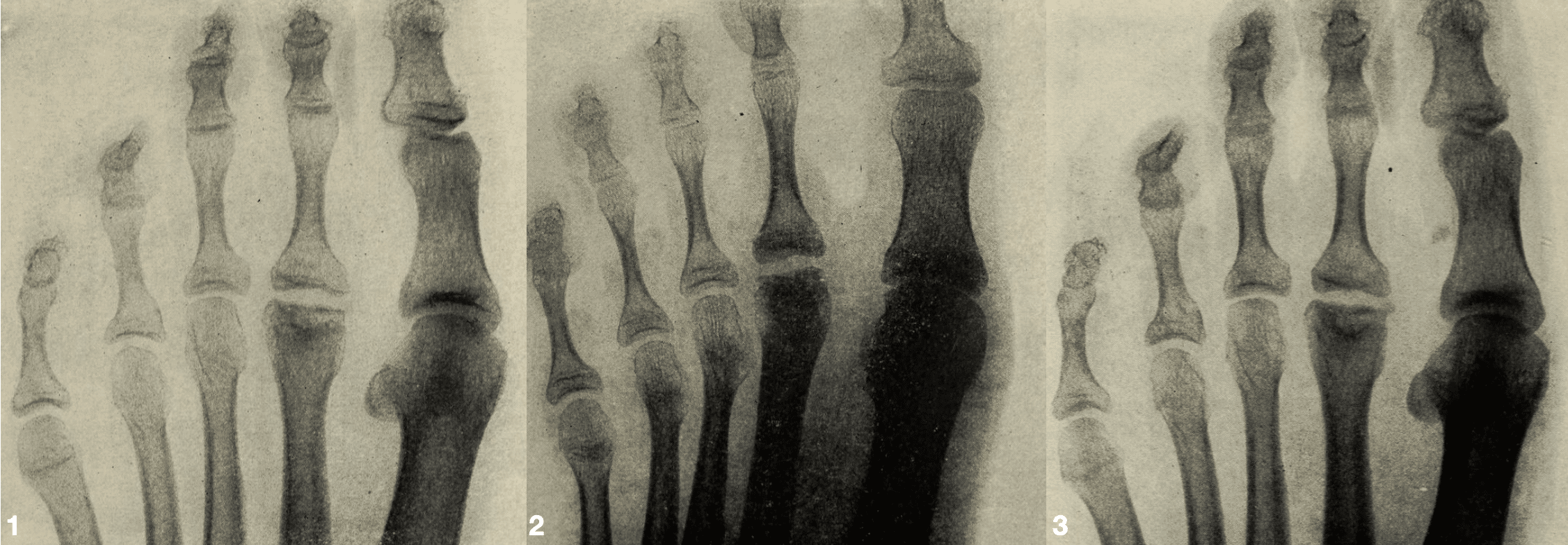
Freiberg infraction (Freiberg disease; Freiberg–Köhler disease; Köhler disease II) is an osteochondrosis of a lesser metatarsal head, most commonly the second, characterised by subchondral osteonecrosis, collapse and progressive deformity of the articular surface.
Freiberg first encountered the disorder in 1903 in a 16-year-old girl with pain beneath the second metatarsal following a tennis injury. He subsequently collected six cases, presented them to the Southern Surgical and Gynecological Association in 1913, and published his description in 1914. Freiberg interpreted the lesion as an “infraction”, or incomplete fracture, of the distal second metatarsal and proposed acute or repetitive trauma as its pathogenesis.
His publication established priority for the entity now predominantly known as Freiberg disease. Alban Köhler (1874–1947) independently described the disorder shortly afterwards and subsequently broadened its radiographic definition. Freiberg revisited the subject in 1926 and accepted that simple trauma alone could not explain the complete syndrome.
I felt justified in the diagnosis of infraction of the distal end of the second metatarsal, a condition which I have thus far failed to find described in the literature.
Freiberg 1914
Major Publications
- Freiberg AH, Schroeder JH. A note on the foot of the American. The American Journal of the Medical Sciences, 1903
- Freiberg AH. Congenital luxation of the ankle. Annals of Surgery, 1903
- Freiberg AH. Preliminary statement regarding the treatment of joint tuberculosis with Marmorek’s serum. 1907
- Freiberg AH. Some of the Ultimate Physical Effects of Premature Toil. Annals of the American Academy of Political and Social Science, 1907; 29: 19-25
- Freiberg AH. Some Effects of Improper Posture in Factory Labor. Annals of the American Academy of Political and Social Science, 1909; 33: 104-110
- Freiberg AH. Infraction of the second metatarsal – a typical injury. Transactions of the Southern Surgical and Gynecological Association 1914;26:171-174. [Freiberg infraction]
- Freiberg AH. The Restoration of Disabled Soldiers to Industrial Service. Proceedings of the Academy of Political Science in the City of New York, Volume 8. 1919
- Freiberg AH. The so-called infraction of the second metatarsal bone. J Bone Joint Surg 1926; 8: 257-61.
References
Biography
- Mostofi SB. Albert H. Freiberg 1868–1940. In: Who’s Who in Orthopedics. Springer, London 2005: 106
- Albert H. Freiberg 1868–1940. The Journal of Bone & Joint Surgery 1940; 22(4): 1104-1105
- Freiberg Family Papers. American Jewish Archives Collection No. 716
Eponymous terms
- Katcherian DA. Treatment of Freiberg’s disease. Orthop Clin North Am. 1994; 25(1): 69-81
- Ashman CJ et al. Forefoot Pain Involving the Metatarsal Region: Differential Diagnosis with MR Imaging. Radiographics. 2001; 21(6): 1425-1440
- Torriani M, Thomas BJ, Bredella MA, Ouellette H. MRI of metatarsal head subchondral fractures in patients with forefoot pain. AJR Am J Roentgenol. 2008; 190(3): 570-5.
- Cerrato RA. Freiberg’s disease. Foot Ankle Clin. 2011; 16(4): 647-58.
- Lin HT, Liu AL. Freiberg’s infraction. BMJ Case Rep. 2013 Jun 18;2013:bcr2013010121
- Talusan PG, Diaz-Collado PJ, Reach JS Jr. Freiberg’s infraction: diagnosis and treatment. Foot Ankle Spec. 2014 Feb;7(1):52-6
- Trnka HJ, Lara JS. Freiberg’s Infraction: Surgical Options. Foot Ankle Clin. 2019 Dec;24(4):669-676
- Inokuchi R, Iwashita K, Jujo Y, Takao M. Freiberg’s disease. BMJ Case Rep. 2019 Oct 10;12(10):e232171
- Cadogan M. Eponymythology of foot injuries. LITFL
Eponym
the person behind the name

BA MA (Oxon) MBChB (Edin) FACEM FFSEM. Emergency physician, Sir Charles Gairdner Hospital. Passion for rugby, medical history, medical education, and asynchronous learning #FOAMed evangelist. Editor-in-Chief and Webmaster of Life in the Fast lane, LITFL | On Call 4e| Eponyms | Books | Horology |
[…] https://litfl.com/albert-henry-freiberg/ […]
[…] https://litfl.com/albert-henry-freiberg/ […]
[…] https://litfl.com/albert-henry-freiberg/ […]