
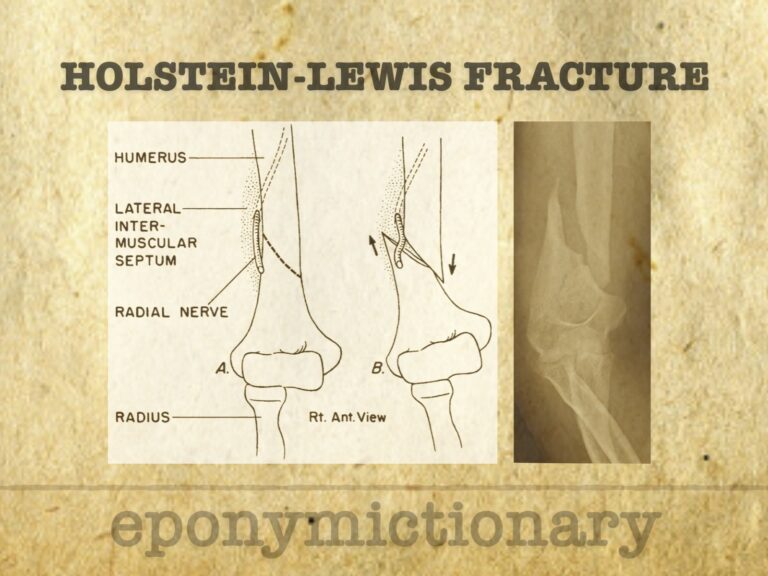
Holstein–Lewis fracture
Holstein–Lewis fracture: simple spiral fracture of the distal third of the shaft of humerus with distal bone fragment displaced and the proximal end deviated toward the radial side

Holstein–Lewis fracture: simple spiral fracture of the distal third of the shaft of humerus with distal bone fragment displaced and the proximal end deviated toward the radial side

Arthur Holstein (1913-2000) was an American Orthopedic Surgeon with Gwilym Lewis described the Holstein–Lewis fracture (1963)

Thromboangiitis obliterans (aka Buerger disease) is a non-atherosclerotic, segmental, inflammatory disease that most commonly affects the small to medium-sized arteries and veins of the upper and lower limbs.

Emergency Procedure: Ocular foreign body removal. Exactly what it says on the tin

Albert Hoffa (1859-1907) was a German orthopedic surgeon. eponymously affiliated with a distal femur fracture (1888); an operation for congenital hip dislocations (1890); the development of a system of massage therapy, the Hoffa system (1893); and the Hoffa fat pad

Leopold Schrötter Ritter von Kristelli (1837-1908) an Austrian internal physician. He is known for his description of effort thrombosis (upper limb DVT) eponymously termed Paget-Shroetter syndrome in 1884.

Michael Antony Denborough (1929 – 2014) was an Australian anaesthetist, academic, activist and medical researcher. First described malignant hyperthermia (Maladie de Denborough)

Irving Freiler Stein (1887-1976) was an American gynaecologist. remembered for his contribution to the field of infertility and eponymously for the Stein–Leventhal Syndrome (1934)
COPD is a chronic respiratory disease with irreversible airflow limitation, often due to smoking, marked by exacerbations needing oxygen and ventilatory support.

Charles Miller Fisher (1913 - 2012) was a Canadian neurologist. Miller Fisher syndrome (1956) an acquired nerve disease variant of Guillain-Barré syndrome.
Visceral artery aneurysm (VAA) and visceral artery pseudoaneurysm (VAPA) are arterial aneurysms affecting the coeliac, superior mesenteric, or inferior mesenteric arteries and their branches.
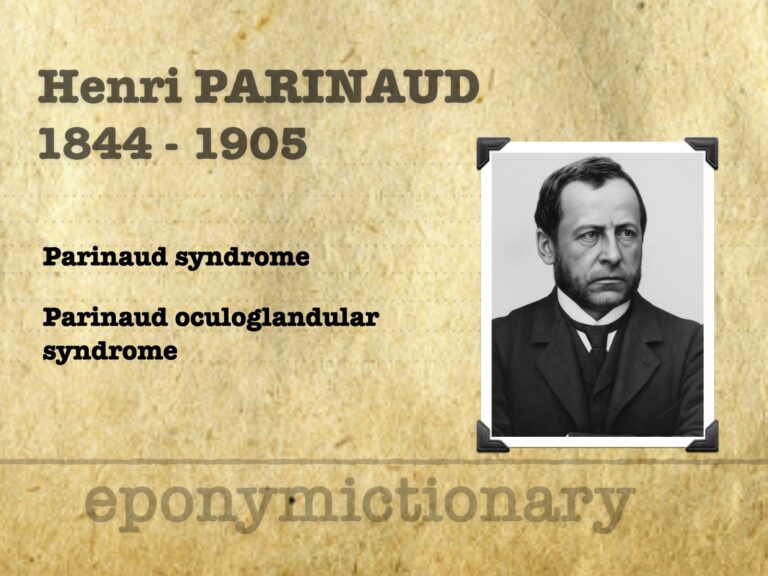
Henri Parinaud (1844-1905) was a French ophthalmologist and neurologist. Parinaud Syndrome (1883) aka Dorsal Midbrain Syndrome