

Hot lips
aka Trauma Tribulation 010
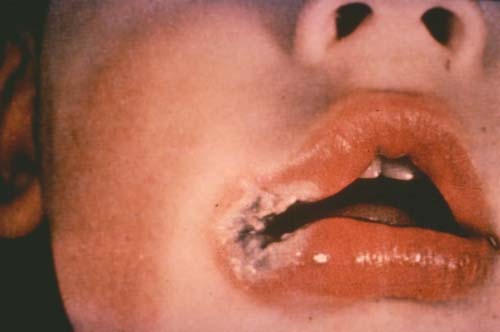
Your next patient is a 2 year-old girl who has sustained a burn. This is what the injury looks like:
Questions
Q1. What is shown and what is the likely mechanism?
Answer and interpretation
An oral commissure burn.
These injuries typically result from biting on an electrical cord (no, not from smoking a cigarette and letting it burn all the way down…). This is one of the most common mechanisms of electrical injury in toddlers, who tend to explore their environment by putting things in their mouths.
Q2. What key complication must be considered?
Answer and interpretation
Delayed labial artery hemorrhage
These burns are often full thickness and are subject to the usual complications of burns. They may be disfiguring and result in microstomia. They are often underestimated. A particularly important complication is the potential for labial artery hemorrhage. This occurs in about 10% of cases, typically about 5 to 21 days after the injury when separation of the maturing eschar occurs.
Q3. Why is a top-to-toe examination of this child important?
Answer and interpretation
Consider the possibility of systemic electrical injury.
- look for an ‘exit’ wound. This may suggest the likely path of current through the body.
- a baseline ECG and cardiac monitoring should be considered if current may have passed through the heart.
- musculoskeletal injuries can result from tetanic contractions (e.g. rhabdomyolysis or fractures)
- assess for neurological injury, deep tissues burns and other organ injuries.
Q4. What is the appropriate disposition of this patient?
Answer and interpretation
Referral to a plastics/ burns surgeon, patients are usually discharged with outpatient follow up.
In the past children were often admitted for observation to ensure that a delayed labial artery bleed would be detected and treated. However, in modern times, the pressure on bed numbers is such that this is infeasible. Parents should be instructed on how to apply bidirectional direct pressure in the event of labial artery hemorrhage. If this occurs urgent plastics/ ENT/ maxillo-facial surgery assessment and management is essential.
Admission may be required for analgesia, nutrition (e.g. nasogastric feeding) or for assessment of possible non-accidental injury or neglect. Definitive treatment options include conservative management with an oral commissure split, early reconstruction or delayed excision of the burn site.
References
- Hoffman KA, Trigger CC. Pediatric Oral Commissure Burn. Clin Pract Cases Emerg Med. 2017 Jan 18;1(1):59-60. doi: 10.5811/cpcem.2016.10.32247. PMID: 29849408; PMCID: PMC5965444.
- Marx JA, Hockberger R, Walls RM. Rosen’s Emergency Medicine: Concepts and Clinical Practice (7th edition), Mosby 2009. [mdconsult.com]
- Suture for a Living. Electrical burns to the mouth.
CLINICAL CASES
Trauma Tribulation

Chris is an Intensivist and ECMO specialist at The Alfred ICU, where he is Deputy Director (Education). He is a Clinical Adjunct Associate Professor at Monash University, the Lead for the Clinician Educator Incubator programme, and a CICM First Part Examiner.
He is an internationally recognised Clinician Educator with a passion for helping clinicians learn and for improving the clinical performance of individuals and collectives. He was one of the founders of the FOAM movement (Free Open-Access Medical education) has been recognised for his contributions to education with awards from ANZICS, ANZAHPE, and ACEM.
His one great achievement is being the father of three amazing children.
On Bluesky, he is @precordialthump.bsky.social and on the site that Elon has screwed up, he is @precordialthump.
| INTENSIVE | RAGE | Resuscitology | SMACC
The answer to question 2 discusses lingual artery hemorrhage, but I think this is incorrect and should say labial artery hemorrhage instead
Thanks for spotting the error – it has now been corrected.
Cheers
Chris