


Spit, Scratch, Splash, Stick
HIV exposures in the ED
A patient spits in your eye. Another scratches a nurse. Blood splashes onto a mucous membrane. Then a hollow-bore needle goes through a glove. All four scenarios prompt the same question “Do I need HIV PEP?“.
The bedside decision comes down to three things: Was the fluid capable of transmitting HIV? Did it reach a susceptible site? and, if both are true, how quickly should PEP start?
This article follows four common ED exposures — spit, scratch, splash and stick — from essentially no HIV risk through to the exposure where minutes matter.
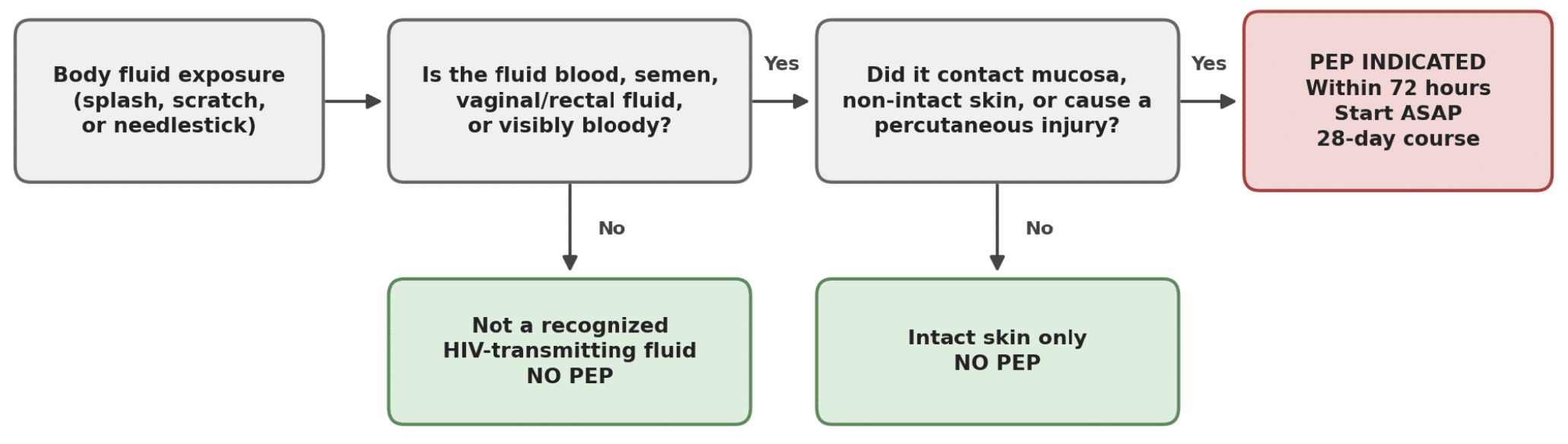
Deciding whether an exposure needs PEP. The fluid type and the route of contact both have to line up before PEP is on the table. Adapted from the 2025 US Public Health Service occupational PEP guidelines and CDC 2025 nPEP recommendations.
Snapshot 1 — Spit
A patient spits directly into a clinician’s eye during an assessment. There is no visible blood in the saliva.
Your immediate instinct may be to think “mucous-membrane exposure”, but the route is only half the equation.
Does this need HIV PEP?
No. Saliva without visible blood is not considered an HIV-transmitting fluid.
What actually transmits HIV?
| Potentially infectious | NOT infectious, unless visibly bloody |
|---|---|
| Blood and any visibly bloody fluid | Saliva, tears, sweat |
| Semen, pre-seminal, vaginal, amniotic and rectal fluids | Urine, faeces, vomitus |
| Cerebrospinal, synovial, pleural, peritoneal and pericardial | Nasal secretions and sputum |
Why it matters
The mucous membrane sounds alarming, but HIV risk requires both an infectious fluid and a portal of entry. Exposure to the wrong fluid is not rescued into significance by an impressive route.
Snapshot 2 — Scratch
During restraint, a patient scratches a nurse’s forearm. The scratch breaks the skin, but there is no visible blood or other infectious body fluid on the fingernails.
Does this need HIV PEP?
Again: No.
Why it matters
Broken skin alone does not create an HIV exposure. There must also be contact with potentially infectious fluid: a scratch from fingernails without blood or other infectious material does not transmit HIV.
Snapshot 3 — Splash
Blood splashes into a clinician’s eye while a line is being inserted in a patient known to have HIV.
Is this a real HIV exposure?
Yes.
How big is the risk?
- Mucous membrane: ~0.09%
- Non-intact skin: lower, but poorly quantified
- Intact skin: no recognised transmission risk
Risk is not the same thing as indication for PEP. A 0.09% average transmission estimate sounds small, but a recognised mucous-membrane exposure to HIV-containing blood is still an exposure for which PEP should be considered/commenced according to current guidance.
What about an undetectable source viral load?
Viral suppression substantially reduces the biological plausibility of transmission, but U=U cannot simply be extrapolated to occupational inoculation. Seek expert advice when deciding whether PEP is required or can be discontinued.
What is U=U?
Undetectable = Untransmittable (U=U) means that a person with HIV who takes antiretroviral therapy and maintains viral suppression does not transmit HIV through sex.
Large studies including HPTN 052, PARTNER, PARTNER2 and Opposites Attract documented no genetically linked sexual transmissions when the partner with HIV was virally suppressed.
But U=U is a sexual-transmission evidence base. It has not been established for occupational needlestick or other parenteral exposures, so an undetectable source viral load should modify the risk assessment rather than automatically exclude PEP.
This exposure enters the PEP pathway. The principles are the same as for the needlestick that follows, where we will work through the management step by step.
Snapshot 4 — Stick
A hollow-bore needle passes through a glove immediately after venepuncture from a patient known to have HIV.
How big is the risk?
~0.3%
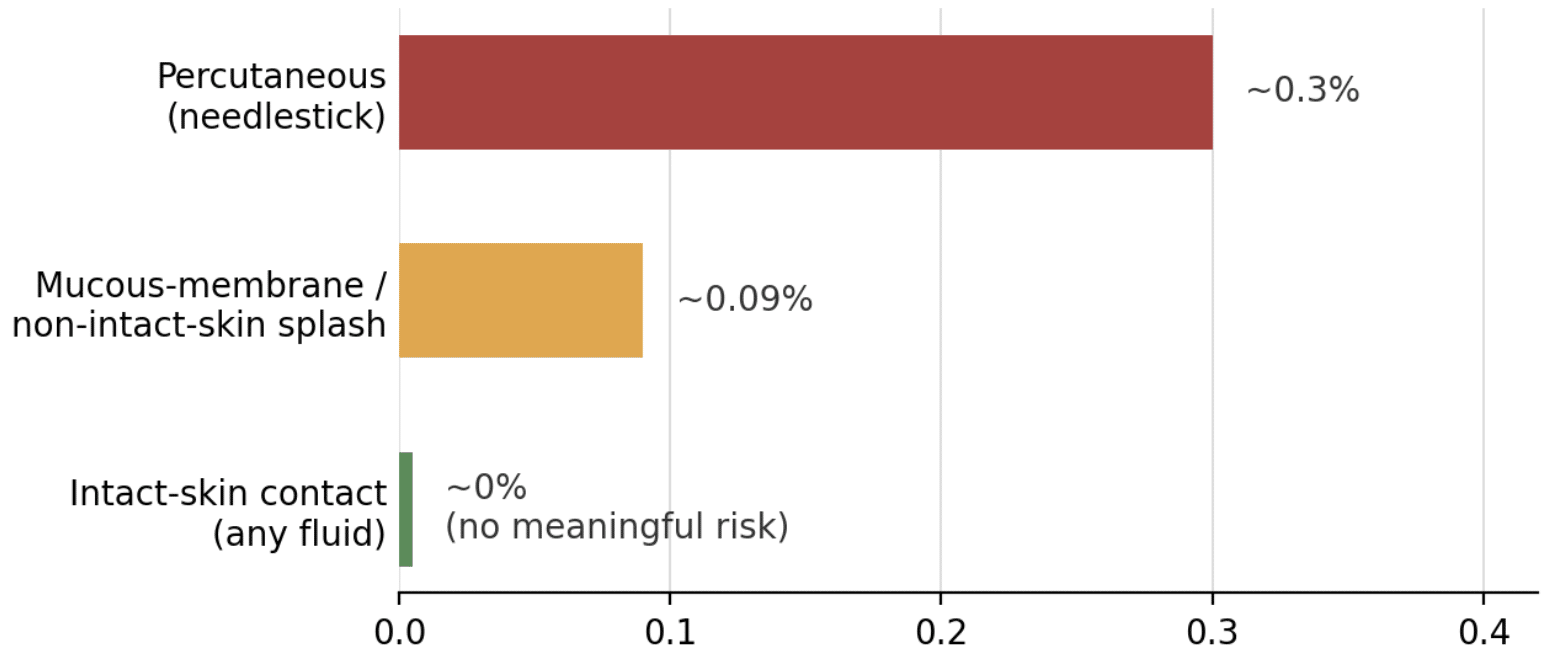
Risk in context
Occupational HIV transmission is now uncommon. US surveillance has documented 58 confirmed occupational infections and approximately 150 possible cases. Only one confirmed case occurred after 1999, following a laboratory needlestick involving live HIV culture.
PEP works. In the classic CDC case-control study, zidovudine use after occupational percutaneous exposure was associated with an approximately 81% reduction in the odds of HIV seroconversion. Contemporary three-drug regimens are preferred because of their greater antiviral potency, tolerability and resistance barrier.
What should you do?
Treat first, clarify the details second.
1. Start treatment
Start PEP as soon as possible. Ideally within hours and no later than 72 hours after the exposure. Do not wait for source-patient testing or baseline laboratory results before giving the first dose.
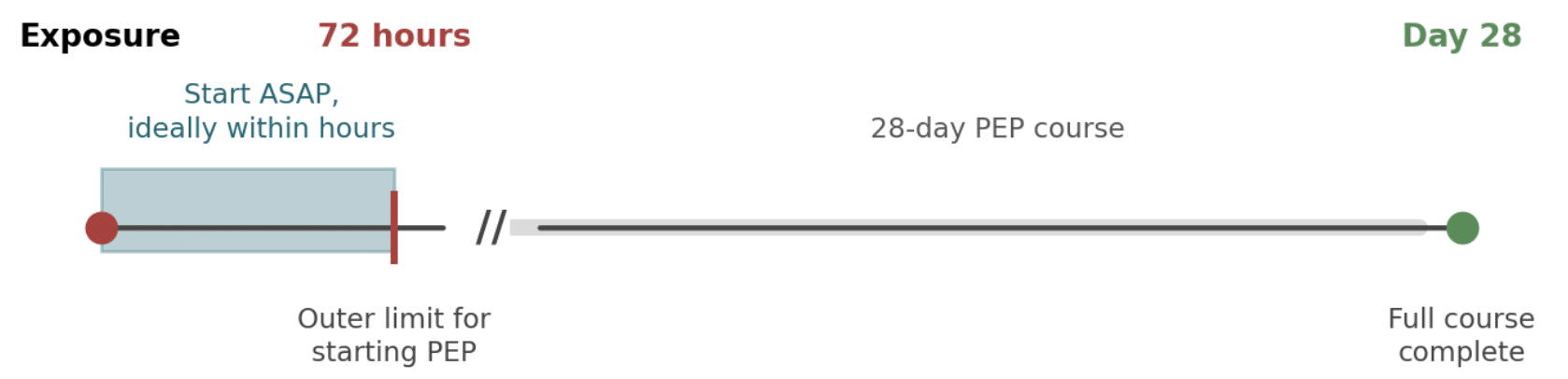
Beyond 72 hours: PEP is generally not recommended routinely, but seek expert advice when the exposure is substantial or circumstances are unusual.
For most adults and adolescents, contemporary PEP uses a three-drug integrase inhibitor-based regimen for 28 days.
Choosing a PEP regimen
Integrase inhibitor-based regimens
- Bictegravir/emtricitabine/tenofovir alafenamide: one tablet, once daily, with or without food.
- Dolutegravir plus (tenofovir alafenamide or tenofovir disoproxil fumarate) plus (emtricitabine or lamivudine).
Alternative regimens
- Boosted darunavir (with cobicistat or ritonavir) plus two NRTIs, when an integrase inhibitor-based regimen is not available.
- Raltegravir plus emtricitabine/tenofovir remains effective if neither of the above can be given.
2. Test the source and the exposed clinician
Source
- Establish HIV status, treatment history and viral load where available.
- Source testing should proceed urgently, but it should not delay PEP.
- If the source is subsequently confirmed HIV-negative, PEP can be stopped.
Exposed healthcare worker
- Obtain baseline HIV Ag/Ab testing, renal and liver function and pregnancy testing where relevant.
- Baseline results help determine whether the preferred regimen remains appropriate, but again should not delay the first dose.
3. Decide whether anything changes the pathway
a. Undetectable viral load. A source with sustained viral suppression requires a more nuanced assessment. Seek expert advice rather than extrapolating U=U directly to occupational inoculation.
b. Renal/hepatic impairment. Tenofovir-containing regimens (TDF in particular) require dose adjustment or avoidance in significant renal impairment. Boosted PI regimens undergo hepatic metabolism and warrant caution in hepatic dysfunction. When either is present, involve a pharmacist or HIV specialist to select and dose an alternative regimen.
c. Pregnancy/breastfeeding. Treat the same as any other exposed worker. Do not withhold or delay PEP. Involve an HIV specialist at initiation, since guidelines name pregnancy and breastfeeding among the scenarios warranting consultation. Cobicistat-boosted regimens have reduced drug levels in pregnancy and are not preferred. For a breastfeeding worker, counseling should support shared decision-making about continuing versus interrupting breastfeeding while on PEP.
PEP pearl: Bictegravir and other INSTIs bind polyvalent cations. Separate from aluminum/magnesium antacids (2 hours before or 6 hours after), and take with food when given alongside calcium or iron. A well-meant antacid can drop drug levels
d. Existing PrEP. If the exposed healthcare worker is already taking PrEP, establish the regimen and adherence. Expert advice may be appropriate to determine whether additional PEP is required.
Need help?
The US National Clinician Consultation Center PEPline (1-888-448-4911) provides expert occupational PEP advice. If consultation is not immediately available, do not delay indicated PEP while waiting for specialist advice.
4. Complete the course
If PEP remains indicated, complete the 28-day course. Compliance matters as missed doses or delayed initiation may alter subsequent follow-up testing.
5. Arrange follow-up
Additional testing at 4–6 weeks is recommended for personnel who began PEP more than 24 hours after exposure or who missed doses.
Final testing consists of HIV Ag/Ab plus nucleic acid testing at 12 weeks after exposure.
Routine repeat renal and hepatic testing is unnecessary in a patient tolerating treatment with normal baseline results. Repeat creatinine, AST, and ALT testing is driven by abnormal baseline values or symptoms.
HIV exposure assessment is not about whether an event looks frightening. It is about whether an infectious fluid reached a susceptible site. Spit and scratches generate anxiety but usually no HIV risk. Blood to a mucous membrane or through a needle changes the equation. Once PEP is indicated, speed matters.
CONCLUSION
Spit, scratch, splash and stick may provoke very different levels of anxiety, but the assessment is the same: Was the fluid capable of transmitting HIV, and did it reach a susceptible site?
If both are true, assess the source and start indicated PEP promptly rather than waiting for perfect information.
This article accompanies the HIV in Primary Care course by Dakota Price, MD. For a fuller approach to screening, diagnosis, staging and management of HIV.
References
HIV specific clinical cases
- Price D. The Mono That Wasn’t. LITFL
- Price D. Spit, Scratch, Splash, Stick. LITFL
Guidelines and recommendations
- Kofman AD, Struble KA, Heneine W, et al. 2025 US Public Health Service Guidelines for the Management of Occupational Exposures to Human Immunodeficiency Virus and Recommendations for Post-exposure Prophylaxis in Healthcare Settings. Infect Control Hosp Epidemiol. 2025;46(9):863-873.
- Tanner MR, O’Shea JG, Byrd KM, Johnston M, Dumitru GG, Le JN, Lale A, Byrd KK, Cholli P, Kamitani E, Zhu W, Hoover KW, Kourtis AP. Antiretroviral Postexposure Prophylaxis After Sexual, Injection Drug Use, or Other Nonoccupational Exposure to HIV – CDC Recommendations, United States, 2025. MMWR Recomm Rep. 2025 May 8;74(1):1-56.
- Kuhar DT, Henderson DK, Struble KA, Heneine W, Thomas V, Cheever LW, Gomaa A, Panlilio AL; US Public Health Service Working Group. Updated US Public Health Service guidelines for the management of occupational exposures to human immunodeficiency virus and recommendations for postexposure prophylaxis. Infect Control Hosp Epidemiol. 2013 Sep;34(9):875-92 [Source of the 0.09% mucous-membrane transmission estimate]
Key papers and surveillance
- Cardo DM, Culver DH, Ciesielski CA, Srivastava PU, Marcus R, Abiteboul D, Heptonstall J, Ippolito G, Lot F, McKibben PS, Bell DM. A case-control study of HIV seroconversion in health care workers after percutaneous exposure. Centers for Disease Control and Prevention Needlestick Surveillance Group. N Engl J Med. 1997 Nov 20;337(21):1485-90.
- Joyce MP, Kuhar D, Brooks JT. Notes from the field: occupationally acquired HIV infection among health care workers – United States, 1985-2013. MMWR Morb Mortal Wkly Rep. 2015 Jan 9;63(53):1245-6.
- Eisinger RW, Dieffenbach CW, Fauci AS. HIV Viral Load and Transmissibility of HIV Infection: Undetectable Equals Untransmittable. JAMA. 2019 Feb 5;321(5):451-452.
Clinical resources
- National Clinician Consultation Center. PEPline: 1-888-448-4911. (accessed 2026).
- CDC. HIV Occupational Transmission: confirmed and possible cases among US healthcare personnel. (accessed 2026)
- New York State Department of Health AIDS Institute. U=U Guidance for Implementation in Clinical Settings. hivguidelines.org (accessed 2026)

CLINICAL CASES
Microbial Mystery

Dakota Price MD is a Family Medicine Faculty Physician and Family Medicine Residency Clinical Director of HIV Care for Cahaba Medical Care and the University of Alabama at Birmingham. He is also the Project Director for the HIV Clinical Training Tracks in Primary Care Residency Programs for the AETC Program, which provides clinical training and support. He has dedicated his career to bridging the gap in primary care for individuals living with HIV. | HIV Medmastery Course |