


The Mono That Wasn’t
Recognising HIV one ED visit at a time
By the time HIV is diagnosed, the patient may already have passed through the emergency department more than once. The median interval between acquiring HIV and diagnosis is around three years, and roughly 1 in 8 people with HIV in the US do not yet know they have it. Those years are often filled with healthcare encounters for something else.
This article follows one patient across three ED visits, each representing a different point in untreated HIV infection: acute infection, chronic HIV and advanced disease.
Each stage changes what we should recognise, what we should test and how we should interpret the result.
The figure below shows the trajectory: CD4 count falls and HIV RNA changes across acute infection, chronic infection and advanced disease. The three ED presentations that follow are snapshots along that same course.
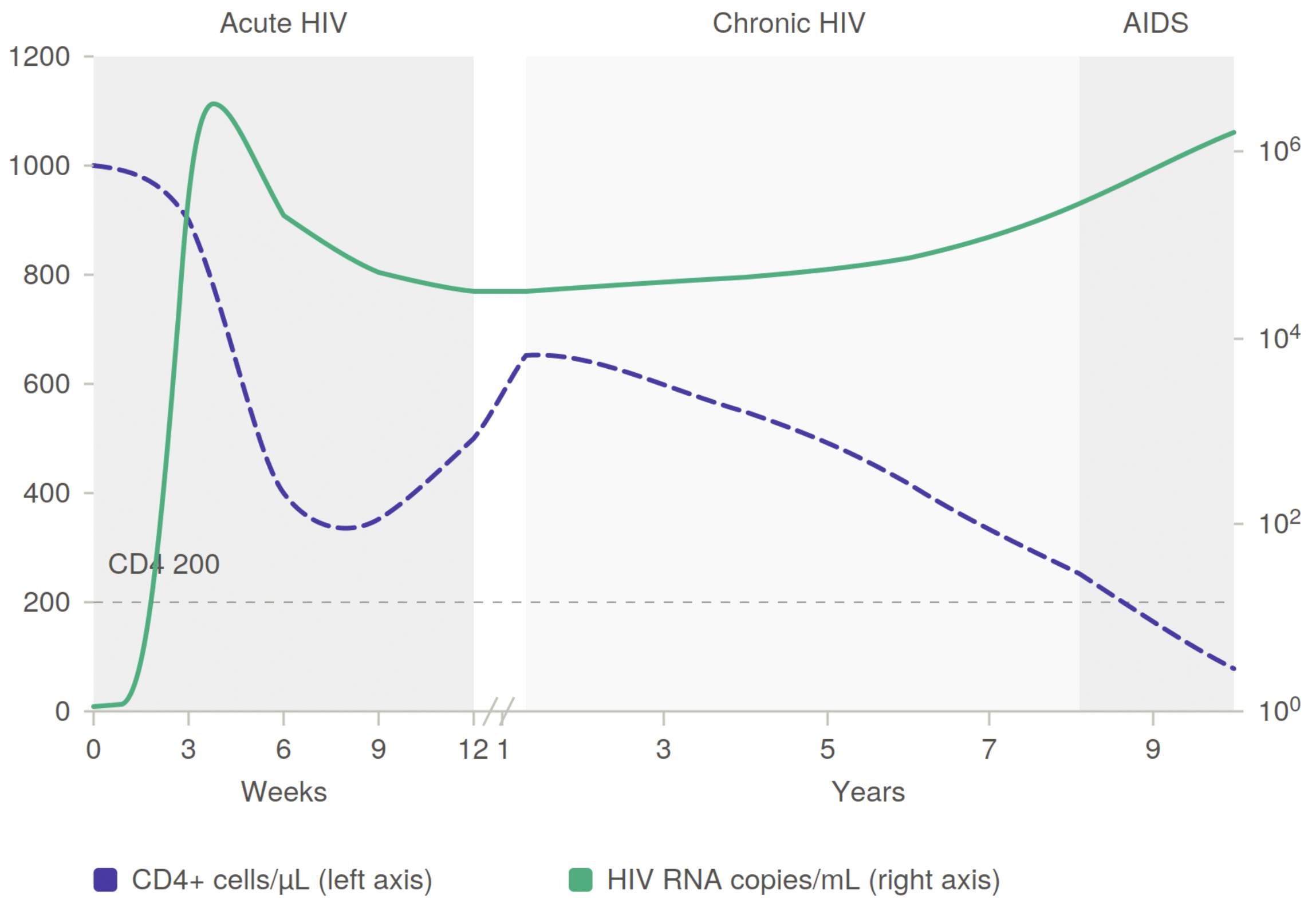
Natural history of untreated HIV. The CD4+ count (purple, left axis) falls as HIV RNA (teal, right axis) rises across the acute, chronic, and AIDS stages. Note the axis break: the acute phase is measured in weeks, the rest in years. Curves are schematic and not drawn to scale. Concept adapted from Fauci AS et al 1996
Snapshot 1 — Acute HIV
A young adult presents three weeks after a new sexual partner with fever, sore throat and rash. The Monospot is negative and the presentation is labelled another viral illness. Most of the time, that diagnosis will be correct. Sometimes, however, this is acute HIV — the period when viraemia and transmissibility are at their highest.
What should you do?
Think of it, then establish whether the exposure history supports it. Acute retroviral syndrome appears roughly 2 to 4 weeks after acquisition; fever, pharyngitis, lymphadenopathy, maculopapular rash, and mucocutaneous ulcers are the most discriminating features. But the syndrome is nonspecific, so what pushes acute HIV up the differential is a non-judgmental sexual and injection-drug history. The exposure history is often what separates “another viral illness” from “test for acute HIV today.”
Know when routine screening can miss acute HIV. The HIV Ag/Ab immunoassay detects both the p24 antigen and HIV antibodies, and the diagnostic markers become detectable in a predictable sequence after acquisition:
- ~Day 10: HIV RNA becomes detectable. It is not measured by the routine Ag/Ab screening assay.
- ~2 weeks: p24 antigen becomes detectable and may trigger the antigen component of the assay.
- ~3 weeks: HIV antibodies begin to appear.
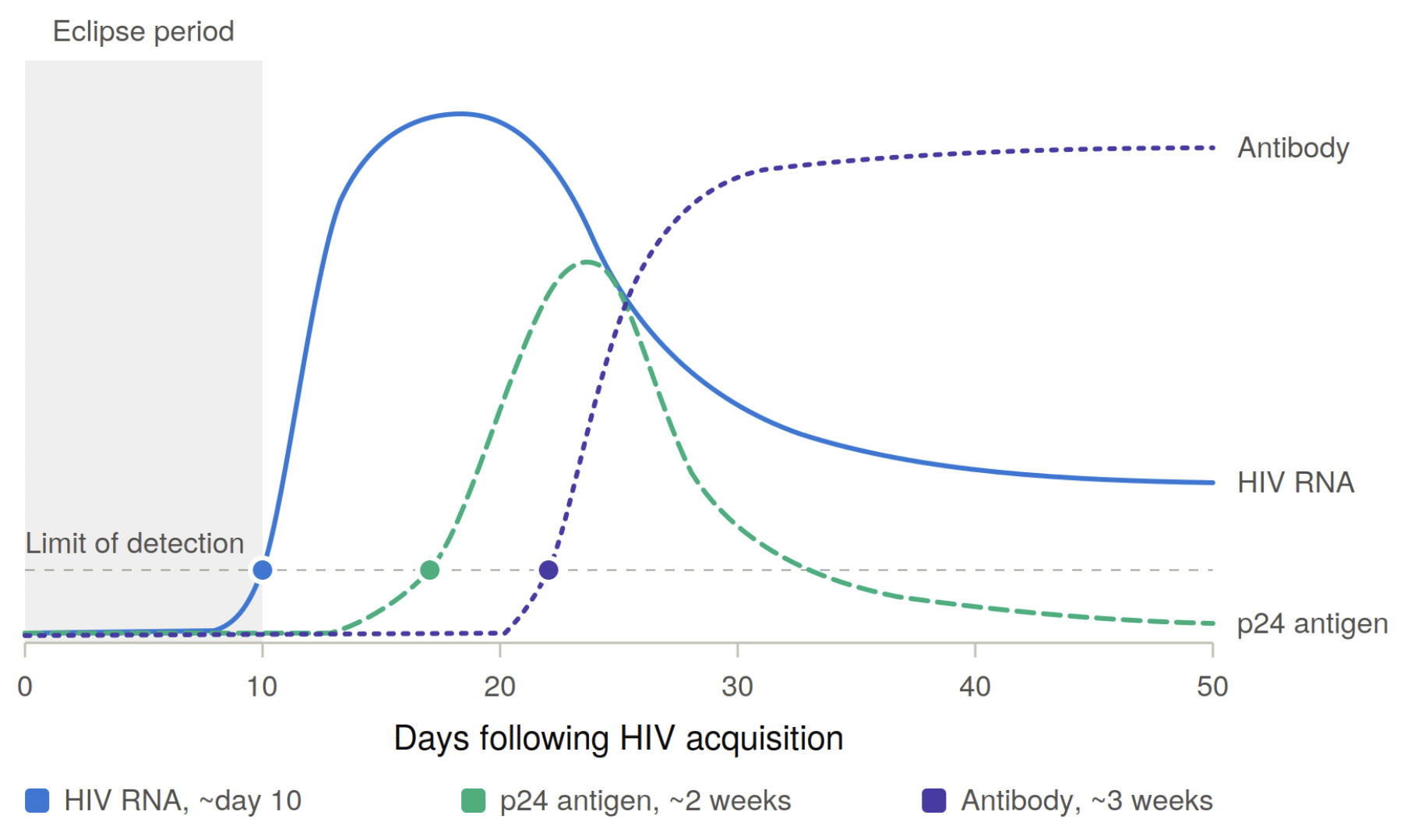
Timing of HIV marker detectability after acquisition. These are population medians with considerable individual variation. Curves are qualitative and not drawn to scale. Adapted from Fiebig EW et al. 2003
Do not let a negative screen close a high-suspicion presentation. If the exposure history is compelling and acute HIV remains in the differential, a non-reactive Ag/Ab test may simply be too early. Send HIV RNA (NAT) at the same visit and ensure there is a defined pathway for result follow-up, or arrange repeat testing when appropriate.
Why it matters. Acute HIV is a hyperviraemic state, with viral loads that may reach millions of copies/mL and high potential for onward transmission. Early diagnosis allows prompt treatment, rapid viral suppression and preservation of immune function.
POC pearl: A point-of-care HIV test should not reassure you when acute HIV is strongly suspected. Many rapid tests are antibody-only, and even rapid fourth-generation assays are less reliable during very early infection. Send a laboratory Ag/Ab assay and consider HIV RNA rather than relying on POC testing alone
Snapshot 2 — Chronic HIV / clinical latency
The well patient, two years later. Same patient, feeling fine, in for an ankle sprain. Clinical latency is often asymptomatic, frequently years long, and invisible unless someone tests.
This is the opportunity cost of the missed first visit. Every ED contact during clinical latency is another screening opportunity.
Routine screening should not depend on perceived risk. US guidance recommends that adolescents and adults undergo HIV screening at least once, independent of recognised risk factors. An ED visit is therefore an opportunity to offer screening to an eligible patient who has not previously been tested.
Use an opt-out approach where supported by local policy. Present HIV screening as part of routine care and inform patients that testing will be performed unless they decline. Normalising testing improves uptake and reduces the stigma created by selectively identifying patients as “high risk.”
A reactive screen is the beginning of the diagnostic algorithm, not the diagnosis.
The next step depends on the HIV-1/HIV-2 differentiation assay, with HIV RNA resolving a negative or indeterminate differentiation result.
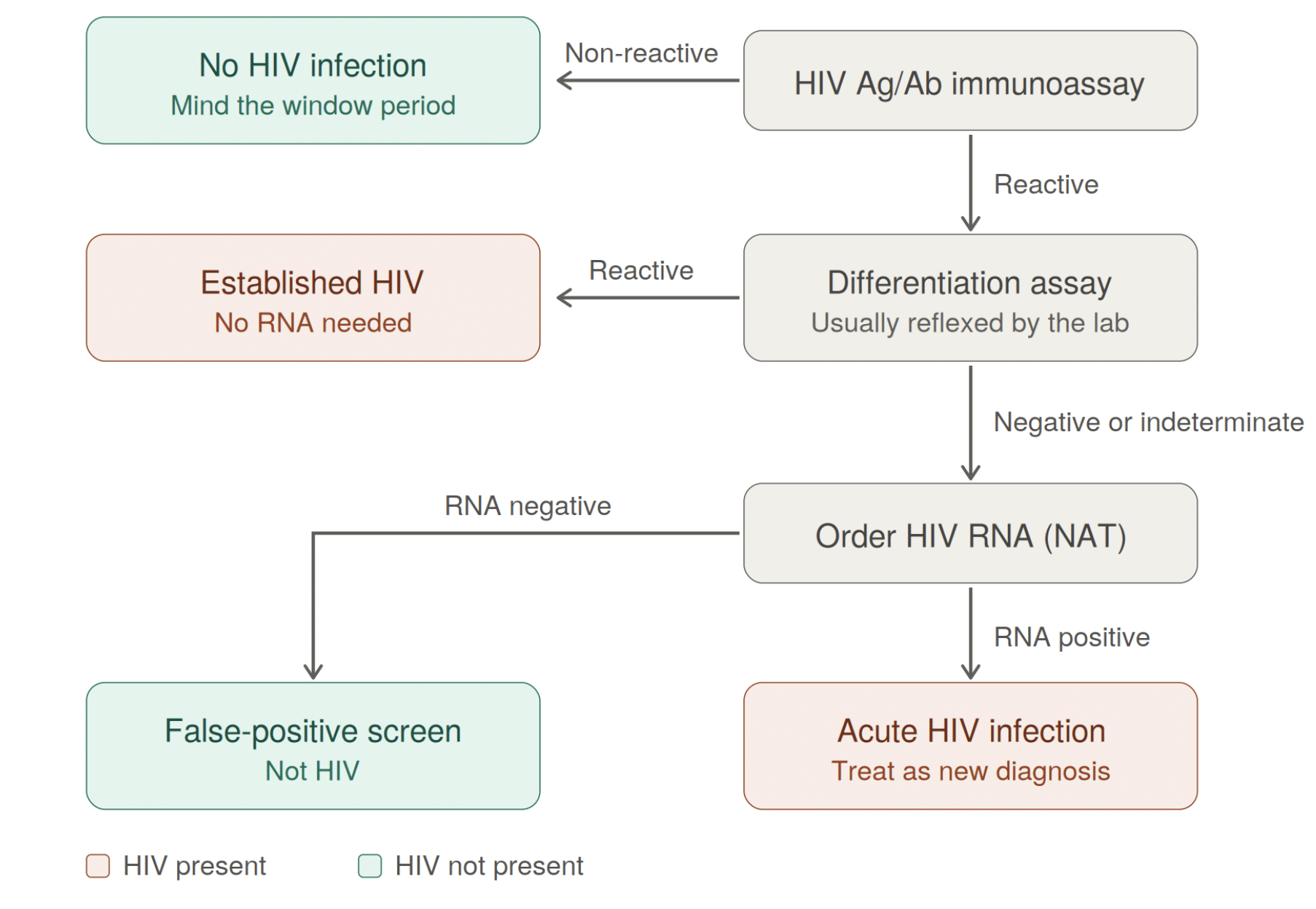
Interpreting the HIV screening result. Adapted from the CDC/APHL recommended laboratory HIV testing algorithm for serum or plasma specimens (2018 quick reference guide).
HIV-2 is uncommon outside epidemiologically linked populations, but is the reason the confirmatory assay differentiates HIV-1 from HIV-2.
Snapshot 3 — Advanced HIV disease
Same patient, now presenting with several weeks of progressive exertional dyspnoea, dry cough and fever. Pulse oximetry demonstrates hypoxaemia with further desaturation on exertion. The chest radiograph shows subtle bilateral perihilar interstitial opacities — relatively unimpressive imaging for the degree of physiological disturbance. In a patient at risk for advanced HIV, that discordance should immediately raise concern for Pneumocystis jirovecii pneumonia (PJP).
An AIDS-defining opportunistic infection establishes advanced disease regardless of the CD4 count. In a patient with confirmed HIV, the opportunistic infection in front of you is itself the staging event.
The discordance is the clue. Marked hypoxaemia with relatively modest chest-radiograph abnormalities should raise concern for PJP in the appropriate clinical context. Let the physiology, not the apparent severity of the radiograph, drive disposition.
PJP may not be the only problem. A patient this advanced warrants a broader opportunistic infection workup. Confirm HIV if not already established and early involve the admitting or ID team early. This presentation warrants admission.
The through-line: This is the visit everyone remembers, and the one the first two snapshots were trying to prevent. Every earlier ED encounter was an opportunity to diagnose HIV before advanced disease developed.
CONCLUSION
The three stages of HIV can appear in the ED as three very different presentations in the same person: acute retroviral syndrome, clinically silent chronic infection and advanced disease. The earlier the diagnosis, the greater the opportunity to preserve immune function, suppress viraemia and prevent onward transmission.
Routine opt-out Ag/Ab screening identifies otherwise silent chronic infection. Maintaining a low threshold for HIV RNA when acute infection is suspected helps close the diagnostic window before routine screening becomes reliably positive.
The aim is simple. Make the diagnosis at Snapshot 1 or 2, so Snapshot 3 never happens.
This article accompanies the HIV in Primary Care course by Dakota Price, MD. For a fuller approach to screening, diagnosis and staging, see the Screening and diagnosis chapter, including the lessons Understanding the results and Reviewing the stages of HIV.
References
HIV specific clinical cases
- Price D. The Mono That Wasn’t. LITFL
- Price D. Spit, Scratch, Splash, Stick. LITFL
Guidelines and algorithms
- Centers for Disease Control and Prevention, Association of Public Health Laboratories. 2018 Quick Reference Guide: Recommended Laboratory HIV Testing Algorithm for Serum or Plasma Specimens. Published January 27, 2018.
- Branson BM, Handsfield HH, Lampe MA, Janssen RS, Taylor AW, Lyss SB, Clark JE; Centers for Disease Control and Prevention (CDC). Revised recommendations for HIV testing of adults, adolescents, and pregnant women in health-care settings. MMWR Recomm Rep. 2006 Sep 22;55(RR-14):1-17; quiz CE1-4.
- US Preventive Services Task Force; Owens DK, Davidson KW, Krist AH, Barry MJ, Cabana M, Caughey AB, Curry SJ, Doubeni CA, Epling JW Jr, Kubik M, Landefeld CS, Mangione CM, Pbert L, Silverstein M, Simon MA, Tseng CW, Wong JB. Screening for HIV Infection: US Preventive Services Task Force Recommendation Statement. JAMA. 2019 Jun 18;321(23):2326-2336.
- Guidelines for the Use of Antiretroviral Agents in Adults and Adolescents With HIV clinicalinfo.hiv.gov (accessed 2026).
- Guidelines for the Prevention and Treatment of Opportunistic Infections in Adults and Adolescents With HIV clinicalinfo.hiv.gov (accessed 2026).
Key papers and surveillance
- Fauci AS, Pantaleo G, Stanley S, Weissman D. Immunopathogenic mechanisms of HIV infection. Ann Intern Med. 1996 Apr 1;124(7):654-63.
- Fiebig EW, Wright DJ, Rawal BD, Garrett PE, Schumacher RT, Peddada L, Heldebrant C, Smith R, Conrad A, Kleinman SH, Busch MP. Dynamics of HIV viremia and antibody seroconversion in plasma donors: implications for diagnosis and staging of primary HIV infection. AIDS. 2003 Sep 5;17(13):1871-9.
- Cohen MS, Shaw GM, McMichael AJ, Haynes BF. Acute HIV-1 Infection. N Engl J Med. 2011 May 19;364(20):1943-54.
- Dailey AF, Hoots BE, Hall HI, Song R, Hayes D, Fulton P Jr, Prejean J, Hernandez AL, Koenig LJ, Valleroy LA. Vital Signs: Human Immunodeficiency Virus Testing and Diagnosis Delays – United States. MMWR Morb Mortal Wkly Rep. 2017 Dec 1;66(47):1300-1306.
- Li Z, Purcell DW, Sansom SL, Hayes D, Hall HI. Vital Signs: HIV Transmission Along the Continuum of Care – United States, 2016. MMWR Morb Mortal Wkly Rep. 2019 Mar 22;68(11):267-272.
- Centers for Disease Control and Prevention. Estimated HIV Incidence and Prevalence in the United States, 2018–2022. HIV Surveillance Supplemental Report. 2024;29(No. 1).
- Tan WS, Chow EP, Fairley CK, Chen MY, Bradshaw CS, Read TR. Sensitivity of HIV rapid tests compared with fourth-generation enzyme immunoassays or HIV RNA tests. AIDS. 2016 Jul 31;30(12):1951-60.

CLINICAL CASES
Microbial Mystery

Dakota Price MD is a Family Medicine Faculty Physician and Family Medicine Residency Clinical Director of HIV Care for Cahaba Medical Care and the University of Alabama at Birmingham. He is also the Project Director for the HIV Clinical Training Tracks in Primary Care Residency Programs for the AETC Program, which provides clinical training and support. He has dedicated his career to bridging the gap in primary care for individuals living with HIV. | HIV Medmastery Course |