

William Gowers
Sir William Richard Gowers (1845 - 1915) was an English neurologist. Gowers sign (1879). Esteemed author of Manual of the Diseases of the Nervous System

Sir William Richard Gowers (1845 - 1915) was an English neurologist. Gowers sign (1879). Esteemed author of Manual of the Diseases of the Nervous System

Klippel-Trenaunay syndrome (KTS) is a rare congenital cutaneous vascular malformation syndrome. Three classic signs of localised cutaneous capillary malformations, venous abnormalities, and limb hypertrophy
Weber-Cockayne syndrome: a mild, localised form of epidermolysis bullosa simplex, causing recurrent blistering of the palms and soles due to KRT5 or KRT14 mutations.

Peutz-Jeghers-syndrome: A Syndrome gastrointestinal polyposis characterized by specific melanin pigmentations of the skin and mucous membranes

Johannes Peutz (1886–1957), Dutch internist, first described Peutz-Jeghers syndrome in 1921; pioneer of clinical diagnostics in The Hague.

Harold Jeghers (1904–1990), US internist, co-described Peutz-Jeghers syndrome in 1949; pioneer educator and founder of the Jeghers Medical Index
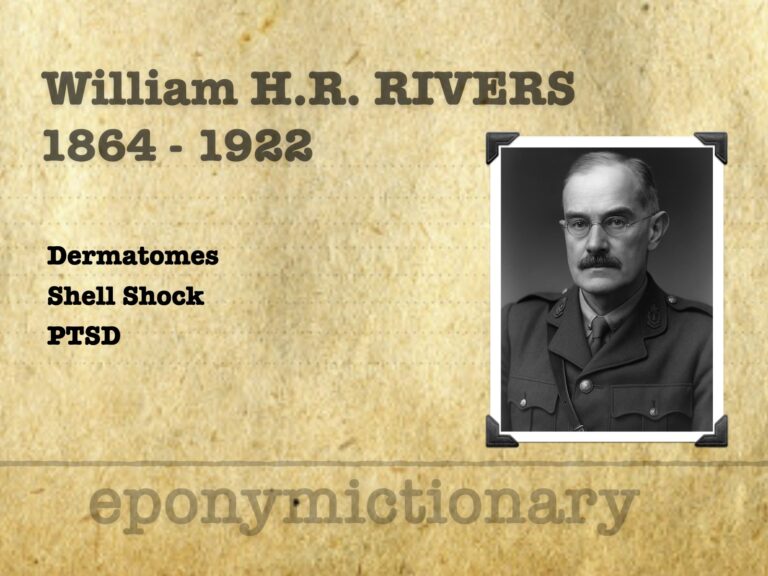
William Halse Rivers Rivers (1864–1922): neurologist, anthropologist, WWI shell shock pioneer, dermatomes co-mapper, protopathic/epicritic sensation theorist

Hans Chiari (1851-1916) was an Austrian pathologist. Eponymously affiliated with the Chiari malformation; Type II Chiari malformation (Arnold–Chiari malformation) and Budd–Chiari syndrome
Emergency procedure, instructions and discussion: Radial Arterial Line, with a guide made in partnership with a recent publication in Emergency medicine Australasia
Sturge-Weber syndrome (SWS) is a rare, congenital neurocutaneous disorder characterised by capillary-venous malformations involving the skin, leptomeninges, and ocular structures.
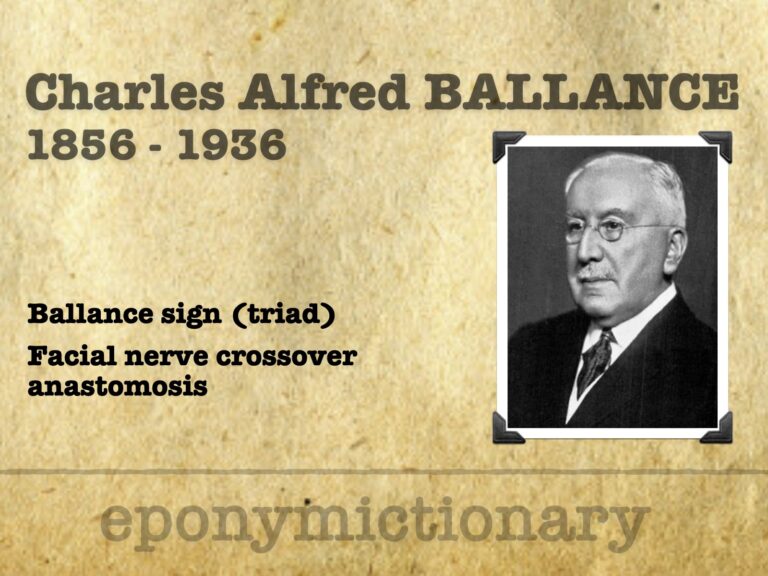
Sir Charles Ballance (1856–1936), pioneer of neurosurgery and otology, first performed facial nerve crossover anastomosis in 1895—an enduring milestone.
Emergency Procedure: Radial Arterial Line, with a guide made in partnership with a recent publication in Emergency medicine Australasia