


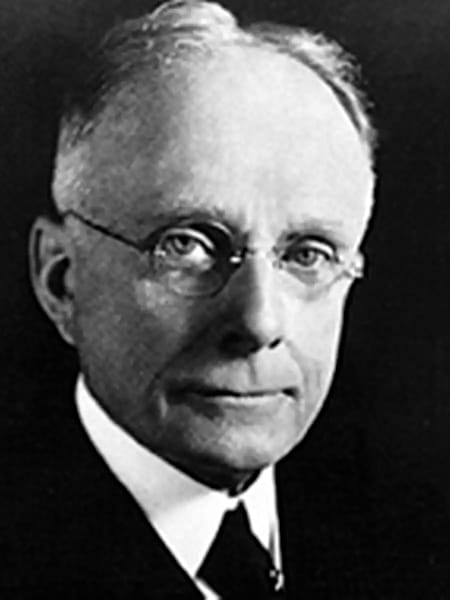
Chevalier Quixote Jackson (1865-1958) was an American laryngologist, endoscopist and surgeon
Jackson helped transform peroral endoscopy from a hazardous experimental technique into a clinical discipline. He developed and refined instruments for oesophagoscopy, bronchoscopy and direct laryngoscopy. Jackson established safer techniques for foreign-body extraction and standardised approaches to tracheotomy. During his career he treated more than 2,000 patients with inhaled or swallowed foreign bodies and became ant influential advocate for broncho-oesophagology.
Jackson combined direct vision, illumination, instrument design, patient positioning, procedural technique and structured training into a system that could be taught. A prolific writer, he produced more than 700 articles and 12 textbooks during his career he made contributions to laryngeal surgery, oesophageal disease, caustic-injury prevention and public health.
Biographical Timeline
- Born November 4, 1865 in Pittsburgh, Pennsylvania, the son of William Stanford Jackson and Katherine Ann Morange Jackson.
- 1879–1883 – Studied at Western University of Pennsylvania, later the University of Pittsburgh.
- 1886 – Graduated MD from Jefferson Medical College, Philadelphia.
- 1886–1887 – Travelled to Europe and observed laryngological practice, including work with Sir Sir Morell Mackenzie (1837-1892) in London. Returned to Pittsburgh and began practice specialising in laryngology.
- 1900–1912 – Appointed to the chair of Laryngology at Western Pennsylvania Medical College; formally elected Professor of Laryngology at the University of Pittsburgh in 1912.
- 1911–1913 – Diagnosed with pulmonary tuberculosis and later suffered a pulmonary haemorrhage. Recurrent illness forced periods of reduced clinical activity, although Jackson continued writing, teaching and instrument development.
- 1913 – Founding member and inaugural governor of the American College of Surgeons.
- 1916 – Moved to Philadelphia as Professor of Laryngology at Jefferson Medical College and established a new bronchoscopic clinic.
- 1919 – Appointed to the newly created Chair of Bronchoscopy and Esophagoscopy at the University of Pennsylvania Graduate School of Medicine.
- 1927 – His prolonged campaign against childhood caustic ingestion culminated in passage of the Federal Caustic Poison Act. Appointed Chevalier of the French Légion d’Honneur and of the Belgian Order of Leopold.
- 1935–1941 – President of Woman’s Medical College of Pennsylvania.
- 1938 – Published The Life of Chevalier Jackson: An Autobiography.
- Died August 16, 1958 in Philadelphia, aged 92.
Medical Eponyms
Jackson laryngoscope
The Jackson laryngoscope was developed from earlier direct-laryngoscopic designs. Jackson modelled his laryngoscope from earlier such as the autoscope of Alfred Kirstein and the split tubular spatula of Gustav Killian. Jackson’s design used a separable blade that allowed a bronchoscope or other tube to be passed through the exposed glottis before the laryngoscope was separated and removed.
1907 – Jackson published and illustrated the instrument as his “separable speculum for passing bronchoscopes” in Tracheo-Bronchoscopy, Esophagoscopy and Gastroscopy. He described a split spatula based on Killian’s device but separating in the opposite direction to reduce trauma to the mucosa. Illuminated and non-illuminated versions were available.
1913 – Jackson demonstrated the laryngoscope as an instrument for directly visualised tracheal intubation in his description of the insertion of intratracheal insufflation tubes. The larynx was exposed with the laryngoscope and the tube passed under direct vision through the vocal cords.
1915 – In Peroral Endoscopy and Laryngeal Surgery, Jackson stated that the ‘laryngeal speculum or direct laryngoscope was devised by the author in 1903‘. He noted that it had been variously termed the laryngeal speculum, slide speculum and direct laryngoscope, but preferred the increasingly standard term laryngoscope.
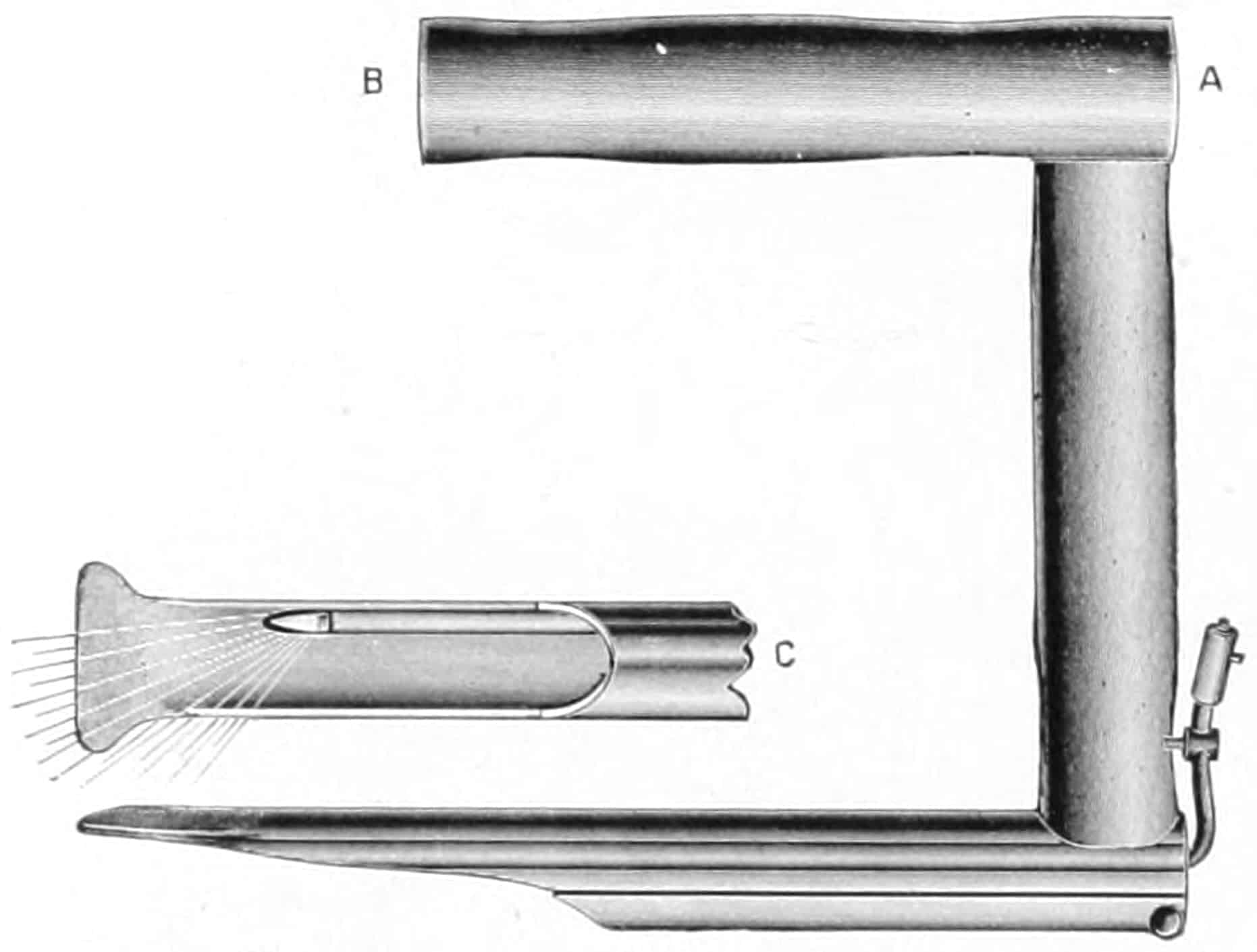
Jackson did not invent direct laryngoscopy, but developed a practical direct laryngoscope designed for both laryngeal exposure and the passage of bronchoscopes and tracheal tubes under direct vision.
Jackson sign [asthmatoid wheeze] (1918)
Asthmatoid wheeze, is a dry wheezing sound associated with a partially obstructing foreign body in the trachea or bronchus. It is heard by auscultation at the open mouth, usually during expiration and often most clearly during prolonged forced expiration. The term Jackson sign was applied later as an eponymous designation.
1917–1918 – Jackson presented A new diagnostic sign of foreign body in the trachea or bronchi, the “asthmatoid wheeze” to the American Academy of Ophthalmology and Oto-Laryngology on October 29, 1917 and published in November 1918.
Jackson recorded the presence or absence of the sign in 62 confirmed foreign-body cases. The asthmatoid wheeze was present in 41 and absent in 21. He described a characteristically dry wheeze, heard at the open mouth and often accentuated after coughing had cleared secretions.
The sign was most prominent during forced and prolonged expiration. Jackson considered a positive finding more useful than its absence and noted that smooth, rounded foreign bodies tightly occluding a bronchus might produce no wheeze because insufficient air could pass around them. He proposed that the sound resulted from air passing through narrowed, irregular spaces between the foreign body and bronchial wall.
1928 – In Wheezing Respiration in Children: Bronchoscopic Observations on Stridulous and Asthmatoid Breathing, Jackson cautioned against diagnosing asthma before excluding mechanical causes of wheeze. He introduced the dictum:
“All is not asthma that wheezes” is an aphorism that I think should be inculcated into every medical student so that in his after life he would be on the alert for the causes of wheezing that not only are often serious and fatal if overlooked but are quickly and easily curable if discovered.
Jackson 1928
1929 – Gabriel Tucker, Jackson’s colleague at the Chevalier Jackson Bronchoscopic Clinics, attributed the aphorism to Jackson
So many cases have been referred for bronchoscopic study and on direct examination there have been found foreign body, cicatricial stenoses, cancer or other organic lesions of the larynx, trachea, bronchi, or mediastinum that Dr. Jackson has coined the paraphrase, “all is not asthma that wheezes.”
Tucker 1929
Eponymythology
Two closely related aphorisms have became associated with the concept. The wording “All that wheezes is not asthma” was already in print in Dr William Brady’s syndicated Health Talks column in April 1918 and 1925. Jackson’s formulated the dictum “All is not asthma that wheezes.” which was first published in 1928.
A frequently repeated modern attribution states that Chevalier Jackson published “All that wheezes is not asthma” in the Boston Medical Quarterly in 1865. This attribution cannot be correct. Jackson was born in November 1865, and no such publication has been identified.
Jackson tracheotomic triangle [Jackson safety triangle] (1922)
Jackson’s tracheotomic triangle is a triangulation of the anterior neck intended to guide safe midline emergency tracheotomy. Jackson defined the triangle with:
- apex: suprasternal notch
- sides: anterior borders of the sternomastoid muscles
- base: horizontal line at the lower border of the cricoid cartilage
The central midline represents the safety line, with the major vascular and neural structures lying laterally within the danger zones.
1909 – In Tracheotomy, Jackson advocated deliberate dissection exactly in the midline and emphasised careful haemostasis and avoidance of lateral structures. No named triangle was described.
1915 – In Peroral Endoscopy and Laryngeal Surgery, Jackson illustrated a schema of practical anatomy for emergency tracheotomy. He described the middle line as the “safety line”, widening superiorly and narrowing inferiorly to a vanishing point at the suprasternal notch. The adjacent lateral regions were shown as “danger” zones.
His two-stage, finger-guided technique used the left thumb and middle finger to displace the sternomastoid muscles and lateral neurovascular structures posteriorly, bringing the trachea and median safety line into prominence.
1922 – In Bronchoscopy and Esophagoscopy, Jackson reproduced the schema and stated that it was “generally known as Jackson’s tracheotomic triangle.” He formally defined the triangle as an anterior neck landmark for emergency tracheotomy, bounded by the suprasternal notch inferiorly, the anterior borders of the sternomastoid muscles laterally, and the lower border of the cricoid cartilage superiorly.
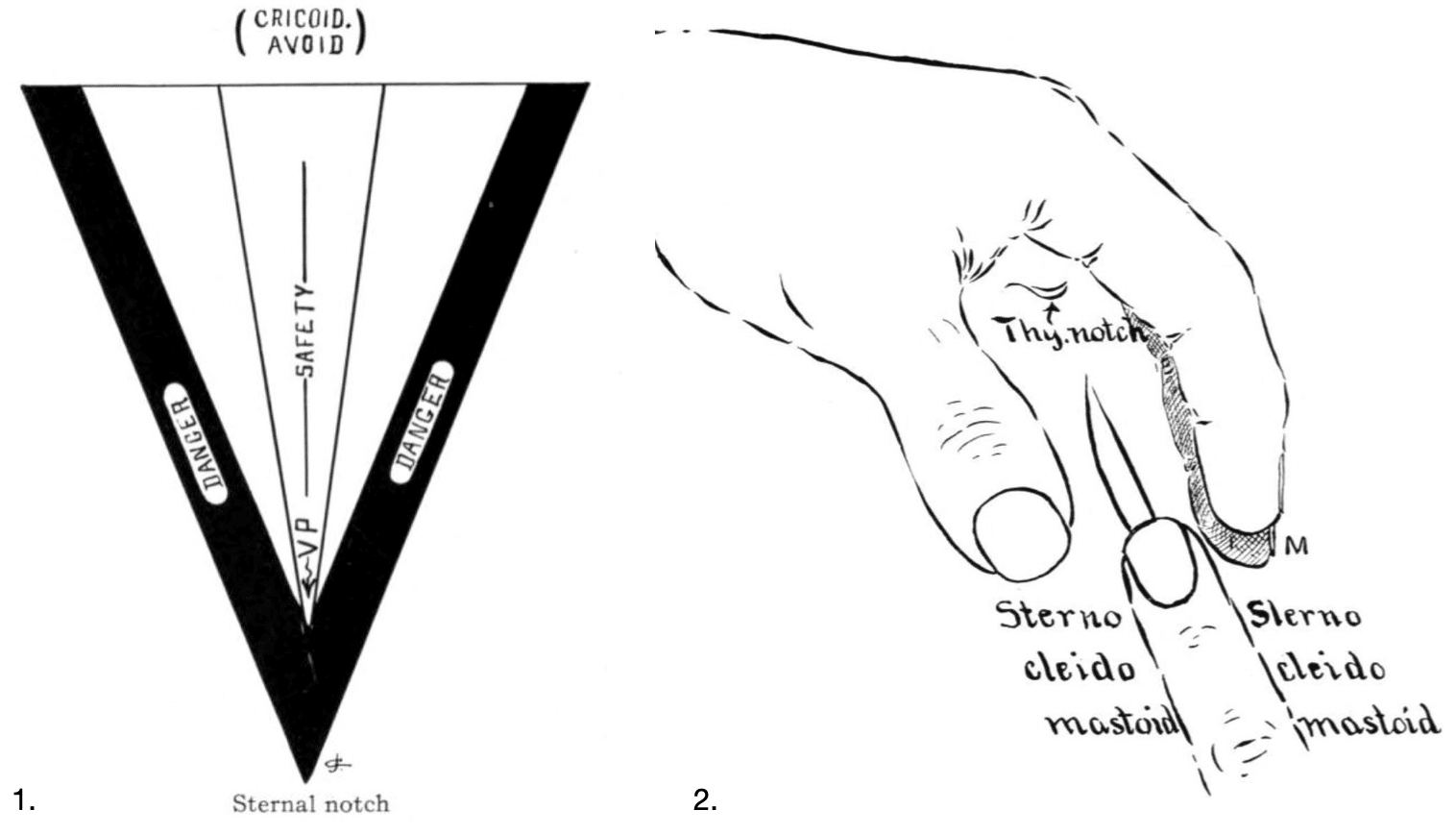
Fig 2. Jackson’s rapid tracheotomy technique. The left thumb and middle finger displace the sternocleidomastoid muscles and associated carotid–jugular structures posteriorly, bringing the trachea and central safety line forward into prominence before the initial midline incision. Jackson, 1922
Jackson position
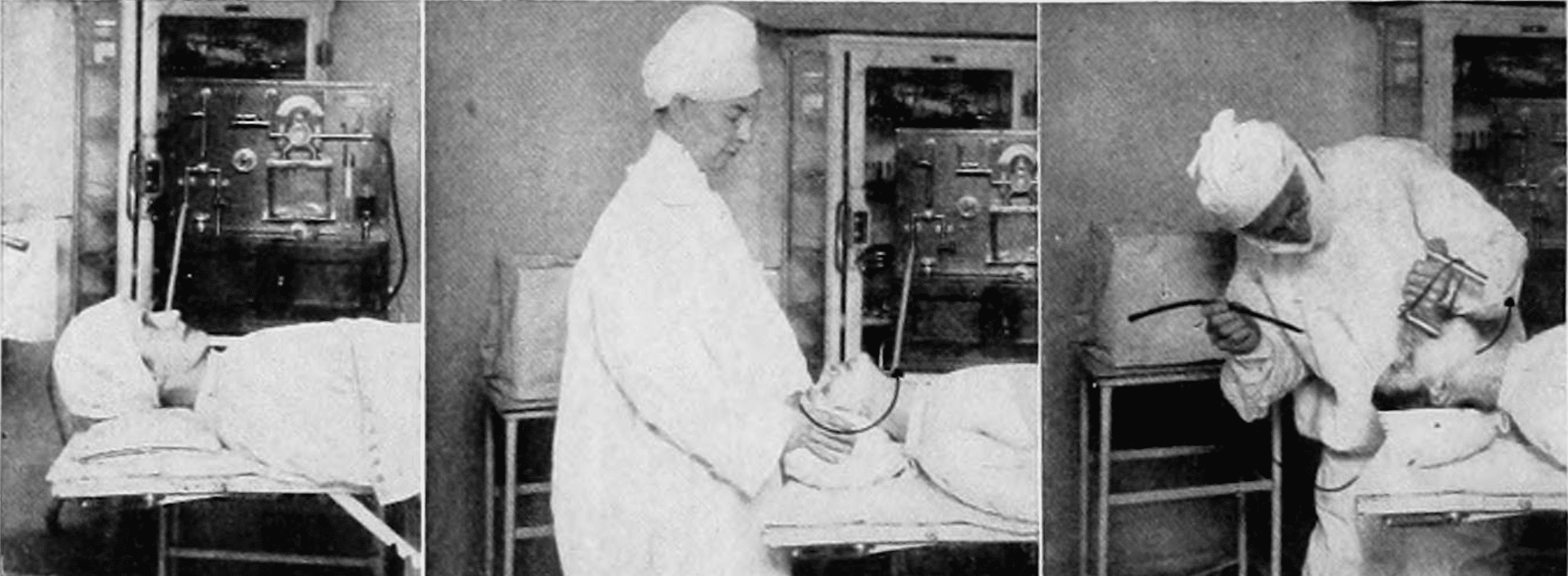
The term Jackson position has been used for a head position for direct laryngoscopy and intubation, and is sometimes equated with the modern sniffing position.
Jackson’s original descriptions were more complex. He advocated different head and neck positions according to the procedure. For example, for the introduction of intratracheal insufflation tubes he used the elbow rest position.” He used full extension of the head at the occipito-atlantal joint with the head remaining on the operating table.
For rigid bronchoscopy and oesophagoscopy Jackson preferred the Boyce position named after his assistant John Welch Boyce (1871–1930). This position has later been termed the Boyce–Jackson position, in which an assistant supported the elevated and extended head and neck beyond the end of the operating table to permit movement of the rigid endoscope.
Neither position is identical to the modern sniffing position. Descriptions that equate Jackson position directly with the sniffing position combine Jackson’s principles of head extension and airway alignment with the subsequently developed intubating posture.
Key Medical Contributions
Peroral endoscopy and instrument design
Jackson developed and refined a series of instruments for direct examination of the upper air and food passages. His oesophagoscopes, bronchoscopes and laryngoscopes incorporated improved illumination, suction or drainage and purpose-designed instruments for biopsy and foreign-body extraction.
Foreign-body retrieval and safe bronchoscopy
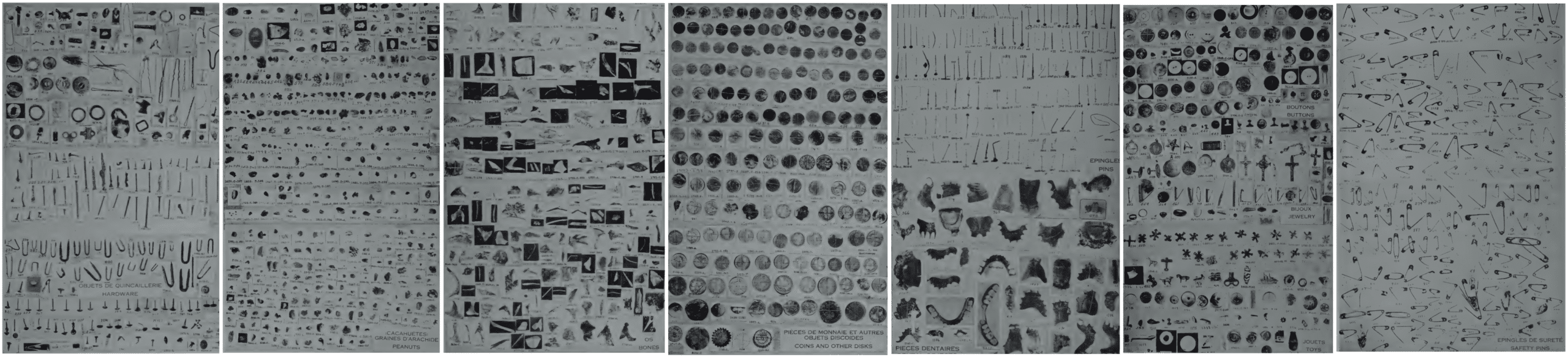
Foreign-body extraction became one of Jackson’s defining clinical contributions. Over his career he treated more than 2,000 patients with inhaled or swallowed foreign bodies, developing specialised forceps, extraction techniques and detailed methods for managing objects of different shapes and locations.
Following complications when inexperienced physicians used his early oesophagoscope, Jackson developed a staged training programme progressing from anatomical study and practice in simulated tubes to cadaveric and animal training before supervised human procedures.
Direct laryngoscopy, laryngeal surgery and tracheotomy
Jackson refined direct laryngoscopy through instrument design, patient positioning and techniques for exposing the larynx while avoiding trauma to the teeth and surrounding structures. He devised the separable Jackson laryngoscope, methods for directly visualised tracheal tube insertion and detailed descriptions of head and neck positioning.
With Gabriel Tucker and Louis Clerf he later developed Laryngostasis and the laryngostat, using internal lateral distension of the supraglottic tissues to improve glottic exposure and precision during endolaryngeal surgery.
Oesophageal disease and public health
Jackson used oesophagoscopy not only for foreign-body removal but also for the diagnosis and treatment of oesophageal strictures and other disease.
In 1929 he described peptic ulceration and erosive oesophagitis as clinical entities and linked oesophageal inflammation and heartburn with retrograde exposure to gastric contents.
His experience treating children with severe caustic oesophageal injuries also led to a prolonged public-health campaign for compulsory labelling of household lye and other corrosive substances. This work culminated in the Federal Caustic Poison Act of 1927.
Major Publications
- Jackson CQ. A satisfactory tongue depressor. Medical Record 1892
- Jackson C. The aural masseur in the Manhattan Eye and Ear Hospital. JAMA 1895
- Jackson C. Tracheo-bronchoscopy, esophagoscopy and gastroscopy. 1907
- Jackson C. I. Tracheo-Bronchoscopy: With Report of Cases. Ann Surg. 1908 Mar;47(3):321-31.
- Jackson C. Tracheotomy. The Laryngoscope 1909; 19(4): 285–290
- Jackson C. The technique of insertion of intratracheal insufflation tubes. Surgery, Gynecology & Obstetrics 1913; 17(4): 507-509
- Jackson C. Peroral endoscopy and laryngeal surgery. 1915
- Jackson C. A new diagnostic sign of foreign body in the trachea or bronchi, the “asthmatoid wheeze”. The American journal of the medical sciences. 1918; 156(5): 625
- Jackson C. Bronchoscopy and esophagoscopy; a manual of peroral endoscopy and laryngeal surgery. 1922
- Jackson C, Tucker G, Clerf LH. Laryngostasis and the laryngostat Arch Otolaryngol 1925;1;(2):167-169.
- Jackson C. Bronchoscopy; Past, Present and Future. New England Journal of Medicine. 1928;199(16):759-763.
- Jackson C. Wheezing Respiration in Children: Bronchoscopic Observations on Stridulous and Asthmatoid Breathing. American Journal of Diseases of Children 1929; 37(6): 1331-1333
- Jackson C. Peptic ulcer of the esophagus. JAMA 1929;92;(5):369-372.
- Jackson C. The life of Chevalier Jackson: an autobiography. 1938
References
Biography
- Zeitels SM. Chevalier Jackson’s contributions to direct laryngoscopy. J Voice. 1998 Mar;12(1):1-6.
- Cappello M. Swallow: Foreign Bodies, Their Ingestion, Inspiration, and the Curious Doctor Who Extracted Them. The New Press. 2010
- Eriksson SE, Jobe BA, Ayazi S. Chevalier Jackson: father of endoscopic surgery, and champion of women in medicine, social justice, and public health. Surg Endosc. 2023 Sep;37(9):6660-6671.
- Alrassi J, Daniels A, Rosenfeld RM. The Pedagogical Legacy of Dr. Chevalier Jackson: An Archival Visit to the John Q. Adams History Center at the American Academy of Otolaryngology-Head and Neck Surgery. Otolaryngol Head Neck Surg. 2024 Mar;170(3):992-995.
Eponymous terms
- Boyce JW. Duties of the second assistant in endoscopy per os. In: Jackson C. Tracheo-Bronchoscopy, Esophagoscopy and Gastroscopy. 1907:145–147.
- Jobson TB. Specimen of Bone Flake causing “Asthmatoid Wheeze” extracted from the Entrance to the Left Bronchus. Proc R Soc Med. 1929 Apr;22(6):788.
- Greenland KB, Eley V, Edwards MJ, Allen P, Irwin MG. The origins of the sniffing position and the Three Axes Alignment Theory for direct laryngoscopy. Anaesth Intensive Care. 2008 Jul;36 Suppl 1:23-7.
Eponym
the person behind the name

MBChB - Liverpool. RMO in Emergency Medicine at Sir Charles Gairdner Hospital, currently soaking up the sun down under. Aiming to pursue a career in anaesthetics.

BA MA (Oxon) MBChB (Edin) FACEM FFSEM. Emergency physician, Sir Charles Gairdner Hospital. Passion for rugby, medical history, medical education, and asynchronous learning #FOAMed evangelist. Editor-in-Chief and Webmaster of Life in the Fast lane, LITFL | On Call 4e| Eponyms | Books | Horology |