


Magill forceps are angled airway forceps designed to grasp and guide a nasally introduced catheter or endotracheal tube through the glottis under direct laryngoscopic vision while keeping the operator’s line of sight clear.
The forceps were developed by Ivan Whiteside Magill (1888–1986) at the Queen’s Hospital for Facial and Jaw Injuries, Sidcup, in 1920 as an alternative to the guiding rod of his colleague Edgar Stanley Rowbotham (1890-1979)
Modern use
Magill forceps remain in clinical use for:
- guiding a nasotracheal tube through the glottis during direct laryngoscopy
- directing nasogastric or orogastric tubes into the oesophagus
- removing foreign material from the pharynx or upper airway
- positioning or removing pharyngeal packs
Description
Modern Magill forceps are scissor-handled, angulated forceps designed so that the operator’s hand and the shaft of the instrument remain outside the direct line of sight during laryngoscopy.
The distal jaws are blunt and curved for atraumatic grasping of tubes or foreign material. Reusable and disposable versions are available in adult and paediatric sizes, with variations in jaw design according to intended use.
The characteristic bend remains the defining feature: it permits manipulation within the oropharynx while maintaining an unobstructed view of the larynx.

Development of the Magill forceps
1920 – On October 16, Stanley Rowbotham published Intratracheal anaesthesia by the nasal route for operations on the mouth and lips. His technique involved passing a catheter through the nose, identifying it in the oropharynx with a laryngoscope, engaging its distal opening with a specially shaped metal guiding rod, and directing the catheter through the vocal cords.
The method provided tracheal anaesthesia while keeping the anaesthetic tubing away from the operative field during facial and oral surgery.
1920 – Later that month, Ivan Magill published Forceps for intracheal anaesthesia, proposing an alternative method to Rowbotham’s technique for controlling the nasal catheter.
Magill’s forceps were manufactured for him by Meyer and Phelps. They measured approximately 6½ inches in length and incorporated an angular bend designed to clear the operator’s field of vision.
The distal jaws formed a longitudinally divided cylinder with serrated inner surfaces, allowing the catheter to be securely grasped without damaging its end.
Magill compared his forceps with Rowbotham’s guiding rod. He noted that the catheter could be picked up more easily within the oropharynx; the grasp remained secure without maintaining external tension on the catheter; the forceps could be used alongside or within the laryngoscope; and the operator’s visual field remained clear.
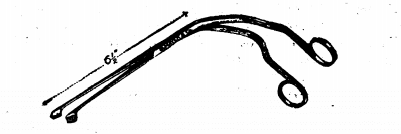
Modern Magill forceps. The basic geometry has changed remarkably little. Modern Magill forceps retain the characteristic angulation introduced to permit manipulation of tubes and other objects under direct laryngoscopic vision.
Eponymythology
Magill published the instrument descriptively as “Forceps for Intratracheal Anaesthesia” rather than naming it after himself.
The term Magill forceps was later applied eponymously and remains in widespread clinical use more than a century after the original description.
Associated Persons
- Edgar Stanley Rowbotham (1890-1979)
- Sir Ivan Whiteside Magill (1888-1986)
References
Historical references
- Rowbotham S. Intratracheal anaesthesia by the nasal route for operations on the mouth and lips. Br Med J. 1920 Oct 16;2(3120):590-1.
- Magill IW. Forceps for intracheal anaesthesia. Br Med J 1920;2:670
Eponymous term review
- Baskett P. The Resuscitation Greats. Sir Ivan Whiteside Magill KCVO DSc (Hon) Resuscitation. 2003 Nov;59(2):159-62.
- McLachlan G. Sir Ivan Magill KCVO, DSc, MB, BCh, BAO, FRCS, FFARCS (Hon), FFARCSI (Hon), DA, (1888-1986). Ulster Med J. 2008 Sep;77(3):146-52.
eponymictionary
the names behind the name

MBChB - Liverpool. RMO in Emergency Medicine at Sir Charles Gairdner Hospital, currently soaking up the sun down under. Aiming to pursue a career in anaesthetics.

Chris is an Intensivist and ECMO specialist at The Alfred ICU, where he is Deputy Director (Education). He is a Clinical Adjunct Associate Professor at Monash University, the Lead for the Clinician Educator Incubator programme, and a CICM First Part Examiner. He is an internationally recognised Clinician Educator with a passion for helping clinicians learn and for improving the clinical performance of individuals and collectives. He was one of the founders of the FOAM movement (Free Open-Access Medical education) has been recognised for his contributions to education with awards from ANZICS, ANZAHPE, and ACEM.
His one great achievement is being the father of three amazing children.
On Bluesky, he is @precordialthump.bsky.social and on the site that Elon has screwed up, he is @precordialthump. | INTENSIVE | RAGE | Resuscitology | SMACC