


My legs feel so heavy
74-year-old female presents feeling unwell with heavy legs following three days of diarrhoea and reduced oral intake.
She has a history of hypertension, heart failure with reduced ejection fraction and chronic kidney disease stage 3, and takes ramipril, spironolactone, amitriptyline, bisoprolol 2.5 mg and metformin.
| Observations | |||
| SpO2 | 96% | ||
| Temperature | 36.8 °C | ||
| Blood pressure | 108/64 | ||
| Heart rate | 78 |
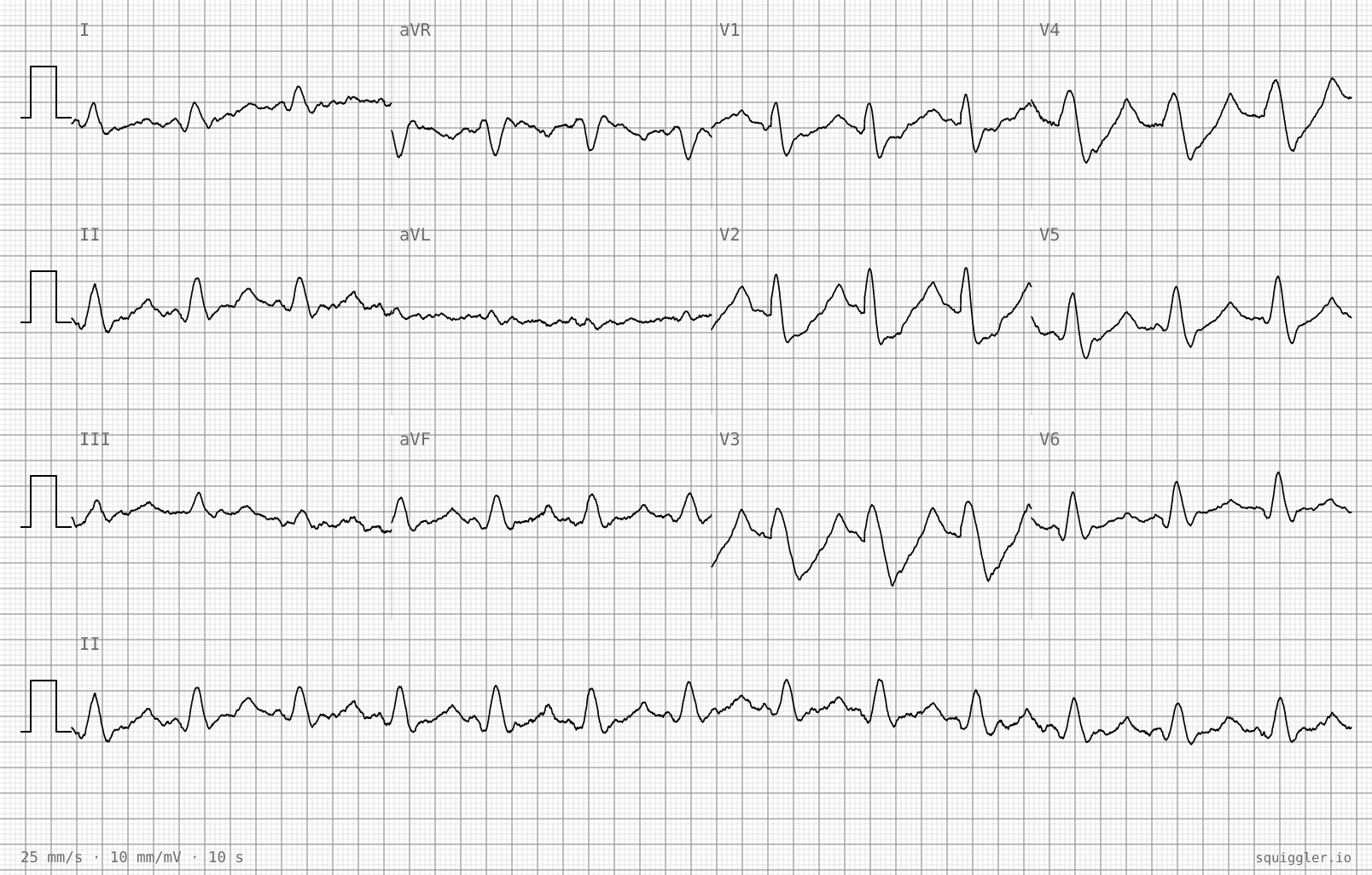
On examination she is alert with mild proximal weakness in both legs. An ECG is recorded on arrival.
A venous blood gas is performed
| Bloods | |||
| pH | 7.29 | ||
| Glucose | 7.8 mmol/L | ||
| K+ | 8.4 mmol/L |
Questions
The QRS is grossly widened at about 300 ms with bizarre complexes merging into tall, peaked T waves, approaching a sine-wave pattern. Despite this, the rhythm is regular and small P waves are still visible before each complex, which argues strongly against ventricular tachycardia. Sodium-channel blocker toxicity can produce similar widening, but the clinical picture of a patient on ramipril and spironolactone with three days of diarrhoea and poor intake points to hyperkalaemia. Left bundle branch block does not widen the QRS to this degree.
With a QRS this wide and a near sine-wave pattern, cardiac arrest is imminent. Intravenous calcium stabilises the myocardial membrane within minutes and is the first treatment in severe hyperkalaemia with ECG changes, as recommended by the Resuscitation Council UK and the European Resuscitation Council. Insulin and dextrose lower potassium but take fifteen to thirty minutes to act and do not protect the myocardium in the interim. Amiodarone would be appropriate for VT but not for this rhythm.
Initial treatment
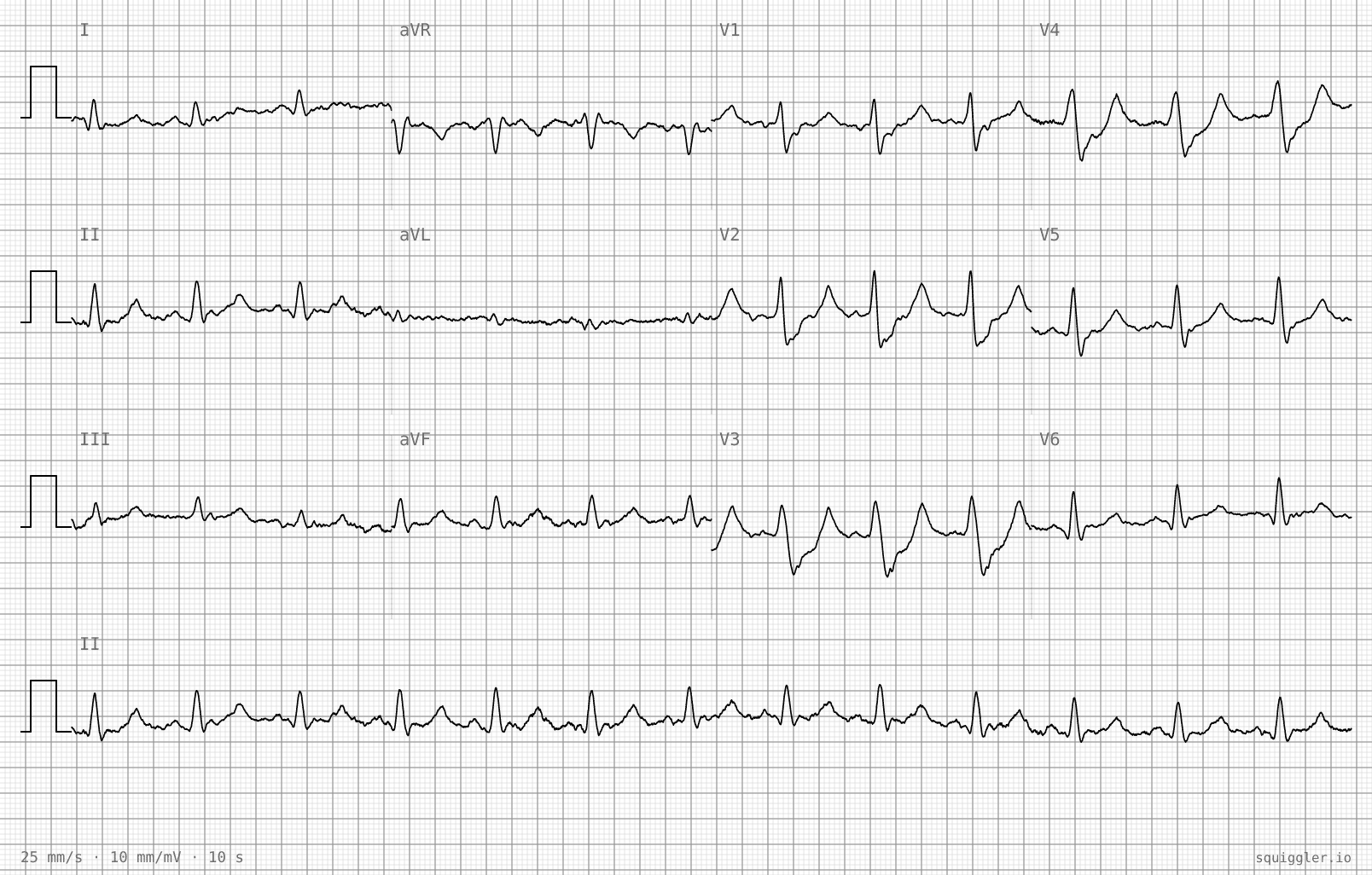
You give 10 mL of 10% calcium chloride intravenously over two minutes. A repeat ECG is recorded five minutes later.
Questions
The QRS has narrowed from about 300 ms to about 170 ms, and the sine-wave morphology has resolved. This demonstrates that calcium antagonises the membrane effects of potassium and narrows the QRS rapidly. However, it does not lower the serum potassium or correct the acidosis. The QRS is still significantly wide and peaked T waves remain prominent, so the conduction abnormality is improved rather than resolved. The effect of calcium is temporary, typically lasting thirty to sixty minutes.
Now that the membrane is stabilised, the priority is to shift potassium into cells. Insulin with dextrose is the most effective pharmacological method, lowering potassium by about 1 mmol/L over sixty minutes, and nebulised salbutamol adds to the effect. A second dose of calcium may be needed if the QRS widens again, but it does not address the potassium itself. Calcium resonium takes hours to act and is not effective as sole acute treatment. Furosemide may help with renal potassium excretion in a patient who is still making urine but is far too slow as the sole intervention.
Follow up and review
You give 10 units of soluble insulin with 25 g of glucose intravenously and start nebulised salbutamol. Thirty minutes later the repeat venous gas shows potassium 7.1 mmol/L.
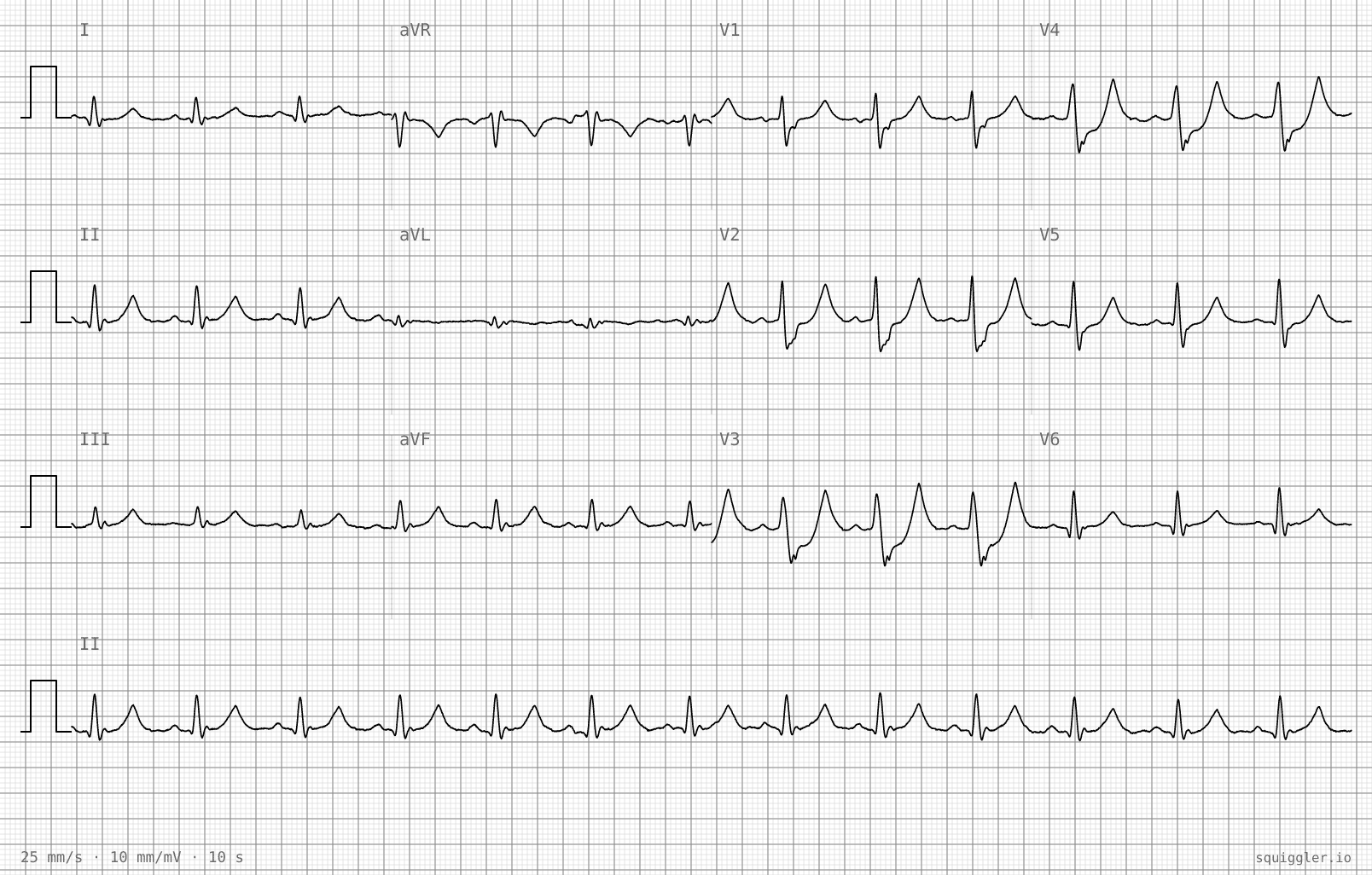
A further ECG is recorded. At ninety minutes, the capillary glucose is 3.4 mmol/L.
Hypoglycaemia is a recognised complication of insulin and dextrose treatment for hyperkalaemia, common and sometimes delayed by several hours. A glucose of 3.4 mmol/L at ninety minutes requires treatment with intravenous glucose and continued hourly capillary glucose monitoring for at least six hours. It is not an expected or acceptable nadir, and in this clinical context it is far more likely to be iatrogenic than due to sepsis.
The QRS has narrowed further to about 125 ms, but the T waves remain tall, narrow-based and peaked, particularly in V2 to V4 and in lead II. This is not new ST elevation; the downward deflection in V1 to V4 reflects residual QRS and ST distortion from the conduction delay rather than ischaemia. The rhythm is still sinus, and the tracing is far from normal. The peaked T waves reflect persisting hyperkalaemia even as the conduction abnormality improves.
Further review
Four hours after presentation, the potassium is 5.9 mmol/L. Her creatinine has come back at 312 micromol/L with a urea of 24 mmol/L, well above her baseline.
A further ECG is recorded.
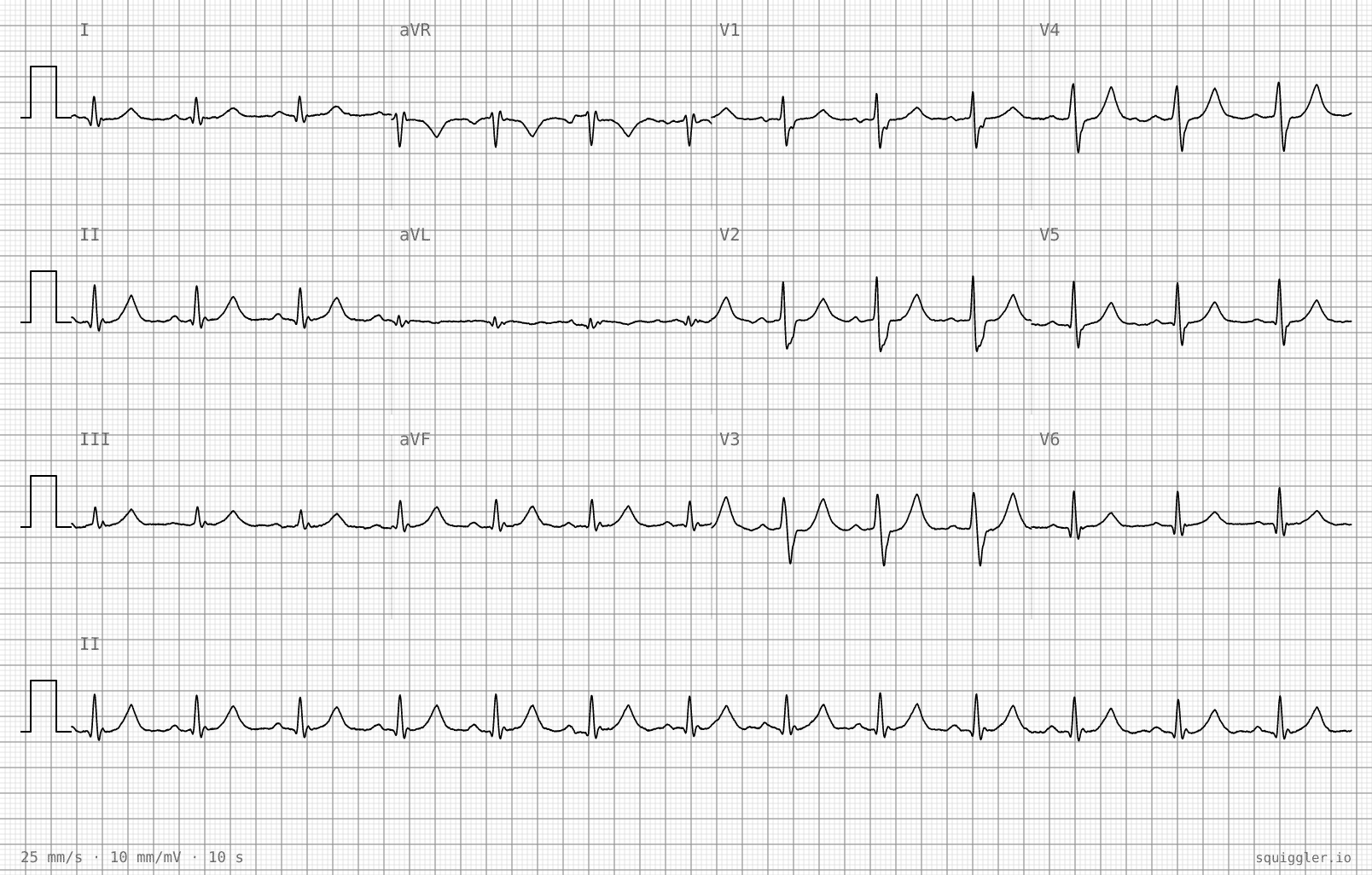
The QRS is now about 100 ms, which is essentially normal, but the T waves remain tall and peaked in V2 to V4. The potassium at 5.9 mmol/L is still above normal. The ECG changes of hyperkalaemia do not resolve in a fixed sequence; peaked T waves are often the first to appear and the last to go. Calcium does not cause persistent T-wave peaking, and these symmetrical, narrow-based T waves are not the morphology of acute ischaemia.
The QRS is now about 100 ms, which is essentially normal, but the T waves remain tall and peaked in V2 to V4. The potassium at 5.9 mmol/L is still above normal. The ECG changes of hyperkalaemia do not resolve in a fixed sequence; peaked T waves are often the first to appear and the last to go. Calcium does not cause persistent T-wave peaking, and these symmetrical, narrow-based T waves are not the morphology of acute ischaemia.
Diagnosis and Summary
Severe hyperkalaemia with progressive ECG changes
This woman’s grossly widened QRS (300 ms), peaked T waves and near sine-wave morphology are the ECG of severe hyperkalaemia, not ventricular tachycardia. The cause is clear in this case: acute kidney injury on a background of CKD, driven by volume depletion and RAAS blockade.
Intravenous calcium is the first treatment because it stabilises the cardiac membrane within minutes, in this case narrowing the QRS from 300 to 170 ms on the repeat ECG, but it does not lower the potassium. Insulin with dextrose and nebulised salbutamol shift potassium into cells. In this case, the initial ECG is diagnostic and calcium should be administered a soon as possible. Monitor glucose at least hourly for at least six hours after insulin as hypoglycaemia is common, consider measurements q30min initially.
Always consider the cause of hyperkalemia, and whether a route for actual elimination (not only redistribution) is present in the patient.
References
- Littmann L, Gibbs MA. Electrocardiographic manifestations of severe hyperkalemia. J Electrocardiol. 2018 Sep-Oct;51(5):814-817.
- Lott C, Truhlář A, et al. European Resuscitation Council Guidelines 2021: Cardiac arrest in special circumstances. Resuscitation. 2021 Apr;161:152-219.
Note. These ECG tracings were generated, not recorded. The Squiggler ECG generation studio can be used to live edit and review each generated ECG for education purposes. Open the studio
TOP 150 ECG Series