


ECG Case 141
Palpitations and feeling unwell
83-year-old woman presents two days after falling on her left arm. She has been feeling lightheaded since. She as a single-chamber ventricular pacemaker implanted several years ago for intermittent complete heart block.
You record a twelve-lead ECG
Questions
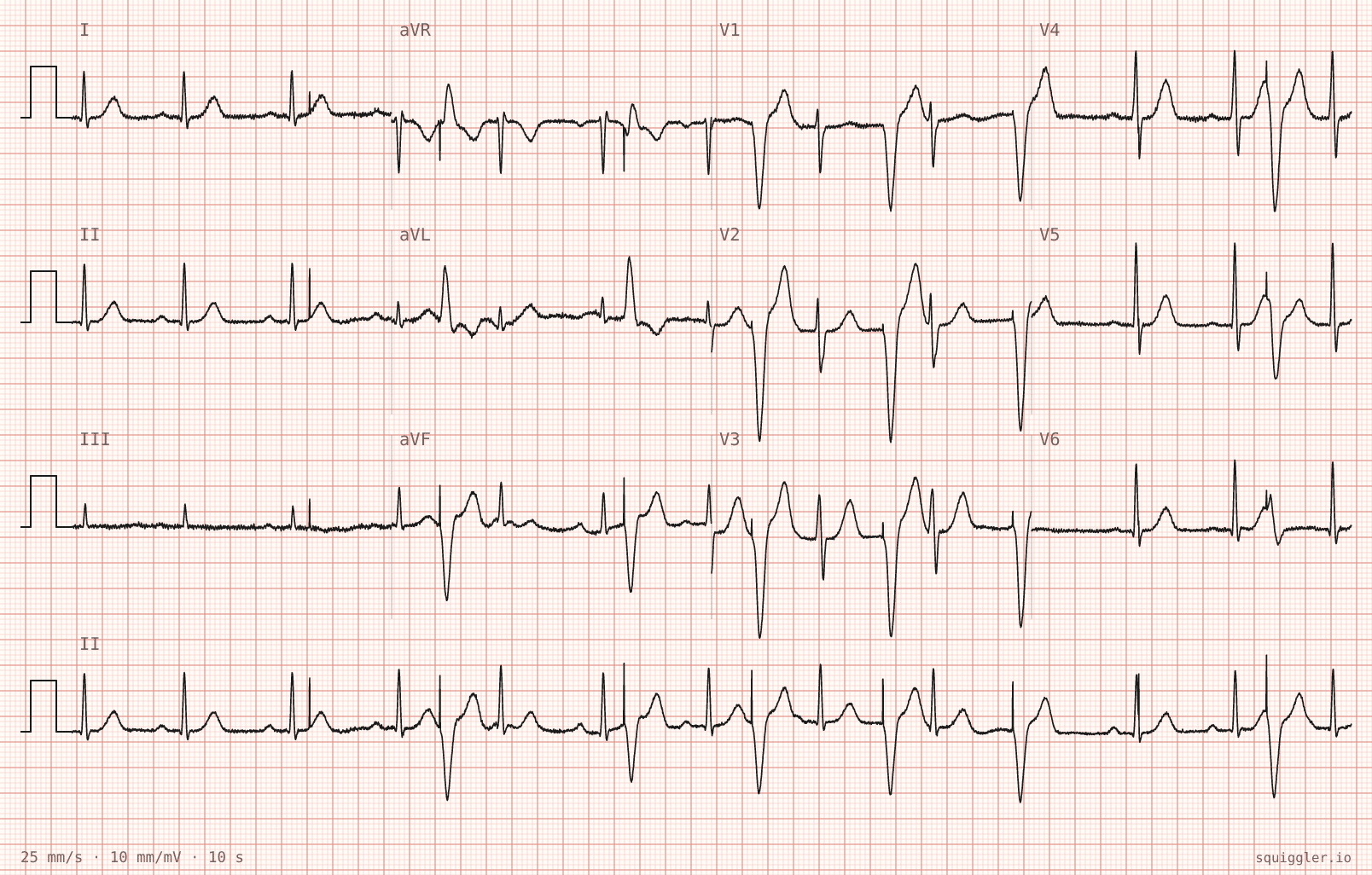
What is the most likely abnormality on this ECG?
Pacing spikes appear at a fixed rate with no relationship to the native QRS complexes. Some spikes fall on or shortly after native beats without capturing because the myocardium is refractory, while those landing in diastole capture and produce broad paced complexes. The pacemaker undersenses and is not inhibited by native beats. In failure to capture, spikes would be appropriately timed but produce no QRS.
Rhythm strip review
You observe several pacing spikes falling on or near the T wave of native beats in the rhythm strip. The patient is haemodynamically stable.
Questions
What is the most important immediate risk of this pattern?
A pacing stimulus delivered during the vulnerable period of repolarisation can trigger ventricular fibrillation, analogous to the R-on-T phenomenon. Although uncommon with low-output pacemaker stimuli, this is the most serious acute risk and is the reason for continuous telemetry monitoring while awaiting device interrogation. Lead perforation is a mechanical complication unrelated to the timing of spikes on the cardiac cycle.
What is the most appropriate immediate management?
A pacing stimulus delivered during the vulnerable period of repolarisation can trigger ventricular fibrillation, analogous to the R-on-T phenomenon. Although uncommon with low-output pacemaker stimuli, this is the most serious acute risk and is the reason for continuous telemetry monitoring while awaiting device interrogation. Lead perforation is a mechanical complication unrelated to the timing of spikes on the cardiac cycle.
Follow up and review
The pacing team interrogate the device and find reduced R-wave amplitude on the ventricular lead. They increase the sensing sensitivity and you record a repeat ECG.
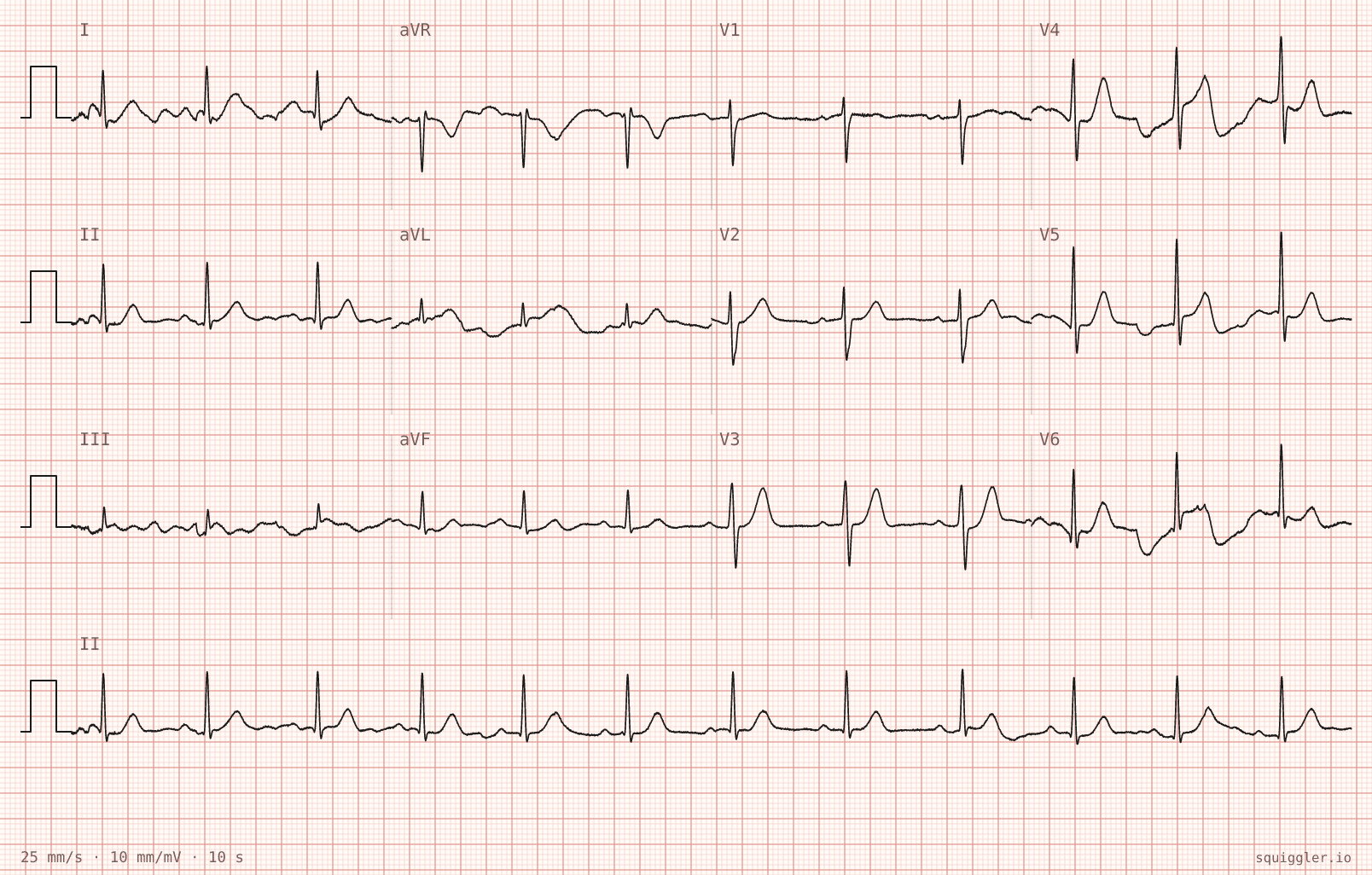
What does this repeat ECG show?
The tracing shows regular sinus rhythm at 72 beats per minute with narrow QRS complexes and no pacing spikes. Because the native rate exceeds the programmed lower rate, the device is sensing each beat and withholding its output, which is normal VVI demand function. Oversensing would cause inappropriate inhibition during periods when pacing was needed, producing pauses, which is not seen here.
Further thoughts
The tachycardia terminates with a modified Valsalva manoeuvre and sinus rhythm with pre-excitation returns. He is referred to the EP service.
Questions
If he later presented with pre-excited AF, which treatment would be contraindicated?
Blocking the AV node in pre-excited AF pushes conduction towards the pathway, with a risk of degeneration into VF. For that reason verapamil, diltiazem, beta-blockers, adenosine, digoxin and IV amiodarone should all be avoided. An unstable patient needs DC cardioversion, while a stable one can be treated with procainamide or ibutilide.
What is the definitive management?
Symptomatic WPW is an indication for an EP study and catheter ablation, which the 2019 ESC guidelines make a Class I recommendation. Ablation has a high success rate and a low complication rate, and it removes the substrate for both AVRT and pre-excited AF.
Diagnosis and Summary
Pacemaker undersensing
This tracing shows pacemaker undersensing. The diagnostic pattern is pacing spikes bearing no relationship to native beats, with an irregular mixture of narrow conducted complexes and broad captured paced beats.
Think of it as a dialogue of two persons. Normally, if your conversation partner says something, you would inhibit your sentence (if you are polite), and then speak yourself when the other person stops speaking. But if you are not listening (undersensing) to your partner, you are instead cutting in the middle of him/her speaking.
The immediate concern is ventricular fibrillation from stimuli falling on the T wave, though this is uncommon at threshold output. A magnet converts most pacemakers to asynchronous mode and does not restore sensing. The management is continuous telemetry and urgent device interrogation. Here, interrogation after the fall showed a reduced R-wave amplitude on the ventricular lead, and increasing the sensing sensitivity resolved the problem
References
- Mulpuru SK, Madhavan M, McLeod CJ, Cha YM, Friedman PA. Cardiac Pacemakers: Function, Troubleshooting, and Management: Part 1 of a 2-Part Series. J Am Coll Cardiol. 2017 Jan 17;69(2):189-210.
- Jacob S, Panaich SS, Maheshwari R, Haddad JW, Padanilam BJ, John SK. Clinical applications of magnets on cardiac rhythm management devices. Europace. 2011 Sep;13(9):1222-30.
- Webb K. Pacemaker Essentials. Medmastery
Note. These ECG tracings were generated, not recorded. The Squiggler ECG generation studio can be used to live edit and review each generated ECG for education purposes. Open the studio
TOP 150 ECG Series

David Yu, M.D., Ph.D. Full time anesthesiologist in the department of Perioperative medicine and Intensive Care (PMI), Karolinska University Hospital, Sweden. Dual board certified in internal medicine, and anesthesiology and critical care. Clinical interests are the critically ill patient, hemodynamic cases, perioperative echocardiography and procedural awareness, and of course all things ECG! | Squiggler |