


Finkelstein Test
Finkelstein test is a provocative manoeuvre used in the clinical assessment of de Quervain disease, intended to reproduce pain over the radial styloid and first dorsal compartment by stressing the abductor pollicis longus and extensor pollicis brevis tendons.
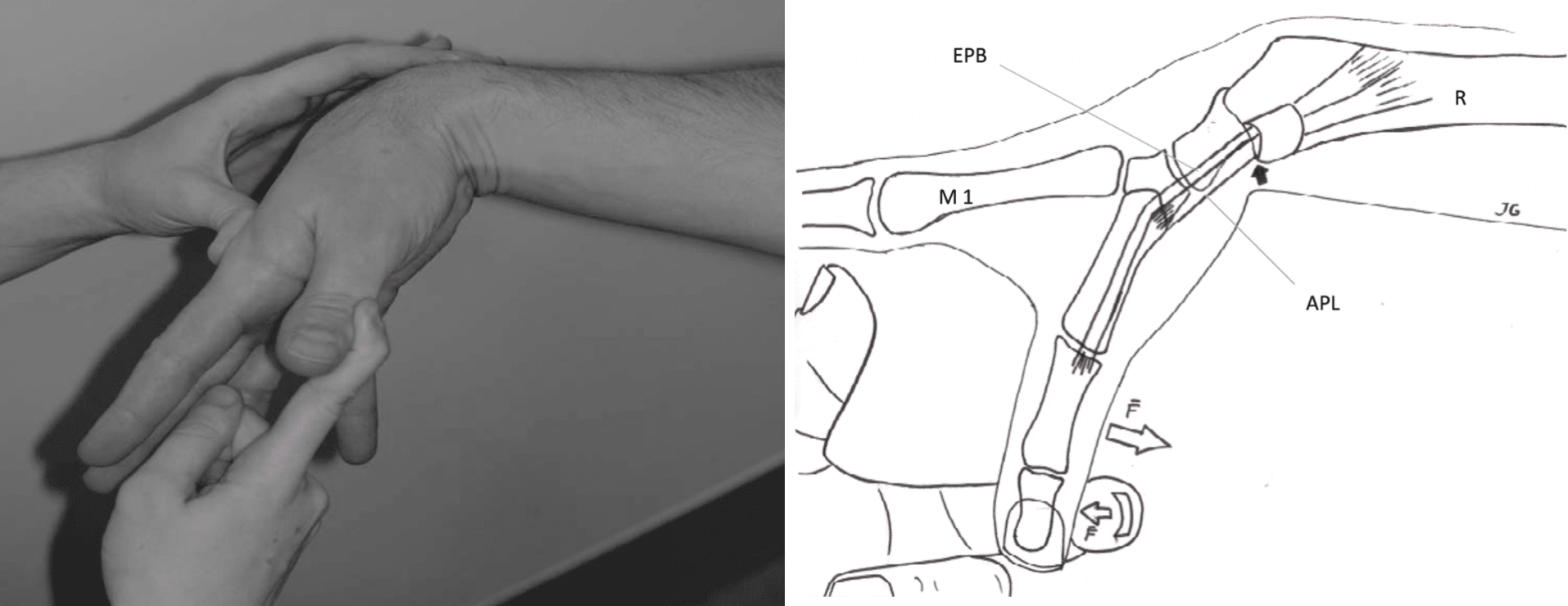
The Finkelstein test is performed by the examiner grasping the patient’s thumb and quickly deviating the hand ulnarward. Reproduction of sharp pain over the radial styloid or first dorsal compartment supports the diagnosis of de Quervain disease.
Finkelstein test should be distinguished from Eichhoff test, in which the patient clenches the thumb in the palm and the wrist is passively deviated ulnarward. Eichhoff’s manoeuvre is commonly but incorrectly taught as Finkelstein’s test and may produce false-positive pain by stressing adjacent radial wrist structures.
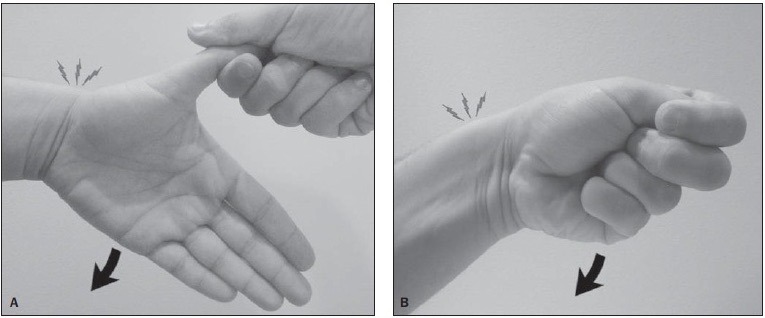
A: Finkelstein Test; holding thumb whilst hand forced into ulna deviation
B: Eichhoff test; grasping thumb in palm of hand whilst wrist is ulna deviated
History of the Finkelstein Test
1927 – Ernst Eichhoff described the thumb-in-fist ulnar deviation manoeuvre as an experiment to support a mechanical theory of de Quervain disease. He noted that pain at the radial styloid disappeared when the thumb was extended, even if ulnar deviation was maintained.
If one places the thumb within the hand, and holds it tightly with the fingers, and then bends the hand severely, in ulnar abduction, an intense pain is experienced on the styloid process of the radius, exactly at the place where the tendon sheath takes its course. The pain disappears the moment the thumb is extended, even if the ulnar abduction is maintained.
Eichhoff E. 1927: 513
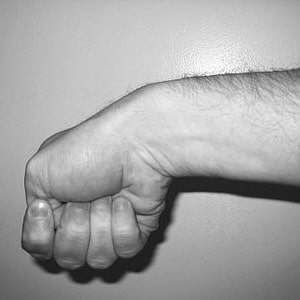
Eichhoff test (commonly mislabelled as Finkelstein)
- Patient places the thumb in the palm.
- Fingers are closed over the thumb.
- Examiner passively deviates the wrist ulnarward.
- Pain at the radial styloid is considered positive.
1930 – Harry Finkelstein (1883–1975) published Stenosing tendovaginitis at the radial styloid process, reviewing the literature and reporting 24 operated cases. He emphasised that de Quervain disease was often misdiagnosed as rheumatism, neuritis, periostitis, nonspecific tenosynovitis, or tuberculous osteitis. He described his own objective sign:
On grasping the patient’s thumb and quickly abducting the hand ulnarward, the pain over the styloid tip is excruciating. This is probably the most pathognomonic objective sign.
Finkelstein 1930
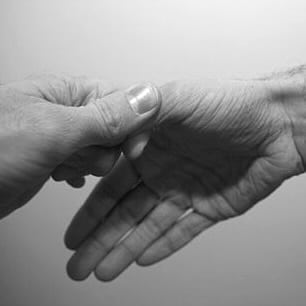
Finkelstein test (original description)
- Patient’s forearm relaxed, usually in neutral rotation.
- Examiner supports the forearm/wrist with one hand.
- Examiner grasps the patient’s thumb with the other hand.
- The hand/wrist is then moved quickly into ulnar deviation while the thumb is held.
- A positive test reproduces sharp or excruciating pain over the radial styloid.
1958 – Luiz Leão published de Quervain’s Disease: A Clinical and Anatomical Study. He reviewed the history of the syndrome and reported dissections of 50 wrists from 27 fresh cadavers. Leão stated that Finkelstein had merely “transcribed the test described by Eichhoff” and then described the thumb-in-fist manoeuvre as “Finkelstein’s sign,” propagating confusion between the two tests.
1992 – Barry G. Elliott corrected the error in Finkelstein’s test: A descriptive error that can produce a false positive. Elliott distinguished Finkelstein’s original thumb-grasp test from Eichhoff’s thumb-in-fist experiment and warned that the incorrect version could produce false positives and lead to inappropriate surgery.
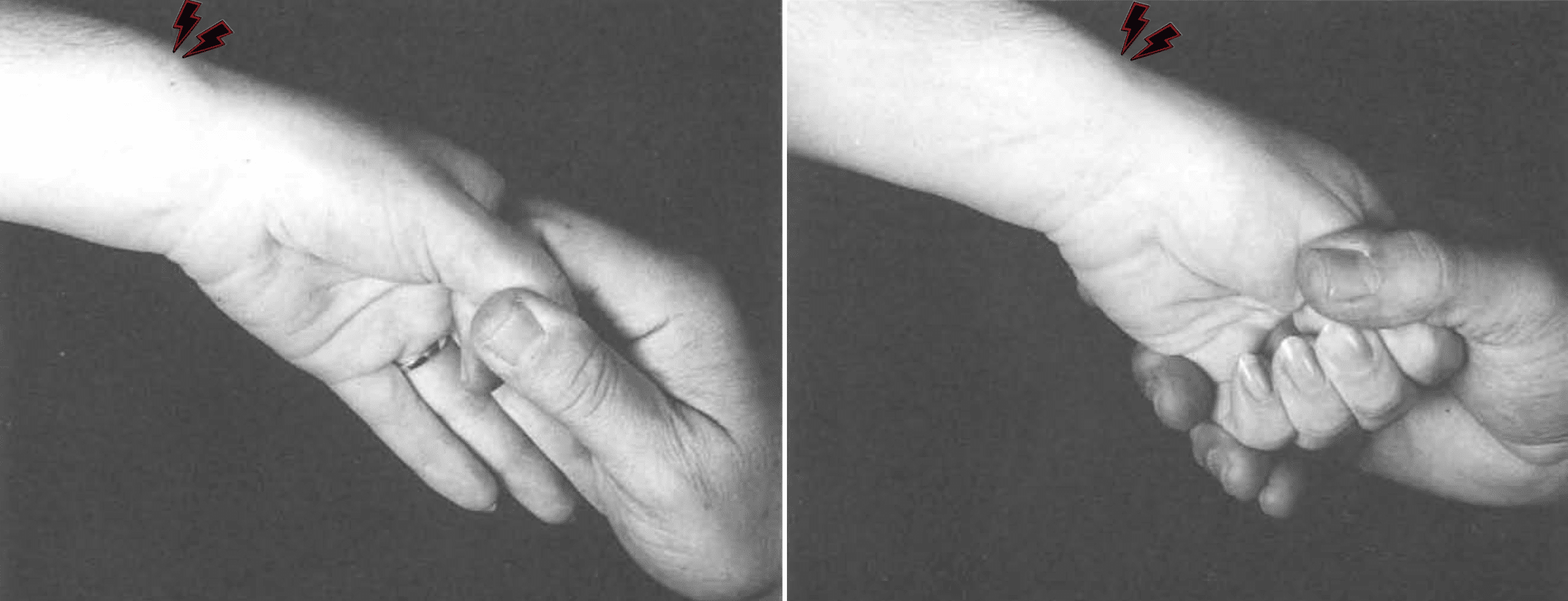
Right: Eichhoff experiment: the thumb is grasped in the clenched fingers and the hand abducted ulnarward.
2003 – Giorgio Brunelli argued that the usual Finkelstein and Eichhoff manoeuvres were mechanically misleading because it stretched the abductor pollicis longus (APL) and extensor pollicis brevis (EPB) tendons. This forced them against the floor of the first dorsal compartment, rather than reproducing friction against the retinacular pulley.
He proposed the Brunelli test. Wrist in radial deviation with forceful thumb abduction/extension, intended to provoke tendon–pulley friction. Brunelli reported this as consistently positive in his own practice, but did not provide formal sensitivity, specificity, PPV, or NPV data.
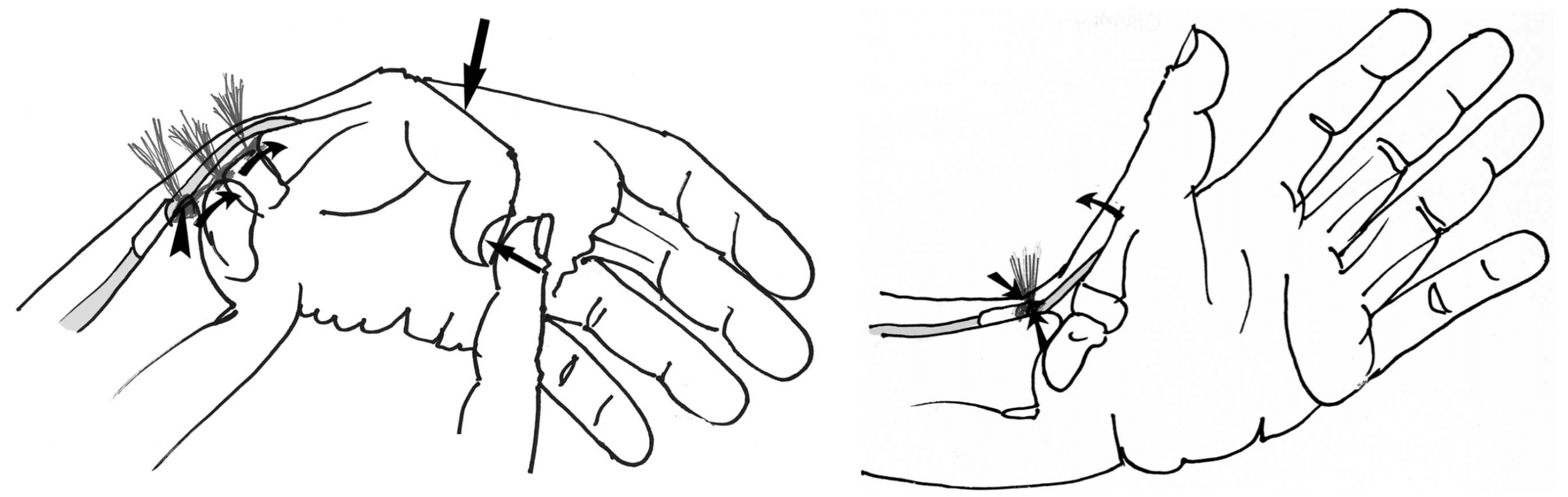
Left: Finkelstein test: thumb opposed toward the little finger with the wrist in ulnar deviation, stretching the first dorsal compartment tendons.
Right: Brunelli test: wrist held in radial deviation while the patient forcefully abducts/extends the thumb, provoking pain by friction between the the abductor pollicis longus (APL) and extensor pollicis brevis (EPB) tendons and the retinacular pulley. Brunelli 2003
2005 – Waseem et al. used Finkelstein’s test as an example of eponym confusion. In their survey, only 10.7% of orthopaedic surgeons recognised the correct method as originally described by Finkelstein and 89.3% did not.
2014 – Goubau et al. introduced the WHAT test as wrist hyperflexion and abduction of the thumb, and compared it with Eichhoff’s test against ultrasound findings in 100 symptomatic patients. WHAT showed higher sensitivity 0.99 vs 0.89, higher specificity 0.29 vs 0.14, PPV 0.95 vs 0.93, and NPV 0.67 vs 0.09. The results favoured WHAT, but the cohort was highly selected and ultrasound-positive in 93/100 patients, so the low specificity and wide confidence intervals should be noted.
Summary of tests
| Test | Date | Manoeuvre | Comment |
|---|---|---|---|
| Eichhoff test | 1927 | Thumb clenched inside fist; wrist ulnar-deviated | Commonly mislabelled as Finkelstein; may produce false positives. |
| Finkelstein test | 1930 | Examiner grasps patient’s thumb and quickly abducts/deviates the hand ulnarward | Original eponymous test; distinct from Eichhoff. |
| Brunelli test | 2003 | Wrist radial deviation with forceful thumb abduction/extension | Proposed to provoke tendon–pulley friction; no formal diagnostic accuracy data. |
| WHAT test | 2014 | Wrist hyperflexion with active thumb abduction against resistance | Ultrasound-correlated study: sensitivity 0.99, specificity 0.29, PPV 0.95, NPV 0.67. |
Associated Persons
- Harry Finkelstein (1883-1975)
- Fritz de Quervain (1868-1940)
Alternative names
- Modified Eichhoff test
References
Historical references
- Eichhoff E. Zur Pathogenese der Tendovaginitis stenosans. Bruns’ Beiträge zur klinischen Chirurgie 1927; 139: 746-755
- Finkelstein H. Stenosing tendovaginitis at the radial styloid process. JBJS 1930, 12: 509-540.
- Leao L. De Quervain’s disease; a clinical and anatomical study. J Bone Joint Surg Am. 1958 Oct;40-A(5):1063-70.
- Elliott BG. Finkelstein’s test: A descriptive error that can produce a false positive. J Hand Surg Br. 1992;17(4):481-2
- Brunelli G. Le test de Finkelstein contre le test de Brunelli dans la tenosynovite de De Quervain [Finkelstein’s versus Brunelli’s test in De Quervain tenosynovitis]. Chir Main. 2003 Feb;22(1):43-5.
Review references
- Aitken AP. Stenosing Tendovaginitis at the Radial Styloid Process (de Quervain’s Disease). N Engl J Med 1945; 232:105-107
- Waseem M, Khan M, Hussain N, Giannoudis PV, Fischer J, Smith RM. Eponyms: errors in clinical practice and scientific writing. Acta Orthop Belg. 2005;71(1):1-8
- Arend CF. Tenosynovitis and synovitis of the first extensor compartment of the wrist: what sonographers should know. Radiol Bras 2012; 45(4)
- Goubau JF, Goubau L, Van Tongel A, Van Hoonacker P, Kerckhove D, Berghs B. The wrist hyperflexion and abduction of the thumb (WHAT) test: a more specific and sensitive test to diagnose de Quervain tenosynovitis than the Eichhoff’s Test. J Hand Surg Eur Vol. 2014 Mar;39(3):286-92
- Wu F, Rajpura A, Sandher D. Finkelstein’s Test Is Superior to Eichhoff’s Test in the Investigation of de Quervain’s Disease. J Hand Microsurg. 2018 Aug;10(2):116-118
eponymictionary
the names behind the name

Studying for Bachelor of Science (Occupational Therapy) at Curtin University

BA MA (Oxon) MBChB (Edin) FACEM FFSEM. Emergency physician, Sir Charles Gairdner Hospital. Passion for rugby, medical history, medical education, and asynchronous learning #FOAMed evangelist. Editor-in-Chief and Webmaster of Life in the Fast lane, LITFL | On Call 4e| Eponyms | Books | Horology |