


Fritz de Quervain
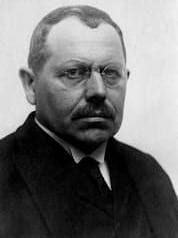
Fritz de Quervain (1868-1940) was a Swiss surgeon.
A true General surgeon who published his work prolifically, wrote a widely used major textbook on surgery and designed an innovative operating table and autoclave for sterilisation. Major interest in the epidemiology of many diseases and perhaps can be described as one of the fathers of modern clinical research.
Published over 300 papers, many of which were devoted to thyroid disease from the epidemiology of thyroid disease to technical procedures relating to thyroidectomy. Worked extensively in disease of the thyroid and defining subacute thyroiditis (De Quervain subacute struma). Evaluated cases of complete testicular feminization the commonest form of male pseudohermaphroditism. Introduced iodised table salt in the treatment of thyroid disease.
One of the earliest clinicians to appreciate that post operative pneumonia was often really a pulmonary infarct due to embolism. In 1894 He described the chronic tendonitis that bears his name De Quervain disease
Biography
- Born on May 4, 1868, Sion, Valais, Switzerland
- 1892 – Qualified in medicine from the University of Bern
- 1893-1894 Surgical assistant to Emil Theodor Kocher at Inselspital – Universitätsspital Bern
- 1895 – Surgical resident La Chaux-de-Fonds in the canton of Neuchâtel
- 1910 – Chair of surgery University of Basel
- 1918 – Succeeded Kocher as professor of surgery at Inselspital – Universitätsspital Bern
- 1920 – President of the Schweizerische Gesellschaft für Chirurgie
- 1938 – Retired
- Died on January 24, 1940 of acute pancreatitis
Medical Eponyms
De Quervain disease (1894)
Chronic tenosynovitis that thickens the tendon sheaths of the abductor muscle long of the thumb and of the extensor short muscle of the thumb.
De Quervain was not first to describe the first painful disorder of the thumb tendon sheaths. Velpeau, Tillaux, and Gray had previously described crepitating overuse tenosynovitis. His contribution was to define a chronic, non-tuberculous, stenosing tendovaginitis at the radial styloid, involving the tendon compartment of the abductor pollicis longus and extensor pollicis brevis. De Quervain showed that operative release or excision of the constricting sheath could cure the condition.
1894 – de Quervain in La Chaux-de-Fonds, recognised a painful thumb-extensor disorder after seeing Mrs D on December 18, 1894 with severe pain in the region of the thumb extensor. He recalled an earlier similar case, Mrs L, observed while he was first assistant to Theodor Kocher (1841–1917) in Bern. That case showed painful thumb movement, tenderness, and slight thickening of the tendon-sheath compartment of the extensor pollicis brevis and abductor pollicis longus near the distal radius.
1895 – de Quervain operated on Mrs D on January 8, 1895, with the same favourable result as the earlier Kocher clinic case. He then published three personal cases and two additional cases supplied by Dr Sandos in Ueber eine Form von chronischer Tendovaginitis / On a Form of Chronic Tendovaginitis. The paper described the clinical syndrome, operative treatment, and distinction from trigger finger.
Original
English
Die Patienten empfinden bei Bewegungen des Daumens mehr oder weniger heftige, von der Handwurzelgegend nach dem Daumen und dem Vorderarm ausstrahlende Schmerzen…Crepitation ist nicht vorhanden. de Quervain, 1895
With movements of the thumb, the patients experience more or less severe pain radiating from the wrist region toward the thumb and forearm…Crepitation is not present. de Quervain, 1895
1895 – de Quervain wrote to Kocher, who replied that he had seen three or four similar cases and had treated them by partial excision of the tendon sheath. Kocher referred to the condition as “fibrous, stenosed tendovaginitis.” Kocher had prior experience and terminology, but de Quervain published the defining account.
1912 – de Quervain returned to the subject with eight additional cases and further comments on the aetiology, pathogenesis, and treatment of stenosing tendovaginitis at the radial styloid.
De Quervain separated his chronic stenosing disorder from the older crepitating tenosynovitis of Velpeau and Tillaux, writing in 1912 that it “must not be confused with so-called crepitating tendovaginitis.” At operation he found a mechanical stenosis with the sheath “too narrow for the two tendons,” and when opened, the tendons “bulged out” of the compartment.
Original
English
..dass die Erkrankung nicht mit der sogen. Tendovaginitis crepitans verwechselt werden darf..das Sehnenscheidenfach als zu eng für die beiden Sehnen. Das Fach wird durch einen Schnitt parallel den Sehnen eröffnet, und nun quellen die Sehnen sozusagen aus demselben hervor.
.. the disease must not be confused with so-called crepitating tendovaginitis…the tendon-sheath compartment appeared too narrow for the two tendons. The compartment is opened by an incision parallel to the tendons, and the tendons then, so to speak, bulge out of it.
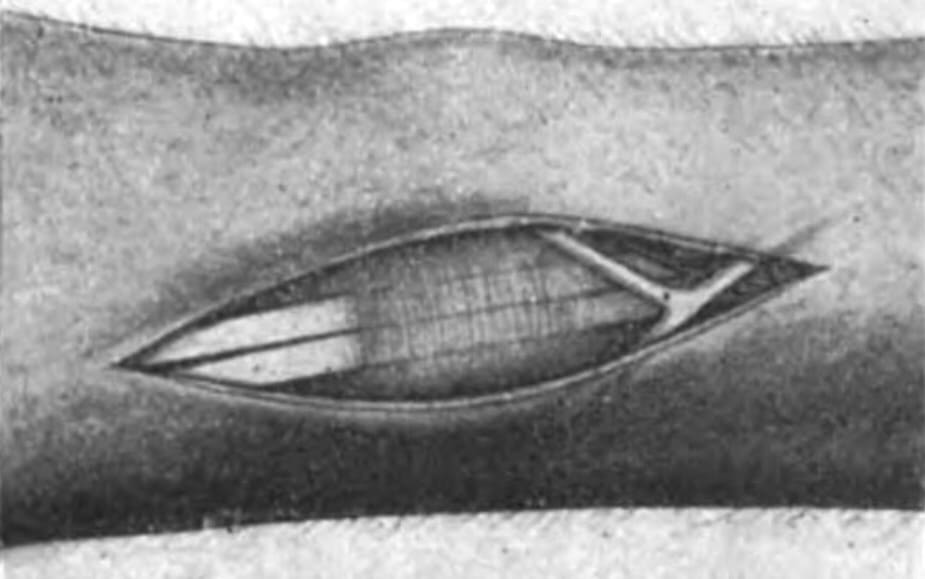
On December 18, 1894, De Quervain, described tenosynovitis in Mrs. D., a 35-year-old woman who had severe pain in the extensor muscle region of the thumb, excluding tuberculosis.
It is a condition affecting the tendon sheaths of the abductor pollicis longus, and the extensor pollicis brevis. It has definite symptoms and signs. The condition may affect other extensor tendons at the wrist
De Quervain F. 1895
The term “de Quervain’s tenosynovitis” may be a misnomer. In fact, de Quervain credits Emil Theodor Kocher with the first description of the disease and first surgical treatment. [PMID 9316729]
A similar tenosynovitis had been described previously by Tillaux (the “aïe” crepitant) and by Grais in 1893 as ‘wasp disease’.
The Finkelstein test or modified Eichhoff test can be used to confirm the diagnosis.
De Quervain thyroiditis
Subacute, non-bacterial inflammation of the thyroid gland, often after viral infection of respiratory tract. Self-limiting granulomatous inflammatory disorder, which is thought to be virally induced in genetically predisposed individuals.
Characterized by thyroid pain and thyrotoxicosis, as well as by systemic symptoms like fever, hepatic cytolysis, and an elevated ESR. Often mistaken for an upper respiratory tract infection.
Major Publications
- de Quervain F. Über die Veränderung des Centralnervensystems bei experimenteller Kachexia thyreopriva der Thiere. MD thesis. Bern: University of Bern, 1893.
- de Quervain F. Ueber eine Form von chronischer Tendovaginitis. Correspondenz-Blatt für Schweizer Aerzte, Basel, 1895; 25: 389-394.
- de Quervain F. Ueber acute, nicht eiterige Thyreoiditis. Archiv für klinische Chirurgie, Berlin, 1902; 67: 706-714.
- de Quervain F. Ueber acute, nicht eiterige Thyreoiditis. Verhandlungen. Deutsche Gesellschaft für Chirurgie 1902; 31: 118–126
- de Quervain F. Die akute, nicht eitrige Thyreoiditis und die Beteiligung der Schilddrüse an akuten Intoxikationen und Infektionen überhaupt. 1904: 1-23
- de Quervain F. Die akute, nicht eiterige Thyreoiditis; und die Beteiligung der Schilddrüse an akuten Intoxikationen und Infektionen überhaupt. Mitteilungen aus den Grenzgebieten der Medizin und Chirurgie. 1904: 2: Supplementband
- de Quervain F. Spezielle Chirurgische diagnostik für Studierende und Ärzte. 1907 [2e 1910, 4e 1913]
- de Quervain F. Veber das Wesen und die Behandlung der stenosierenden Tendovaginitis am Processus styloideus radii. Münchener Medizinische Wochenschrift 1912; 59: 5–6.
- de Quervain F. Clinical Surgical Diagnosis for students and practitioners. 1913 [3e 1921]
- de Quervain F. Ein Fall von Pseudohermaphrodismus masculinus. Schweizerische medizinische Wochenschrift. 1923; 53: 563.
- de Quervain F. Goitre : a contribution to the study of the pathology and treatment of the diseases of the thyroid gland. 1924
References
Biography
- Terrier G. Le docteur Fritz de Quervain à La Chaux-de-Fonds (1894-1910). Rev Med Suisse Romande. 1998 Mar;118(3):193-201.
- Serpell J. Fritz de Quervain. In: Pasieka J, Lee J. (eds) Surgical Endocrinopathies. 2015: 49-51
Eponymous terms
- Troehler U. Quelques médecins suisses et leur apport à la chirurgie de la main. Helv Chir Acta. 1977 Oct;44(4):569-79.
- De Quervain’s stenosing tenovaginitis: Fritz de Quervain, 1868-1940. Orthop Nurs. 1982 Sep-Oct;1(5):24-5
- Grundmann R. Zur Operationstischfrage (anlässlich des 126. Geburtstags von F. de Quervain) . Zentralbl Chir. 1994;119(6):449-50.
- Bon R, Rabitti PG. Tiroidite di De Quervain: concetti attuali e nostra casistica. De Quervain’s thyroiditis: current concepts and a report of four cases. Italian Journal of Medicine 2011; 5: 49-54
- de Quervain F. On a form of chronic tendovaginitis by Dr. Fritz de Quervain in la Chaux-de-Fonds. 1895. Am J Orthop (Belle Mead NJ). 1997;26(9):641-4.
- de Quervain F. On a form of chronic tendovaginitis. [Translated article: Correspondenz-Blatt für schweizer Aerzte 1895; 25: 389-94]. J Hand Surg Br. 2005 Aug;30(4):388-91
Eponym
the person behind the name

Studying for Bachelor of Science (Occupational Therapy) at Curtin University

BA MA (Oxon) MBChB (Edin) FACEM FFSEM. Emergency physician, Sir Charles Gairdner Hospital. Passion for rugby, medical history, medical education, and asynchronous learning #FOAMed evangelist. Editor-in-Chief and Webmaster of Life in the Fast lane, LITFL | On Call 4e| Eponyms | Books | Horology |