


George Phalen
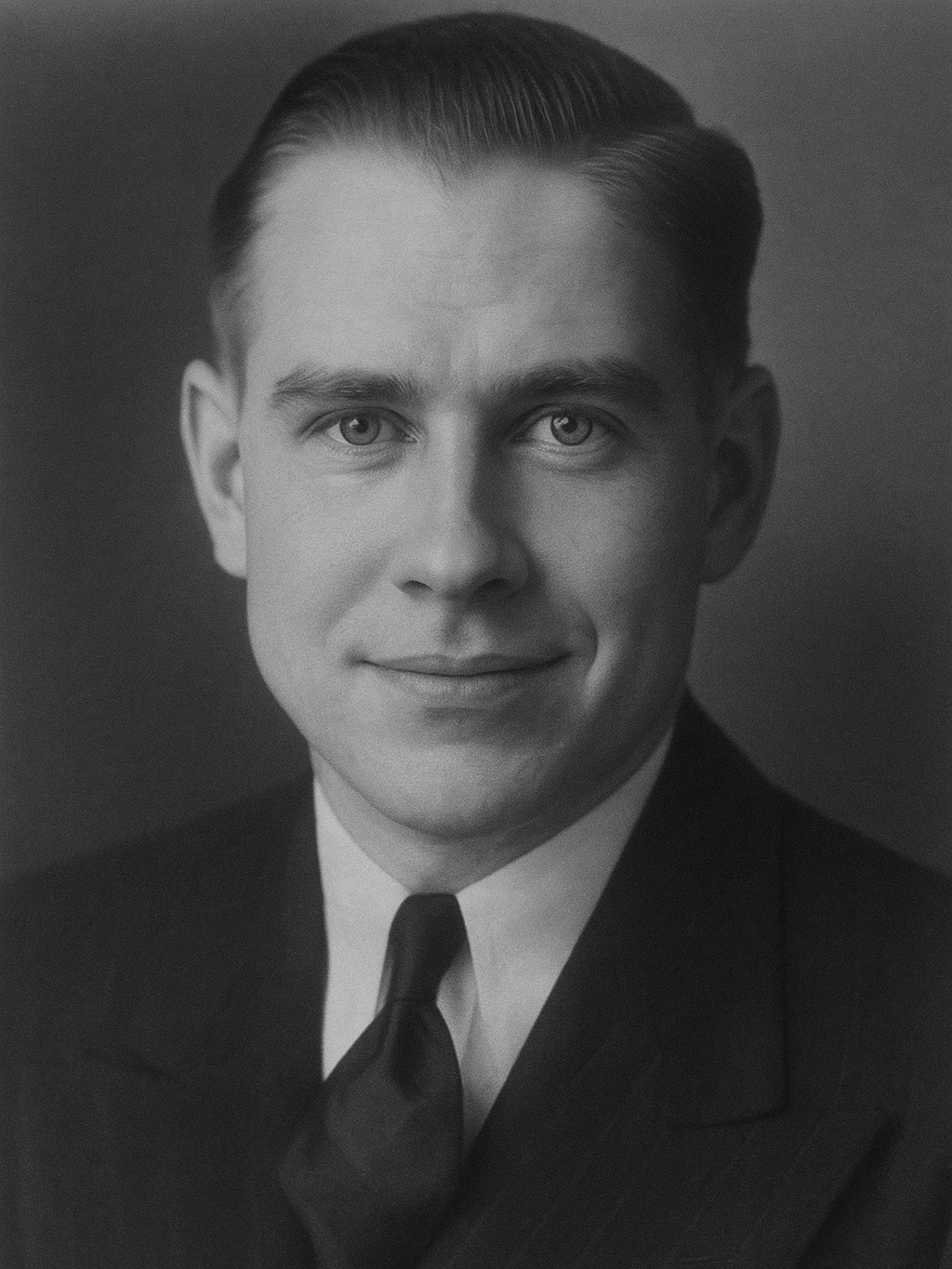
George Smith Phalen (1911-1998) was an American Orthopedic Surgeon.
Phalen was a leading figure in the development of hand surgery in the United States. He trained at Northwestern University and the Mayo Clinic, served in United States Army hand centres during the Second World War, and later established an orthopaedic hand surgery practice at the Cleveland Clinic.
Phalen is remembered for his decades-long work on carpal tunnel syndrome. Between 1950 and 1981, his publications clarified the syndrome’s anatomy, clinical features, diagnosis, and surgical management. Phalen helped transform a previously fragmented group of median nerve disorders into one of the most recognisable and treatable entrapment neuropathies. His name is attached to the Phalen test, the wrist-flexion provocation test for carpal tunnel syndrome.
Biography
- Born December 2, 1911, Peoria, Illinois
- 1932 – Graduated from Bradley University, Peoria, Illinois.
- 1937 – Earned a master’s degree in anatomy and medical degree from Northwestern University, Illinois
- 1937–1940 – Completed a three-year residency in orthopaedic surgery at the Mayo Clinic, Rochester, Minnesota.
- 1942 – Entered the United States Army. Rose to lieutenant colonel and became chief of the Orthopaedic Section at O’Reilly General Hospital, Springfield, Missouri, one of the Army Hand Centers.
- 1945 – Served during the final six months of the war as chief of the Hand Service at William Beaumont General Hospital, El Paso, Texas. Established a practice in orthopaedic hand surgery at the Cleveland Clinic and taught at Western Reserve University School of Medicine.
- 1946 – Helped organise the first meeting of the American Society for Surgery of the Hand and later served as secretary-treasurer and president (1961).
- 1948 – Announced his diagnostic wrist-flexion test (Phalen test) for carpal tunnel syndrome at a meeting of the American Society for Surgery of the Hand
- 1950 – With W. James Gardner and Albert A. La Londe, published Neuropathy of the median nerve due to compression beneath the transverse carpal ligament, defining spontaneous median nerve compression at the wrist as a surgically treatable syndrome.
- 1951 – Published Spontaneous compression of the median nerve at the wrist, further establishing the clinical syndrome and diagnostic approach.
- 1957 – Published The carpal tunnel syndrome.
- 1965 – President of the Association of Bone and Joint Surgeons.
- 1966 – Published a 17-year review on managing The carpal-tunnel syndrome
- 1969 – Chair of the Orthopaedic Section of the American Medical Association.
- 1970 – Received the Distinguished Alumnus Award from Bradley University. After 24 years at the Cleveland Clinic, moved to Texas and joined the Dallas Medical and Surgery Clinic.
- 1972 – Published The carpal-tunnel syndrome. Clinical evaluation of 598 hands
- 1980 – Retired from medical practice.
- 1981 – Published The birth of a syndrome, or carpal tunnel revisited.
- Died on April 14, 1998 in Dallas, Texas, aged 86
Medical Eponyms
Phalen test
Phalen sign is reproduction or exaggeration of numbness and paraesthesia in the median nerve distribution of the hand after sustained wrist flexion. The Phalen test is used as a provocative manoeuvre in suspected carpal tunnel syndrome.
Phalen originally described the manoeuvre as the wrist-flexion test. The patient places the flexed elbows on a table, holds the forearms vertically, and allows the hands to fall freely into maximum wrist flexion. The fingers remain extended; the hands do not touch and are not forced into flexion by the patient or examiner. A positive test reproduces or worsens median-distribution symptoms, usually within 30–60 seconds.

Phalen explained the mechanism as increased compression of the median nerve within the carpal tunnel. In wrist flexion, the nerve is compressed between the proximal edge of the transverse carpal ligament and the adjacent flexor tendons and radius. In a normal hand, prolonged wrist flexion may eventually produce tingling; in carpal tunnel syndrome, symptoms are provoked more rapidly.
In performing the so called wrist-flexion test, the patient is asked to hold their forearms vertically and allow both hands to drop into complete flexion at the wrist for approximately one minute. In this position the median nerve is squeezed between the proximal edge of the transverse carpal ligament and the adjacent flexor tendons ad radius. Maintaining this position for a long time eventually causes numbness and tingling over the distribution of the median nerve
Phalen 1950
Vargas Busquets later recorded Phalen personally demonstrating the test in 1989, emphasising that the wrists should fall freely into flexion, with the hands not touching and not forced into position.
The original Phalen wrist-flexion test was described by George Smith Phalen. Subsequent clinical teaching introduced modified Phalen wrist-flexion variants, most commonly the dorsum-to-dorsum posture. The reverse Phalen test, or Wormser test, is a separate wrist-extension manoeuvre.
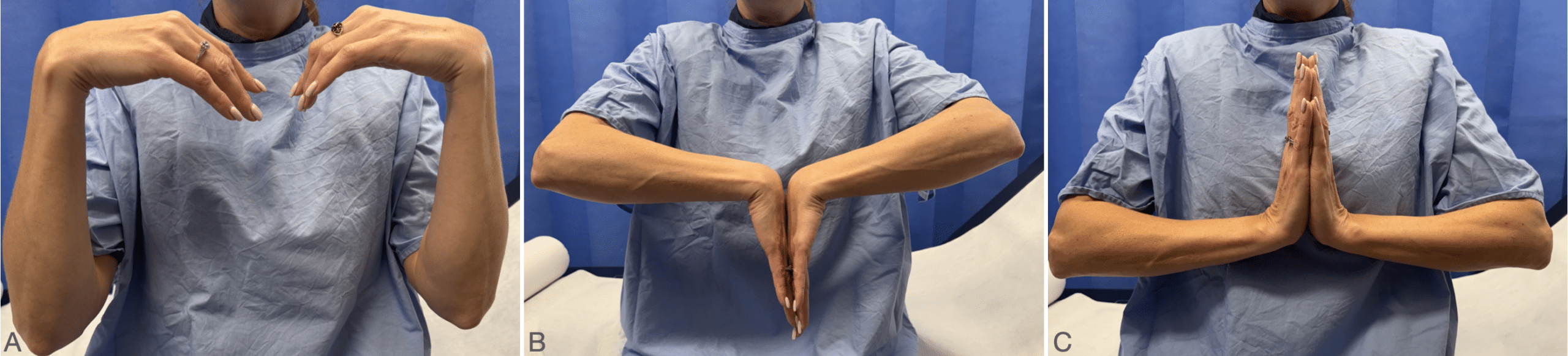
A. Classic Phalen wrist-flexion test: forearms vertical, wrists allowed to fall freely into flexion, hands not touching.
B. Modified Phalen test: dorsal surfaces of the hands placed together to maintain bilateral wrist flexion.
C. Reverse Phalen / Wormser test: palms together with wrists extended.
Major Publications
- Phalen GS, Gardner WJ, Londe AA. Neuropathy of the median nerve due to compression beneath the transverse carpal ligament. J Bone Joint Surg Am. 1950; 32A(1): 109-12.
- Phalen GS. Spontaneous compression of the median nerve at the wrist. JAMA 1951;145:1128-1133.
- Phalen GS. The carpal tunnel syndrome. Instr Course Lect. 1957; 14: 142-8.
- Phalen GS. The carpal-tunnel syndrome. Seventeen years’ experience in diagnosis and treatment of six hundred fifty-four hands. J Bone Joint Surg Am. 1966;48(2):211-228.
- Phalen GS. The diagnosis of carpal tunnel syndrome. Cleve Clin Q. 1968; 35(1): 1-6.
- Phalen GS. Reflections on 21 years’ experience with the carpal-tunnel syndrome. JAMA. 1970; 212(8): 1365-7.
- Phalen GS. The carpal-tunnel syndrome. Clinical evaluation of 598 hands. Clin Orthop Relat Res. 1972; 83: 29-40
- Phalen GS. The birth of a syndrome, or carpal tunnel revisited. J Hand Surg Am. 1981; 6(2): 109-10.
References
- Amadio PC. The Mayo Clinic and Carpal Tunnel Syndrome. Mayo Clin Proc 1992; 67: 42-48
- Pearce JMS. James Paget’s median nerve compression (Putnam’s acroparaesthesia). Pract Neurol. 2009; 9(2): 96-9.
- Boskovski MT, Thomson JG. Acroparesthesia and carpal tunnel syndrome: a historical perspective. J Hand Surg Am. 2014 Sep;39(9):1813-1821.e1
- Boskovski MT, Thomson JG. Carpal tunnel syndrome, syndrome of partial thenar atrophy, and W. Russell Brain: a historical perspective. J Hand Surg Am. 2014 Sep;39(9):1822-1829.e1
- Phalen, George S – Encyclopedia of Cleveland History; Cape Western University
- Joseph Z. Clinical Signs in Carpal Tunnel Syndrome. 2020
Eponym
the person behind the name

Studying for Bachelor of Science (Occupational Therapy) at Curtin University

BA MA (Oxon) MBChB (Edin) FACEM FFSEM. Emergency physician, Sir Charles Gairdner Hospital. Passion for rugby, medical history, medical education, and asynchronous learning #FOAMed evangelist. Editor-in-Chief and Webmaster of Life in the Fast lane, LITFL | On Call 4e| Eponyms | Books | Horology |