


Gissane angle
Gissane angle [crucial angle, critical angle] is an obtuse angle visible on a lateral radiograph of the calcaneus, immediately inferior to the lateral process of the talus. It is formed by the intersection of a line along the downward slope of the posterior calcaneal facet and a line along the upward slope of the anterior calcaneal process.
The angle reflects the relationship between the posterior subtalar facet and the anterior calcaneus. Disruption or distortion may accompany an intra-articular calcaneal fracture, particularly where the primary fracture line passes through this region.
A normal value is commonly quoted as 100–130° or 120–145°, although published measurements extend approximately from 95° to 150° and do not support a single reliable diagnostic threshold.
Modern use and context
The critical or historically, crucial angle of Gissane is measured on a lateral foot or calcaneal XR:
- Draw a line along the downward slope of the posterior facet.
- Draw a second line from the calcaneal sulcus along the superior surface of the anterior process.
- Measure the obtuse angle where the two lines meet beneath the lateral talar process.
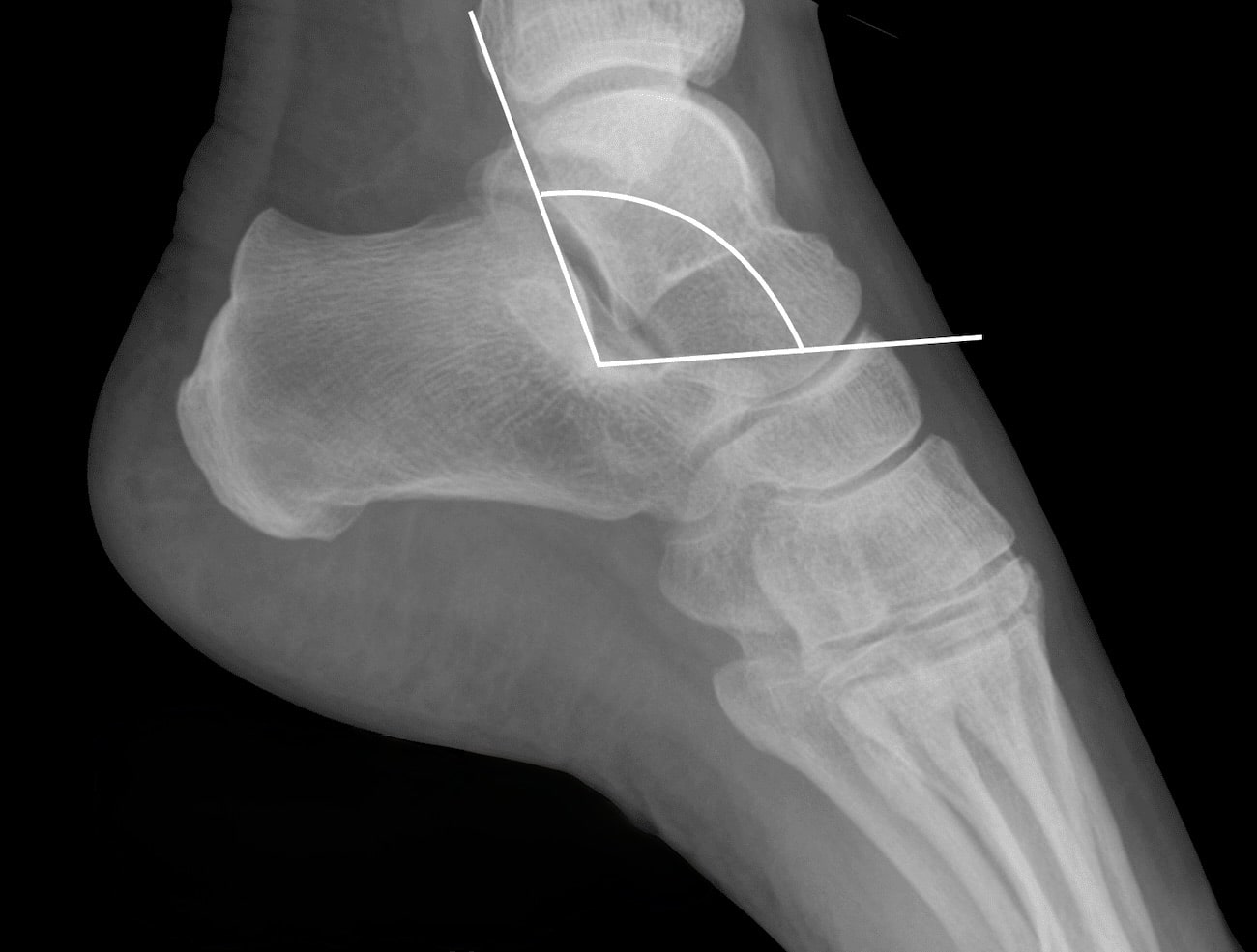
The angle represents the junction of two strong subchondral cortical struts. During axial loading, the lateral process of the talus acts as a wedge against this region; the primary fracture line of many displaced intra-articular calcaneal fractures passes through or close to the angle. The resulting measurement may be widened, reduced, reversed or obscured depending upon posterior-facet depression, fragment rotation and comminution. It is therefore better understood as a marker of distortion of subtalar anatomy than as a simple binary fracture test.
Clinical function
The Gissane angle may provide a rapid indication that the normal superior calcaneal contour has been disrupted and can be used descriptively before and after reduction. It may complement the Böhler angle, but neither measurement defines the location, number or displacement of articular fragments. Computed tomography remains necessary for detailed assessment and classification of displaced intra-articular fractures.
The principal limitations are:
- considerable variation in reported normal values;
- difficulty identifying the landmarks in comminuted fractures;
- poor or inconsistent interobserver reliability;
- limited value as an independent diagnostic test; and
- weak evidence that restoration of the angle predicts functional outcome.
A normal Gissane angle does not exclude a calcaneal fracture, and an abnormal measurement should not determine treatment in isolation.
| Measurement | Anatomical relationship | Principal implication |
|---|---|---|
| Gissane angle | Posterior facet to anterior process at the calcaneal sulcus | Distortion of the subtalar articular region |
| Böhler angle | Calcaneal tuberosity, posterior facet and anterior process | Loss of calcaneal height and posterior-facet depression |
The two measurements describe different consequences of calcaneal injury and should not be used interchangeably.
History of the Gissane angle
1931 – Lorenz Böhler (1885–1973) described the tuber-joint angle, now the Böhler angle, as a measure of calcaneal flattening and loss of height following depression of the posterior facet. His work established the importance of lateral radiographic geometry in calcaneal fractures but did not describe the angle later associated with Gissane.
1946 – William Gissane (1898–1981) presented “Fractures of the os calcis” at the October 1946 meeting of the British Orthopaedic Association. The discussion was published in the 1947 proceedings.
The normal os calcis has a number of features on radiological examination which are important to an understanding of fracture anatomy. There is a strong and thick cortical strut extending on the upper and outer side from the front of the bone to the posterior margin of the posterior subtaloid joint. This strut is angled and the angle supports the sharp lateral spur of the talus. This angle, with the wedge just above it, is of considerable importance and has been termed the ‘crucial angle’
Gissane, 1947; quoted by Essex-Lopresti (1952)
The surviving published discussion is brief and does not appear to have established a rigorously measured normal range. Much of the later understanding of the landmark derives from Essex-Lopresti’s subsequent account.
1952 – Peter Gordon Lawrence Essex-Lopresti (1916–1951) published The mechanism, reduction technique, and results in fractures of the os calcis. Essex-Lopresti credited Gissane and incorporated the crucial angle into his explanation of calcaneal fracture mechanics. He described the lateral process of the talus acting as a wedge at the angle, initiating a primary fracture line that separated the sustentacular fragment from the tuberosity and lateral wall. Secondary fracture propagation then produced the tongue-type or joint-depression patterns bearing Essex-Lopresti’s name.
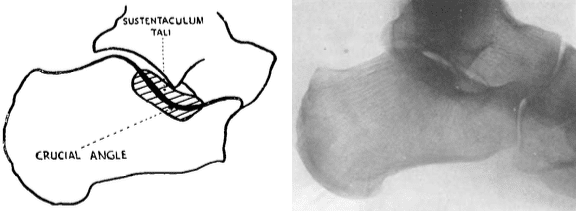
Gissane identified and named the crucial angle. Essex-Lopresti subsequently explained, illustrated and popularised its role in calcaneal fracture mechanics.
1992 – Roy Sanders reviewed contemporary treatment of intra-articular calcaneal fractures as computed tomography increasingly replaced plain radiographs for detailed classification. The Gissane and Böhler angles remained useful descriptive measurements, but CT allowed direct assessment of posterior-facet comminution and fragment position that could not be inferred reliably from either angle alone.
2006 – Knight et al evaluated 65 CT-confirmed calcaneal fractures and 68 controls. Emergency physicians diagnosed fractures from the radiographs with an overall accuracy of 97.9%. The Gissane angle performed poorly as an additional diagnostic test, with receiver-operating-characteristic areas of 0.45–0.67 and interobserver reliability of 0.52.
The findings suggest that direct recognition of the fracture and disruption of calcaneal anatomy is more useful than applying a strict numerical threshold.
2010 – Clint et al measured Böhler and Gissane angles in 227 paediatric radiographs. Whereas Böhler-angle measurement showed excellent interobserver and intraobserver agreement, measurement of the Gissane angle was fair or poor across most age groups. Normal adult thresholds should therefore not be applied uncritically to skeletally immature patients.
2011 – Boyle, Walker and Crawford measured the crucial angle of Gissane on 763 normal paediatric radiographs and 100 adult comparison radiographs. The mean angle was 111.3° in children and 113.8° in adults, with broad ranges of 90.1–147° and 97.1–132° respectively. The angle showed relatively little age-related variation apart from the youngest children, in whom incomplete ossification made measurement more variable.
2015 – Otero and colleagues asked four orthopaedic surgeons to measure the Böhler and Gissane angles on 34 preoperative and postoperative radiographs. Interobserver reliability for the Gissane angle was poor, with ICC values of 0.28 and 0.10 in the two assessment sessions; substantial disagreement persisted even when a wide measurement tolerance was allowed
2020 – De Boer and colleagues tested lateral radiographs of 15 anatomical specimens at progressive angular deviations. Gissane’s angle was relatively resistant to most positioning changes, although marked cranial obliquity reduced the mean measurement by as much as 8.8°. The authors concluded that modest malpositioning alone did not explain the wider problems with reliability.
2021 – Bulut and Gursoy studied 82 postoperative lateral radiographs measured by a radiologist and an orthopaedic surgeon. Reliability coefficients ranged from moderate to very high, but interobserver differences for the Gissane angle averaged approximately 5–7°, and apparent postoperative changes were frequently false-positive. They advised against using either calcaneal angle as a solitary guide during follow-up.
Eponymic interpretation
The available historical literature supports Gissane as the originator of the crucial angle concept. Unlike many eponyms, no earlier equivalent description has yet been identified. Böhler had previously established the value of radiographic angular assessment but measured a different anatomical relationship.
The terminology subsequently drifted from “crucial angle”, Gissane’s apparent original wording, to “critical angle of Gissane.” Essex-Lopresti deserves particular recognition for preserving the description, relating it to the fracture mechanism and establishing its place in calcaneal-fracture literature.
Associated Persons
- Lorenz Böhler (1885-1973) [Böhler angle]
- William Gissane (1898-1981) [Critical angle of Gissane]
- Peter Gordon Lawrence Essex-Lopresti (1916-1951)
Alternative names
- Gissane angle
- Gissane’s angle
- Crucial angle
- Crucial angle of Gissane
- Critical angle of Gissane
References
Historical articles
- Gissane W. Discussion on “Fractures of the os calcis” (Proceedings of the British Orthopaedic Association, 1946). J Bone Joint Surg Am 1947; 29: 254–255
- Essex-Lopresti P. The mechanism, reduction technique, and results in fractures of the os calcis. Br J Surg. 1952 Mar;39(157):395-419.
Review articles
- Sanders R. Intra-articular fractures of the calcaneus: present state of the art. J Orthop Trauma. 1992; (2): 252-265.
- Knight JR, Gross EA, Bradley GH, Bay C, LoVecchio F. Boehler’s angle and the critical angle of Gissane are of limited use in diagnosing calcaneus fractures in the ED. The American Journal of Emergency Medicine, 2006; 24(4): 423–427
- Clint SA, Morris TP, Shaw OM, Oddy MJ, Rudge B, Barry M. The reliability and variation of measurements of the os calcis angles in children. J Bone Joint Surg Br. 2010 Apr;92(4):571-5.
- Boyle MJ et al. The paediatric Bohler’s angle and crucial angle of Gissane: a case series. Journal of Orthopaedic Surgery and Research 2011, 6:2
- Arslan G, Yirgin IK, Tasguzen A. A measuremental approach to calcaneal fractures. Eur J Trauma Emerg Surg. 2014; 40(5): 593-9
- Otero JE, Westerlind BO, Tantavisut S, Karam MD, Phisitkul P, Akoh CC, Gao Y, Marsh JL. There is poor reliability of Böhler’s angle and the crucial angle of Gissane in assessing displaced intra-articular calcaneal fractures. Foot Ankle Surg. 2015 Dec;21(4):277-81.
- De Boer AS, Van Lieshout EMM, Vellekoop L, Den Hartog D, Kleinrensink GJ, Verhofstad MHJ. The Influence of Radiograph Obliquity on Böhler’s and Gissane’s Angles in Calcanei. J Foot Ankle Surg. 2020 Jan-Feb;59(1):44-47.
- Bulut T, Gursoy M. Are radiological measurements reliable methods in the postoperative follow-up of calcaneal fractures? Niger J Clin Pract. 2021 Jan;24(1):110-114.
- Cadogan M. Eponymythology of foot injuries. LITFL
eponymictionary
the names behind the name
BA MA (Oxon) MBChB (Edin) FACEM FFSEM. Emergency physician, Sir Charles Gairdner Hospital. Passion for rugby, medical history, medical education, and asynchronous learning #FOAMed evangelist. Editor-in-Chief and Webmaster of Life in the Fast lane, LITFL | On Call 4e| Eponyms | Books | Horology |