


John J. Gartland
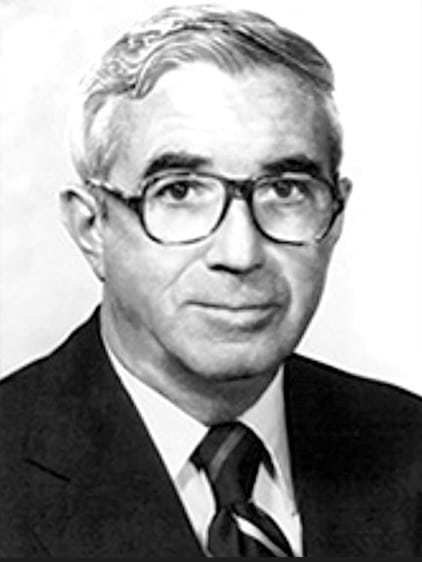
John Joseph Gartland (1918-2016) was an American orthopaedic surgeon
Born with bilateral clubfeet and treated with braces and corrective surgery during childhood, Gartland later pursued orthopaedics at Jefferson Medical College and the New York Orthopaedic Hospital. He became chair of orthopaedic surgery at Thomas Jefferson University, where he expanded the residency programme, strengthened subspecialty teaching and promoted a close relationship between clinical practice, education and scientific publication.
Gartland is remembered principally for two orthopaedic eponyms. With Charles W. Werley, he developed the Gartland–Werley classification and demerit score for evaluating healed Colles fractures; in 1959, he introduced the original three-part Gartland classification of paediatric supracondylar humeral fractures. He served as president of the American Academy of Orthopaedic Surgeons, was a senior editor with the Journal of Bone and Joint Surgery, and remained closely involved in medical writing and education long after retiring from clinical leadership.
Biographical Timeline
- Born on November 16, 1918 in Philadelphia, Pennsylvania
- 1941 – Graduated from Princeton University with a bachelor’s degree in chemistry.
- 1944 – Graduated MD from Jefferson Medical College.
- 1946–1948 – Served as a captain in the United States Army Medical Corps, stationed at Fort George G. Meade, Maryland.
- 1948–1952 – Completed orthopaedic training at Jefferson and the New York Orthopaedic Hospital within Columbia–Presbyterian Medical Center.
- 1951 – With Charles W. Werley, published Evaluation of healed Colles’ fractures subsequently known as the Gartland–Werley classification.
- 1952 – Returned to Jefferson as an instructor in orthopaedic surgery after completing his residency.
- 1954–1960 – Attending orthopaedic surgeon at Fitzgerald Mercy Hospital.
- 1959 – Published Management of supracondylar fractures of the humerus in children later known as the Gartland classification
- 1960–1968 – Chief of orthopaedic surgery at Methodist Hospital in Philadelphia.
- 1961 – Elected president of the Pennsylvania Orthopaedic Society.
- 1965 – Published the first edition of Fundamentals of Orthopaedics, written as an introductory text for medical students
- 1966–1978 – Served as an associate editor of the Journal of Bone and Joint Surgery
- 1968 – Associate professor of orthopaedic surgery at Jefferson and chief of orthopaedic surgery at Lankenau Hospital
- 1970 – President of the Philadelphia Orthopaedic Society. Chair of Jefferson’s Department of Orthopaedic Surgery, its first full-time professor of orthopaedic surgery.
- 1977–1979 – First vice-president and then president of the American Academy of Orthopaedic Surgeons.
- 1981 – Friends and colleagues presented Gartland’s portrait to Thomas Jefferson University. Surplus funds from the presentation established support for an annual Gartland Lecture through the Philadelphia Orthopaedic Society.
- 1985 – James Edwards Professor Emeritus of Orthopaedic Surgery.
- 1985–2008 – Continued at Jefferson as hospital and university medical editor, assisting students and colleagues with manuscripts, academic projects and publications.
- 2007 – With Mithilesh Lal, published Better Physician Writing and Speaking Skills
- 2008 – Retired aged 90
- 2009 – Awarded honorary Doctor of Science degree, Thomas Jefferson University.
- Died of heart failure on November 21, 2016 at Haverford Estates in Haverford, Pennsylvania, aged 98. He was survived by four children, ten grandchildren and four great-grandchildren
Medical Eponyms
Gartland–Werley classification and demerit score (1951)
The Gartland–Werley system was developed to evaluate the anatomical and functional results of healed Colles fractures. The original paper divided fractures into three broad groups according to comminution, extension into the radial articular surface and displacement of the fragments.
- Group I – Simple extra-articular Colles fracture. No involvement of radial articular surface.
- Group II – Comminuted fracture extending into the radial articular surface without significant displacement of the articular fragments.
- Group III – Comminuted intra-articular fracture with displacement of the fragments.
Gartland and Werley found that fracture morphology influenced prognosis, with unsatisfactory outcomes occurring more often after comminuted fractures. Residual dorsal tilt had a stronger association with poor function than radial shortening, radial deviation or distal radioulnar-joint incongruity.
Although 68.3% of their patients achieved satisfactory functional results, 60% of the fractures had healed in a position resembling an unreduced Colles fracture; they attributed the unsatisfactory results principally to incomplete reduction and inadequate immobilisation
The system is sometimes described simply as the Gartland–Werley classification, but the related Gartland–Werley demerit score became the more enduring contribution. It assesses four domains:
- residual deformity
- subjective symptoms and disability
- objective restriction of wrist and forearm movement
- complications, including post-traumatic arthritis, nerve dysfunction and impaired hand function.
Demerit points are added, with a lower total representing the better result:
- 0–2 – Excellent
- 3–8 – Good
- 9–20 – Fair
- 21 or more – Poor
Later modifications added measurements such as grip strength and pronation. It is an observer-based score rather than a purely patient-reported outcome measure, and formal evidence for its reliability and responsiveness is limited.
Gartland classification of supracondylar humeral fractures (1959)
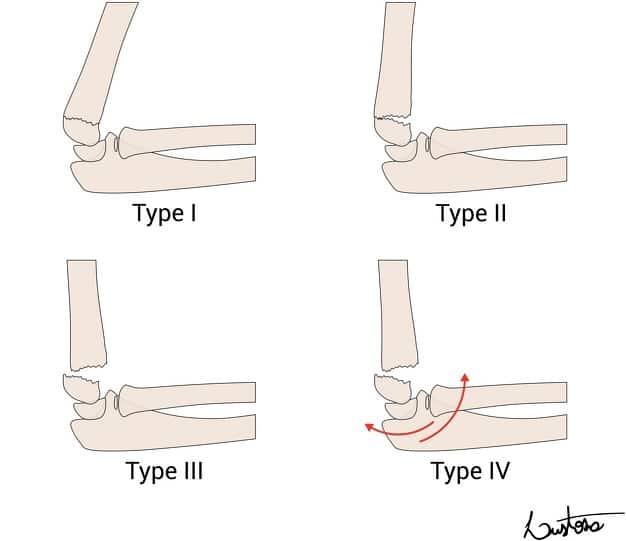
The Gartland classification describes extension-type supracondylar fractures of the humerus in children according to the degree of displacement. His original classification contained three broad categories:
- Type I – Nondisplaced fracture.
- Type II – Moderately displaced fracture, usually with posterior displacement of the distal fragment.
- Type III – Severely displaced and frequently rotated fracture.
Gartland emphasised repeated assessment of the circulation and peripheral nerves as well as recognition of swelling and instability and avoidance of excessive elbow flexion. Proposed treatment was according to displacement and the ability to maintain reduction. Gartland noted that many associated nerve injuries were transient but required careful documentation and observation.
Gartland used the three groups to organise treatment, emphasising careful neurological and vascular examination, recognition of instability and avoidance of excessive elbow flexion.
1984 – Kaye Evan Wilkins (1934–2023) published Fractures and Dislocations of the Elbow Region. He replaced Gartland’s subjective distinction between “moderately” and “severely” displaced fractures with the more objective criterion of posterior cortical contact.
Wilkins further divided completely displaced fractures according to the direction of distal-fragment displacement:
- IIIA — posteromedial
- IIIB — posterolateral
2006 – Leitch and colleagues identified nine multidirectionally unstable fractures among 297 operatively treated supracondylar fractures. Under anaesthesia and fluoroscopy, the distal fragment displaced into both flexion and extension because no functioning periosteal hinge remained. They proposed the designation type IV, noting that instability could result from the original injury or arise during attempted reduction. All nine fractures were treated successfully by closed reduction and percutaneous pinning.
Key Medical Contributions
Major Publications
- Gartland JJ Jr, Werley CW. Evaluation of healed Colles’ fractures. J Bone Joint Surg Am. 1951 Oct;33-A(4):895-907 [Gartland–Werley classification]
- MacAusland WR Jr, Gartland JJ, Halford H. The use of hyaluronidase in orthopaedic surgery. J. Bone Surg., 1953, 35(3): 604-684.
- Gartland JJ, Dowling JJ. Recurrent anterior dislocation of the shoulder joint. Clin Orthop. 1954;3:86-91.
- Gartland JJ, MacAusland WR Jr. Use of hyaluronidase in soft tissue injury and its influence on experimental bone repair. Arch Surg., 1954; 68: 305-314.
- Gartland JJ. Management of supracondylar fractures of the humerus in children. Surg Gynecol Obstet. 1959;109:145–154 [Gartland classification]
- Gartland JJ. A state orthopedic society. Pa Med J. 1962 May;65:612.
- Gartland JJ. Supracondylar fractures of the humerus. Medical trial technique quarterly. 1963;10:37–46
- Gartland JJ. Fundamentals of Orthopaedics. 1962 [2e 1974, 3e 1979, 4e 1987]
- De Palma AF, Gartland JJ, Dowling JJ. Colles’ fracture. Pa Med. 1966 Nov;69(11):72-5
- Gartland JJ. Orthopedic surgery. Surg Gynecol Obstet. 1974 Feb;138(2):206-9
- Gartland JJ, Lal M. Better Physician Writing and Speaking Skills 2007
References
Biography
- Holmes KE. John Gartland, surgeon, medical school professor. The Philadelphia Inquirer 2016
- Vaccaro AR. Remembering John J. Gartland, MD. AAOS 2017
Eponymous terms
- Alton TB, Werner SE, Gee AO. Classifications in brief: the Gartland classification of supracondylar humerus fractures. Clin Orthop Relat Res. 2015 Feb;473(2):738-41.
- Shah M, Agashe MV. Supracondylar Humerus Fractures: Classification Based Treatment Algorithms. Indian J Orthop. 2020 Oct 22;55(1):68-80
- Bridges CS, Taylor TN, Han A, Gladstein AZ, Smith BG, Kan JH. The Gartland classification for expediting supracondylar humerus fracture triage: a collaborative approach to structured reporting between pediatric radiologists and orthopedists. Clin Imaging. 2024 May;109:110118.
Eponym
the person behind the name

BA MA (Oxon) MBChB (Edin) FACEM FFSEM. Emergency physician, Sir Charles Gairdner Hospital. Passion for rugby, medical history, medical education, and asynchronous learning #FOAMed evangelist. Editor-in-Chief and Webmaster of Life in the Fast lane, LITFL | On Call 4e| Eponyms | Books | Horology |