
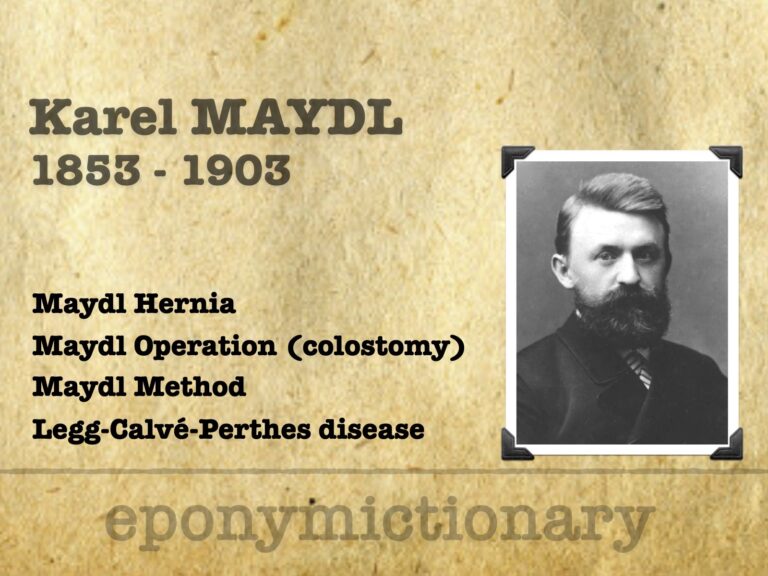
Karel Maydl
Karel Maydl (1853–1903), Czech surgeon, pioneer of colostomy, bladder exstrophy surgery, and Maydl’s hernia; early describer of Legg-Calvé-Perthes disease (LCPD)


Karel Maydl (1853–1903), Czech surgeon, pioneer of colostomy, bladder exstrophy surgery, and Maydl’s hernia; early describer of Legg-Calvé-Perthes disease (LCPD)
Today we cover lateral canthotomy and cantholysis, with a guide made in partnership with a recent publication in Australasian Emergency Care
Understand and identify aortic regurgitation. Learn how to identify and grade aortic regurgitation gradient using measurements and visual clues and quantify aortic regurgitation.
Today we cover lateral canthotomy and cantholysis, with a guide made in partnership with a recent publication in Australasian Emergency Care
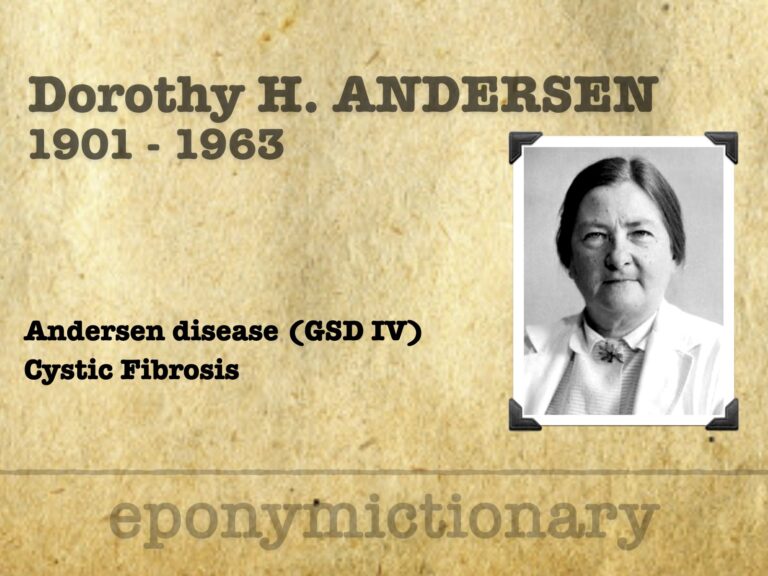
Dorothy Hansine Andersen (1901–1963) was the first to describe cystic fibrosis, shaping paediatric pathology and breaking barriers for women in medicine.
Understand and identify aortic stenosis. Learn how to measure an accurate aortic valve gradient and calculate the aortic valve area. Be able to diagnose low-flow states and paradoxical low flow

Owen Conor Ward (1923–2021), Irish paediatric cardiologist, co-described Romano-Ward syndrome; pioneer of children’s cardiac care and medical historian
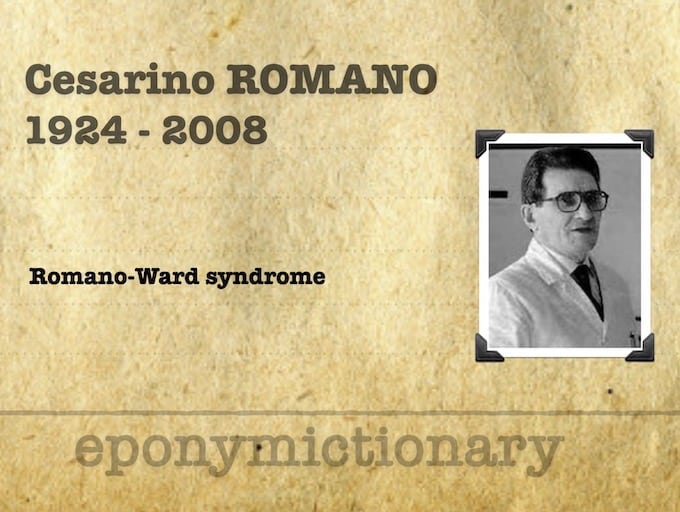
Cesarino Romano (1924–2008), Italian paediatrician, co-described Romano-Ward syndrome; led advances in cystic fibrosis, metabolic screening, and emergency care.

Norwegian internist Fred Lange-Nielsen (1919–1989), co-discoverer of Jervell and Lange-Nielsen syndrome, was a lung specialist, allergy pioneer, jazz musician, and human rights advocate.

Anton Jervell (1901–1987), Norwegian cardiologist and medical educator; co-described Jervell and Lange-Nielsen syndrome, pioneer of ECG research and cardiac electrophysiology in Norway.
Neuro 101: anatomy of the peripheral nervous system, localisation of nerve injuries, pathology affecting peripheral nerves, the brachial and lumbosacral plexuses, peripheral nerve examination, common peripheral neuropathies, and diseases affecting the neuromuscular junction.
Echo basics: Aortic Valve. A normal aortic valve is trileaflet, with equally sized cusps that are supported by a fibrous annulus and separated by three commissures.