


The familiar green and blue-green colours of the modern operating theatre emerged from an attempt to solve the problem that surgeons could no longer see comfortably in an increasingly brightly illuminated, all-white environment.
White had become synonymous with cleanliness, asepsis and modern hospital practice. However, improvements in natural and artificial illumination exposed its disadvantages. Light reflected from white walls, tiles, gowns and drapes produced glare, visual fatigue and transient loss of contrast when the surgeon looked away from the red operative field.
Surgeons experimented with black, grey, ivory, lead, tan and green, while others strongly defended the traditional white theatre. Green became increasingly prominent in the early 1900s with surgeons including Harry Sherman and Berkeley Moynihan reporting reduced glare and greater visual comfort.
Paluel Joseph Flagg attempted to establish a physiological basis for the colour of the operating environment. His work progressed from the clinical measurement of blood colour and oxygenation to the identification of a complementary bluish-green for the operative field.
History
1914 – Harry M. Sherman published The green operating room at St Luke’s Hospital, describing his experiments aimed at reducing the glare and eye fatigue produced by the contemporary all-white operating theatre.
Sherman initially used black cloth around the operative field, but later favoured green. He selected spinach green because it was complementary to the red of blood and tissues. Floors and lower walls were green, while black gowns, towels and instrument covers were used to minimise reflected light.
1915 – Berkeley Moynihan published A green background for the operation area. He reported that he had used green towels and sheets for the preceding two and a half years and had also painted the walls and floor of his operating theatre green.
White, he argued, was “wearisome to the eye and causes fatigue”, whereas “Green is a restful colour, offers no sharp contrast to the colours of the wound surfaces, and allows ligatures and sutures to be clearly seen against it.”
1919 – Not everyone was convinced. For William Lee Secor the answer lay in better control of illumination, rather than coloured walls and drapes. In defense of the white operating room he accepted that glare was a genuine problem but argued that abandoning the white operating theatre was the wrong solution. White reflected light efficiently, made dirt and dried blood easier to detect and remained culturally associated with cleanliness and purity.
The debate concerned more than aesthetics as cleanliness, lighting efficiency, glare, contrast, visual fatigue and even the psychological meaning of colour were all being contested.
1922 – Paluel Joseph Flagg was dissatisfied with subjective descriptions such as mild, moderate and marked cyanosis. He developed an oxyhaemoglobinometer (haemoxometer) to estimate blood oxygenation from colour.
1924 – Flagg applied these colour principles to the operating theatre. In A scientific basis for the use of color in the operating room, he proposed that the problem had three related components: illumination, reflection and colour fatigue.
Flagg tried to identify the true complementary colour to the red of the operative field. Using the colour of 90% oxygenated blood as his reference and applying the Munsell system, he identified a bluish-green. Flagg recommended this complementary colour for walls, floors, drapes, gowns and other surfaces around the operative field.
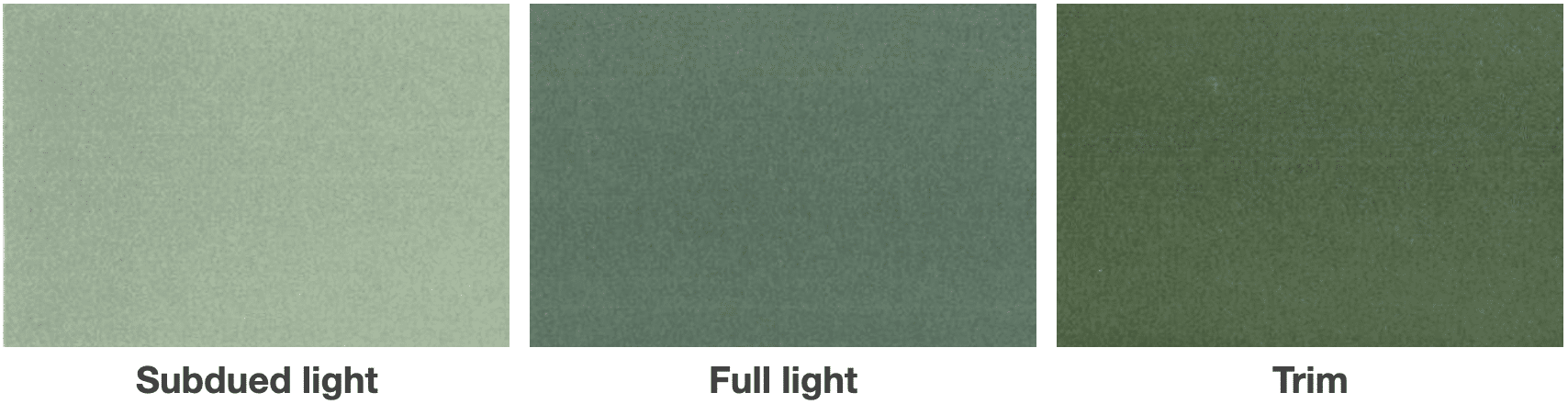
1925 – In Color in the operating room, Flagg refined and illustrated the concept. The complementary colour was commercially reproduced as Eyerest Green, with different intensities specified for areas exposed to subdued light, full illumination and architectural trim.
Flagg also worked to produce green fabrics that retained their colour despite repeated steam sterilisation, extending the concept from painted surfaces to gowns and surgical drapes.
Is green really “calming”?
The original argument for green in the operating theatre was visual, not psychological. Green reduced contrast with the red operative field, reduced after-images and could reduce glare from brightly illuminated white surroundings.
Over time the colour green became described as inherently restful, soothing or calming.
The myth stretched beyond the operating theatre to Alcatraz Prison. Green was reportedly used in the main cell block and solitary-confinement areas on the assumption that a colour useful for reducing visual fatigue could exert a calming psychological effect.
Modern reviews and interpretation are a little more cautious. Colour perception depends on brightness, contrast, lighting, context, culture and individual experience. There is no reliable basis for assuming that a particular hue produces a universal emotional or clinical response.
Associated Persons
- Harry Mitchell Sherman (1856-1921)
- Berkeley Moynihan (1865-1936)
- Paluel Joseph Flagg (1886-1970)
References
Historical references
- Sherman HM. The green operating room at St Luke’s Hospital. California state journal of medicine 1914; 12: 181–183.
- Moynihan B. A green background for the operation area. Lancet 1915; 186(4803): 674.
- Secor WL. In defense of the white operating room. Medical record 1919; 96: 362–364.
- Ludlow WO. Color in the modern hospital. The Modern Hospital 1921; 16: 511–513.
- Flagg PJ. An oxyhaemoglobinometer for the clinical measurement of cyanosis. Proc Soc Exp Biol Med 1922; 20: 1–5.
- Flagg PJ. A scientific basis for the use of color in the operating room. The Modern Hospital 1924; 22: 555–559.
- Flagg PJ. Color in the operating room. Architectural Record 1925; 57: 451–453
- Fehrman KR, Fehrman C. Color: The Secret Influence. 2004: 13
- Tofle RB, Schwarz B et al. Color in healthcare environments – a research report. USA: Coalition for Health Environments Research, 2004.
eponymictionary
the names behind the name

MB ChB, Edinburgh Medical school. F1/F2 in Bath, now in Australia, Perth preparing for a career in Emergency medicine. I have an interest in wilderness medicine and women’s health, but haven’t fully found my niche interest yet.

BA MA (Oxon) MBChB (Edin) FACEM FFSEM. Emergency physician, Sir Charles Gairdner Hospital. Passion for rugby, medical history, medical education, and asynchronous learning #FOAMed evangelist. Editor-in-Chief and Webmaster of Life in the Fast lane, LITFL | On Call 4e| Eponyms | Books | Horology |