


Cope obturator test (thigh-rotation test) is a physical examination manoeuvre used to identify irritation of the obturator internus muscle, classically associated with a pelvic appendix in acute appendicitis.
Passive rotation of the flexed right hip may elicit hypogastric or lower abdominal pain. The test has low sensitivity and a negative result does not exclude appendicitis.
Modern examination technique
With the patient supine, the examiner flexes the right hip and knee to approximately 90°. The right hip is then passively internally rotated by moving the ankle laterally while stabilising the knee.
The test is considered positive when the manoeuvre reproduces lower abdominal pain, particularly in the right iliac fossa, suggesting irritation of the obturator internus muscle by an adjacent inflammatory process.
A positive test may occur with pelvic appendicitis or other pelvic inflammatory conditions. A negative test does not exclude acute appendicitis.
Historical development
1919 – Sir Vincent Zachary Cope (1881-1974) introduced the thigh-rotation or obturator test for detecting pelvic inflammation, particularly appendicitis involving the obturator internus muscle. He described slight flexion of the right thigh followed by full internal and external rotation of the hip, with hypogastric pain indicating a positive result. Cope recognised that the test could also be positive in other pelvic inflammatory conditions, including ruptured ectopic pregnancy.
The right thigh is slightly flexed (so as to relax the psoas muscle) by the surgeon, who stands on the right of the patient: the limb is then fully rotated at the hip, first internally and then externally, so as to put the obturator internus through a full range of movement. The sign is positive if the patient complains of hypogastric pain when the limb is moved in this manner.
Since the fascia covering the obturator internus is fairly dense, the test is not positive unless the inflammation is considerable; and, with a positive result, one always expects the appendix to be adherent to, or even an abscess to be contiguous to, the fascia.
Cope 1919
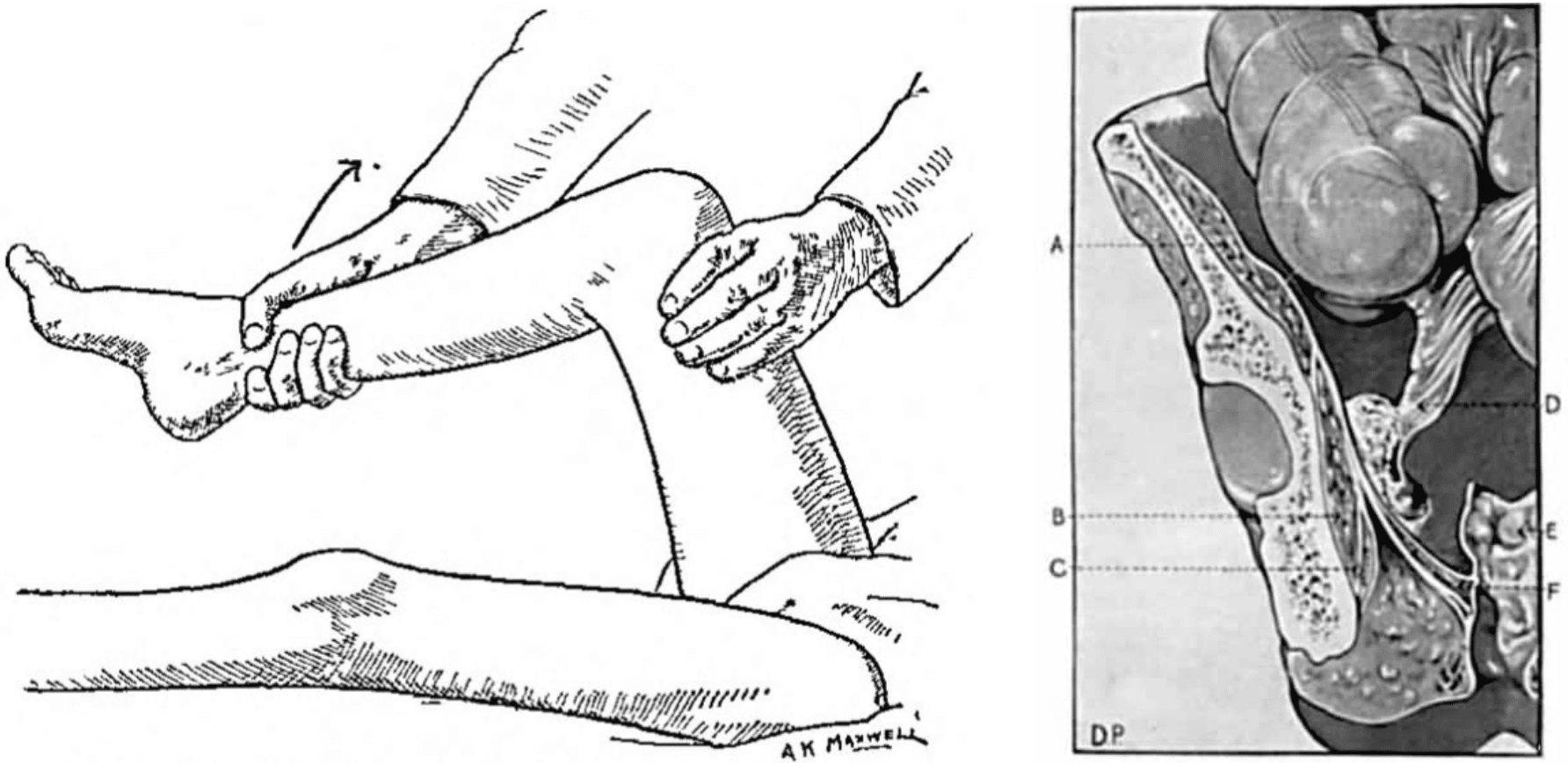
Right: Cope’s illustration of a pelvic appendix and appendicular abscess adjacent to the obturator internus. A, iliacus; B, obturator internus; C, Alcock’s canal; D, appendix; E, rectum; F, levator ani. Cope, 1919.
1929 – Hamilton Bailey included Cope’s obturator test among three signs useful in difficult cases of suspected appendicitis. Bailey described flexion of the right thigh followed by internal rotation of the hip, omitting the external rotation specified by Cope. He retained hypogastric pain as the positive finding.
Diagnostic accuracy
1984 – Berry and Malt published Appendicitis near its centenary. They retrospectively reviewed 300 patients undergoing appendicectomy for suspected acute appendicitis. The obturator sign was recorded in 19 of 246 patients with appendicitis and three of 54 without appendicitis, corresponding to a sensitivity of 7.7% and specificity of 94.4% (LR+ 1.39; LR− 0.98).
The examination technique was not specified, and the study included only patients selected for surgery. These estimates therefore cannot be assumed to represent the diagnostic accuracy of Cope’s original manoeuvre.
2021 – Moris, Paulson and Pappas summarised the obturator sign as having a sensitivity of 8% and specificity of 94%, reflecting the findings reported by Berry and Malt.
2022 – Yale, Tekiner and Yale highlighted the limited and heterogeneous evidence supporting traditional appendicitis signs. They emphasised that differences between original descriptions and contemporary examination techniques complicate interpretation of diagnostic accuracy studies.
Eponymythology
The Cope obturator test has undergone subtle changes since its original description in 1919. Cope advocated slight flexion of the thigh followed by both internal and external rotation of the hip, with hypogastric pain indicating a positive response. Modern descriptions emphasise internal rotation of the hip flexed to approximately 90°, with right iliac fossa pain regarded as positive.
| Feature | Cope (1919) | Modern interpretation |
|---|---|---|
| Hip position | Slightly flexed | Hip and knee flexed to approximately 90° |
| Manoeuvre | Internal and external rotation | Predominantly internal rotation |
| Positive finding | Hypogastric pain | Right iliac fossa or lower abdominal pain |
| Anatomical rationale | Irritation of obturator internus | Irritation of obturator internus |
These differences complicate interpretation of published diagnostic accuracy estimates, particularly where the examination technique was not specified. No comparative study has established whether Cope’s original manoeuvre performs differently from contemporary variations.
Associated Persons
- Sir Vincent Zachary Cope (1881-1974)
Alternative names
- Obturator test
- Cope’s obturator test
References
Historical references
- Cope VZ. The thigh-rotation or obturator test: A new sign in some inflammatory conditions. Br J Surg. 1919; 7: 537
- Cope VZ. The early diagnosis of the acute abdomen, 1921: 47
Eponymous term review
- Bailey H. Physical signs in acute abdominal catastrophies. Medical review of reviews 1929; 35: 161-170
- Berry J Jr, Malt RA. Appendicitis near its centenary. Ann Surg. 1984 Nov;200(5):567-75.
- Moris D, Paulson EK, Pappas TN. Diagnosis and Management of Acute Appendicitis in Adults: A Review. JAMA. 2021;326(22):2299–2311.
- Yale SH, Tekiner H, Yale ES. Signs and syndromes in acute appendicitis: A pathophysiologic approach. World J Gastrointest Surg. 2022 Jul 27;14(7):727-730.
eponymictionary
the names behind the name

BA MA (Oxon) MBChB (Edin) FACEM FFSEM. Emergency physician, Sir Charles Gairdner Hospital. Passion for rugby, medical history, medical education, and asynchronous learning #FOAMed evangelist. Editor-in-Chief and Webmaster of Life in the Fast lane, LITFL | On Call 4e| Eponyms | Books | Horology |