


ECG Case 140
Club doctor said my heart tracing looked odd
A semi-professional rugby player is reviewed for a routine pre-participation screening. He reports no symptoms, takes no regular medication and has no family history of sudden cardiac death.
His physical examination is unremarkable. A resting 12-lead ECG is recorded as part of the screening.
Questions
What is the most likely diagnosis?
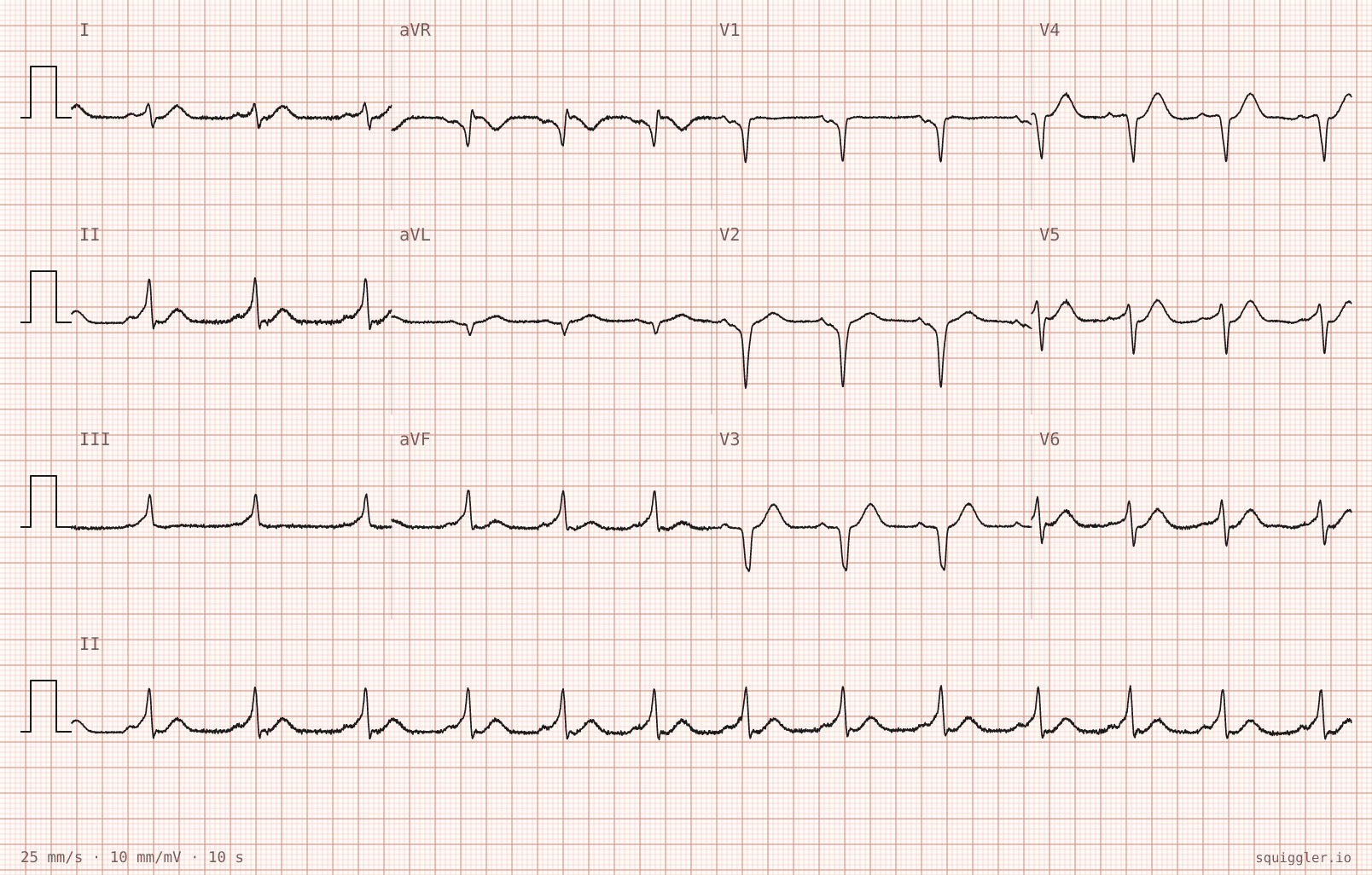
The PR interval is short at 80 ms, the QRS starts with a slurred delta wave that is clearest in II, aVF and V5-V6, and the complex is broad at 135 ms, which together make this ventricular pre-excitation. Left bundle branch block would have a normal PR interval and no slurred initial upstroke, and the deep S waves in V1-V2 are a pseudo-infarct pattern rather than the Q waves of an old infarct. A predominantly negative V1 commonly points to a right-sided pathway, although localisation algorithms are imprecise.
What would you do next?
In a competitive athlete with asymptomatic pre-excitation, the risk should be stratified before he is cleared to play, and the 2019 ESC guidelines support an EP study for this. The danger lies not in the pattern itself but in rapid antegrade conduction over the pathway if he ever develops AF.
Follow up and review
Three weeks later, while still awaiting his clinic appointment, he develops a racing heart of sudden onset during training. He is alert but mildly lightheaded.
Questions
What is the most likely mechanism?
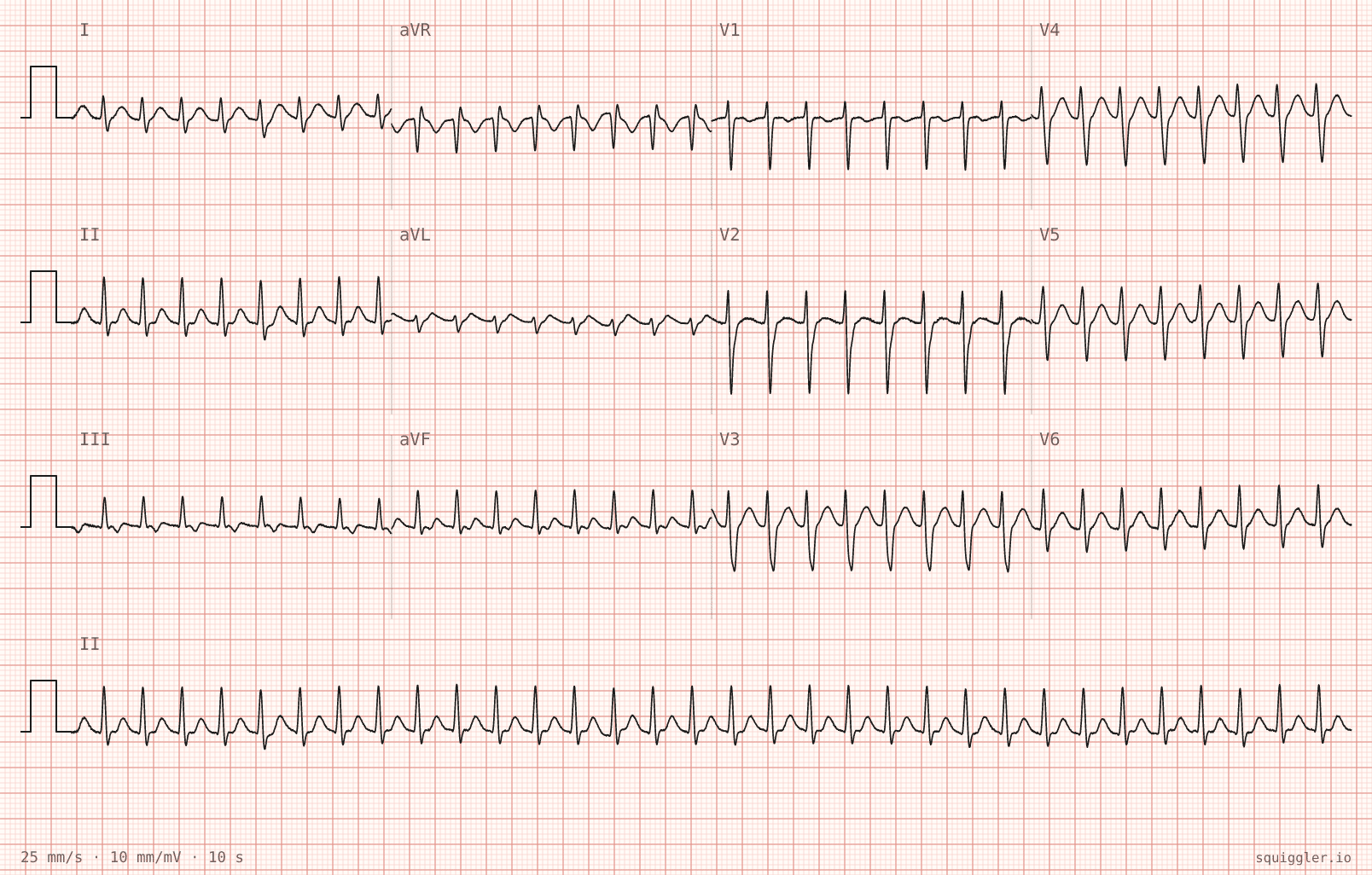
The rhythm is regular and narrow, with a QRS of 71 ms at 196/min, and the delta wave has gone, because the impulse now travels down the AV node and returns up the pathway. A retrograde P wave sitting after the QRS and separate from it favours AVRT over typical AVNRT. There are no flutter waves, and an abrupt onset at 196/min is not a sinus tachycardia.
What is the first-line treatment?
In a stable patient with a narrow-complex SVT, vagal manoeuvres come first, followed by IV adenosine if they fail. Because orthodromic AVRT depends on the AV node, blocking the node terminates it. DC cardioversion is reserved for the haemodynamically unstable patient.
Further thoughts
The tachycardia terminates with a modified Valsalva manoeuvre and sinus rhythm with pre-excitation returns. He is referred to the EP service.
Questions
If he later presented with pre-excited AF, which treatment would be contraindicated?
Blocking the AV node in pre-excited AF pushes conduction towards the pathway, with a risk of degeneration into VF. For that reason verapamil, diltiazem, beta-blockers, adenosine, digoxin and IV amiodarone should all be avoided. An unstable patient needs DC cardioversion, while a stable one can be treated with procainamide or ibutilide.
What is the definitive management?
Symptomatic WPW is an indication for an EP study and catheter ablation, which the 2019 ESC guidelines make a Class I recommendation. Ablation has a high success rate and a low complication rate, and it removes the substrate for both AVRT and pre-excited AF.
Diagnosis and Summary
Wolff-Parkinson-White syndrome, with ventricular pre-excitation and orthodromic AVRT
Both tracings come from one accessory pathway used in two different ways. In sinus rhythm the atrial impulse reaches part of the ventricle early through the pathway, which is why the PR interval is short at 80 ms, the QRS begins with a delta wave and the complex widens to 135 ms. During the episode the circuit runs down the AV node and back up the pathway, so the ventricles are activated normally: the QRS narrows to 71 ms, the delta wave disappears and the rate reaches 196/min.
The practical lesson is that a narrow, regular tachycardia with nothing unusual about it does not exclude Wolff-Parkinson-White; it is the baseline ECG that makes the diagnosis. If he ever develops AF conducted over the pathway, AV-nodal blocking drugs must be avoided, and catheter ablation of the pathway is curative.
References
- Brugada J, Katritsis DG, Arbelo E, et al. 2019 ESC Guidelines for the management of patients with supraventricular tachycardia. Eur Heart J. 2020;41(5):655-720.
- Appelboam A, Reuben A, Mann C, Gagg J, Ewings P, Barton A, Lobban T, Dayer M, Vickery J, Benger J; REVERT trial collaborators. Postural modification to the standard Valsalva manoeuvre for emergency treatment of supraventricular tachycardias (REVERT): a randomised controlled trial. Lancet. 2015 Oct 31;386(10005):1747-53.
Note. These ECG tracings were generated, not recorded. The Squiggler ECG generation studio can be used to live edit and review each generated ECG for education purposes. Open the studio
TOP 150 ECG Series

David Yu, M.D., Ph.D. Full time anesthesiologist in the department of Perioperative medicine and Intensive Care (PMI), Karolinska University Hospital, Sweden. Dual board certified in internal medicine, and anesthesiology and critical care. Clinical interests are the critically ill patient, hemodynamic cases, perioperative echocardiography and procedural awareness, and of course all things ECG! | Squiggler |