


Felix Fleischner
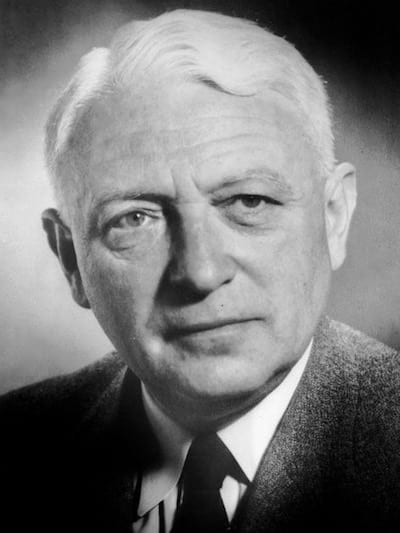
Felix George Fleischner (1893-1969) was an Austrian-American radiologist.
Fleischner developed an international reputation for relating chest radiographic appearances to the underlying anatomy, pathology and physiology of pulmonary disease. His major interests included plate atelectasis, pleural effusion, pulmonary embolism, bronchiectasis and cardiopulmonary disease. He published more than 250 scientific papers across two distinct careers. First in Vienna and, after his forced emigration in 1938, in Boston.
In the United States he became the first full-time radiologist at Beth Israel Hospital and developed a formal radiology residency programme which established a strong culture of teaching and clinical research. His name survives in the Fleischner sign, describing proximal pulmonary arterial enlargement associated with pulmonary embolism and Fleischner lines, describing plate-like pulmonary atelectasis. The Fleischner Society, named posthumously in recognition of his contributions to chest radiology, teaching and research.
Fleischner is remembered for his clinical observation, teaching and unusually broad scholarship. He was fluent in Latin and ancient Greek and had a particular knowledge of classical archaeology.
Biography
- Born July 29, 1893 in Vienna, Austria, son of Moritz Fleischner and Adele Gans.
- 1912 – Graduated from the State Gymnasium, Vienna VI.
- 1919 – Received his medical degree from the University of Vienna. Trained at the Karolinen Kinderspital and First University Medical Clinic before specialising in radiology.
- 1921–1929 – Resident and subsequently assistant in radiology at the Wilhelminenspital, Vienna.
- 1929–1930 – Further radiological training under Guido Holzknecht at the Zentral-Röntgeninstitut.
- 1930–1931 – Academic appointment in radiology at the University of Vienna, including the Second Medical Clinic. Appointed Docent in Radiology.
- 1932 – Appointed chief of radiology at the Vienna C.S. Children’s Hospital.
- 1936 – Published a series of papers on pulmonary collapse, plate-like atelectasis and basal linear shadows which formed the basis of the later Fleischner lines eponym.
- 1938 – Following the Nazi annexation of Austria, Fleischner’s venia legendi was revoked on racial grounds and he was forced to emigrate with his family to the United States.
- 1938–1940 – Graduate assistant in the radiology department at Massachusetts General Hospital, working under George W. Holmes.
- 1940–1942 – Private radiological practice in Greenfield, Massachusetts.
- 1942 – Appointed the first full-time radiologist at Beth Israel Hospital, Boston, with academic appointments at Harvard and Tufts. Established Beth Israel’s first formal radiology residency programme.
- 1943–1955 – Progressed through academic appointments at Harvard Medical School, ultimately becoming Clinical Professor of Radiology.
- 1945–1960 – Radiologist-in-Chief of the Beth Israel radiology department.
- 1960 – Retired from Beth Israel, remained Professor Emeritus at Harvard. Consultant and teacher at Peter Bent Brigham Hospital, Massachusetts General Hospital and Boston-area Veterans hospitals.
- 1964 – An international symposium on Pulmonary Embolism was dedicated to Fleischner in recognition of his contributions to the field.
- 1965 – Represented Harvard Medical School at the 600th anniversary of the University of Vienna.
- 1967 – A second international symposium, The Frontiers of Chest Radiology, was dedicated in his honour.
- 1968 – Elected an Honorary Fellow of the Faculty of Radiologists.
- Died August 17, 1969 suddenly from a cardiac event while swimming, aged 76 at Boston, Massachusetts. He had been invited to participate in the formation of a new society devoted to chest disease and chest radiology.
- 1969 – December – Eight radiologists met in Chicago for the inaugural meeting of the new organisation and named it the Fleischner Society in his memory.
Medical Eponyms
Fleischner sign
Fleischner sign describes prominence or dilatation of a central or proximal pulmonary artery on chest radiography in association with pulmonary embolism. The enlarged arterial contour may reflect a large central embolic obstruction, acute pulmonary hypertension with dynamic dilatation of the proximal pulmonary arteries, or a combination of both.
Fleischner was not the first to observe pulmonary arterial enlargement. However across his 1958, 1961 and 1962 publications on pulmonary embolism, he developed a physiological interpretation. He demonstrated dynamic hilar arterial dilatation associated with acute pulmonary hypertension, distinguishing it from hilar enlargement caused directly by embolothrombus.
Modern descriptions generally distinguish any associated abrupt distal arterial cutoff as the separate knuckle sign.
Fleischner lines (1936)
Fleischner lines are linear or band-like pulmonary opacities produced by focal plate-like (discoid) atelectasis viewed edge-on on chest radiography. They occur most often in the lower lung fields and may be horizontally orientated, although their appearance depends on the orientation of the affected lung segment.
Fleischner investigated plate atelectasis and basal linear pulmonary shadows in a series of papers published in 1936, with further work alongside Aubrey Hampton and Benjamin Castleman in 1941.
The Fleischner Society
The Fleischner Society is an international, multidisciplinary society devoted to advancing knowledge of the normal and diseased chest through thoracic imaging, research and education.
Fleischner had been invited to join the eight radiologists planning the new organisation but died suddenly in August 1969 before its inaugural meeting. When the group met in December, they named the society in his memory, recognising his contributions to chest radiology, teaching and research, as well as his reputation for compassion and collegiality.
Major Publications
- Fleischner F. Atelektase und gerichteter Kollaps der Lunge. Fortschritte auf dem Gebiete der Röntgenstrahlen und der Nuklearmedizin, 1936, 53, 607-625.
- Fleischner F. Plattenformige Atelektasen in der Unterlappen der Lunge. Fortschritte auf dem Gebiete der Röntgenstrahlen und der Nuklearmedizin 1936; 54: 315-321.
- Fleischner F. Über das Wesen der basalen horizontalen Schattenstreifen im Lungenfeld. Wiener Archiv für innere Medizin 1936; 28: 461-480.
- Fleischner F, Hampton AO, Castleman B. Linear shadows in the lung (interlobar pleuritis, atelectasis and healed infarction). Am J Roentgenol 1941; 46(5): 610-618
- Fleischner FG. Pulmonary embolism. Can Med Assoc J. 1958 May 1; 78(9): 653–660.
- Fleischner F. Unilateral pulmonary embolism with increased compensatory circulation through the unoccluded lung. Radiology 1959; 73: 591-597 [Fleischner sign]
- Fleischner F. Roentgen diagnosis of pulmonary embolism. Heart Bull. 1961 Nov-Dec;10:104-7.
- Fleischner FG. Pulmonary embolism. Clin Radiol. 1962 Jul;13:169-82.
References
Biography
- Obituary: Felix Fleischner, MD, FFR (Hon.) Br. J. Radiol 1969; 42 :947
- Felix George Fleischner, 1893-1969. snac
- Felix FLEISCHNER (1893-1969): Vertrieben 1938 [145]. VAN SWIETEN
- Koren N. Felix Fleischner In: Jewish Physicians: A Biographical Index. 1973: 174
Eponymous signs
- Fraser RG, Mellins RB. The Fleischner Society: a 30th anniversary retrospective. Radiology. 2000 Mar;214(3):631-2.
- Maizlin ZV, Cooperberg PL, Clement JJ, Vos PM, Coblentz CL. People Behind Exclusive Eponyms of Radiologic Signs (Part I). Can Assoc Radiol J. 2009 Oct;60(4):201-12.
- Maizlin ZV, Cooperberg PL, Clement JJ, Vos PM, Coblentz CL. People Behind Exclusive Eponyms of Radiologic Signs (Part II). Can Assoc Radiol J. 2010 Feb;61(1):44-53
- Janower ML. A brief history of the Fleischner Society. J Thorac Imaging. 2010 Feb;25(1):27-8
- Cadogan M. CXR eponyms in pulmonary embolism. LITFL
eponymictionary
the names behind the name

BA MA (Oxon) MBChB (Edin) FACEM FFSEM. Emergency physician, Sir Charles Gairdner Hospital. Passion for rugby, medical history, medical education, and asynchronous learning #FOAMed evangelist. Editor-in-Chief and Webmaster of Life in the Fast lane, LITFL | On Call 4e| Eponyms | Books | Horology |