

Francis Rynd
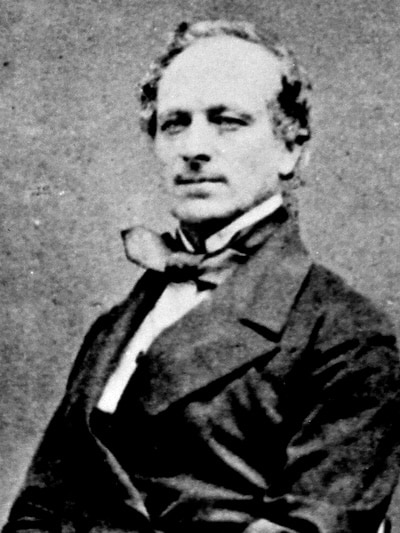
Francis Rynd (1801-1861) was an Irish surgeon.
Rynd is best remembered as an early pioneer of subcutaneous drug delivery for the treatment of neuralgia. Trained at Trinity College Dublin and apprenticed at the Meath Hospital under Sir Philip Crampton, he became surgeon to the Meath in 1836 and developed a reputation for clinical innovation across surgery and hospital medicine.
In 1844, Rynd introduced morphia solution under the skin to relieve severe facial neuralgia and sciatica, and published his method the Dublin Medical Press in 1845. In 1861, amid later priority disputes, Rynd published a detailed description of his cannula-and-trocar instrument and anchored his priority for both the procedure and the instrument.
Biography
- Born 1801 in Dublin, Ireland
- 1817 – Entered Trinity College Dublin, aged 16.
- 1818 – Apprenticed to Sir Philip Crampton at the Meath Hospital, Dublin.
- 1830 – MRCS member of the Royal College of Surgeons
- 1831 – Married Elizabeth Alley.
- 1836 – Elected surgeon to the Meath Hospital replacing Rawdon Macnamara I; working alongside Robert James Graves and William Stokes
- 1836–1850s – Served as medical superintendent of the Mountjoy Convict Prison
- 1844 (Jun 3) – Administered perineural subcutaneous opiate in the management of trigeminal neuralgia. He introduced acetate of morphia in creosote via “four punctures” using an “instrument made for the purpose.”
- 1845 (Mar 12) – Published the cases in the Dublin Medical Press.
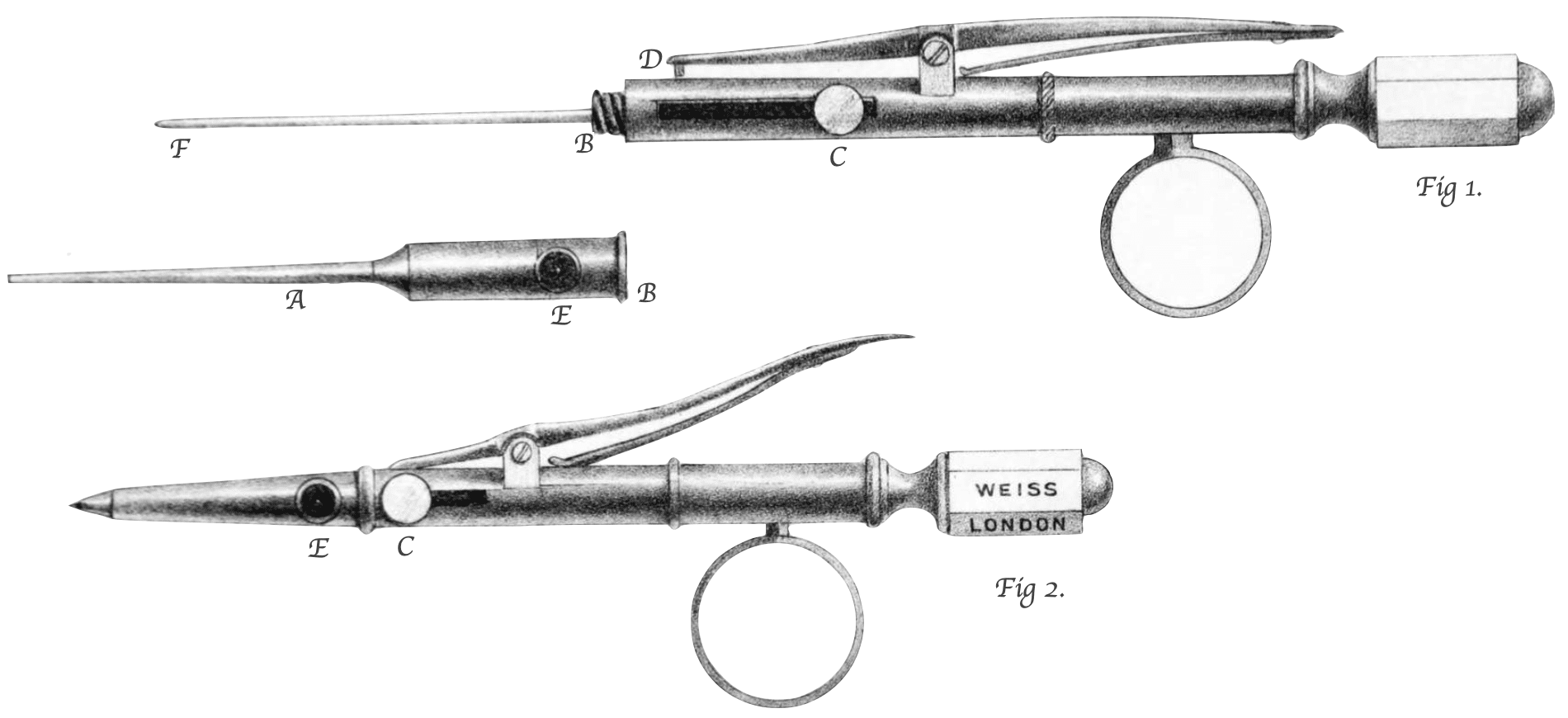
- 1861 – Published the first full technical description of his cannula-and-needle device with spring mechanism .
- Died suddenly on July 19, 1861 in Clontarf, Dublin. He collapsed after a street altercation; post-mortem found extreme fatty degeneration of the heart and diseased kidneys.
Key Medical Contributions
First documented hypodermic (subcutaneous) injection for neuralgia
1844 – While surgeon to the Meath Hospital, Rynd treated Margaret Cox (59) with severe facial neuralgia by introducing a morphia–creosote solution subcutaneously along the course of the affected nerves.
On the 3rd of June [1844] a solution of fifteen grains of acetate of morphia, dissolved in one drachm of creosote, was introduced to the supra-orbital nerve, and along the course of the temporal, malar, and buccal nerves, by four punctures of an instrument made for the purpose. In the space of a minute all pain (except that caused by the operation, which was very slight) had ceased, and she slept better that night than she had for months.
Rynd F. Neuralgia – introduction of fluid to the nerve. Dublin Med Press 1845; 13: 167–168
1845 – Rynd’s published his cases as “Neuralgia—Introduction of fluid to the nerve” in the Dublin Medical Press. He documented further cases including the relief of sciatica in R. Dolon (28), a thin spare man of middle stature.
On the 13th of November [1844] the fluid was introduced, ten grains acetate morphia to the drachm of creosote, one punture behind the trochanter, and one half-way down the thigh. He was instantly relieved from pain, and walked steadily through the ward without any pain or difficulty
Rynd, 1845
1853 – French surgeon, Charles Gabriel Pravaz (1791–1853), described a screw-driven syringe with a fine trocar for intravascular injection of ferric chloride into naevi in a note published in 1853. An early syringe technology milestone rather than clinical analgesic hypodermic therapy.
1853 – Alexander Wood (1817-1884) performed early therapeutic injections in 1853 and published in 1855 his clinical account of hypodermic morphine for neuralgia. He emphasised injection at tender “painful points” (Valleix) popularising the clinical method rather than the first hollow needle per se.
1861 – Although Wood’s Edinburgh paper (1855) is often credited with establishing the hypodermic method of morphine administration, Rynd had already reported subcutaneous instillation of morphia solutions for neuralgia. During the priority debates that followed Wood’s work, Rynd published a formal description of his cannula-and-trocar instrument and reaffirmed his earlier chronology for both the procedure and the published cases:
The subcutaneous introduction of fluids, for the relief of neuralgia, was first practised in this country by me, in the Meath Hospital, in the month of May, 1844. The cases were published in the “Dublin Medical Press” of March 12, 1845. Since then, I have treated very many cases, and used many kinds of fluids and solutions, with variable success
Rynd, 1861
Technical description of the “Rynd instrument”
Rynd published the illustrated description of his device, explaining a cannula that screws onto the instrument, and a spring-loaded needle (trocar) that can be advanced then released so the needle retracts and the fluid descends by gravity through the cannula as the instrument is withdrawn.
Contemporary uptake
1866 – Florence Nightingale described hypodermic opiate injection as the only measure that relieved her chronic pain.
Life is too hard for me. I have suffered so very much all the winter and spring, for which nothing did me any good but a curious new-fangled little operation of putting opium in under the skin, which relieves one for 24 hours, but does not improve the vivacity or serenity of one’s intellect
Miss Nightingale to Julius Mohl, 35 South Street, July 12, 1866
Major Publications
- Rynd F. Neuralgia – introduction of fluid to the nerve. Dublin Med Press 1845; 13: 167–168
- Rynd F. Pathological and practical observations on strictures, and some other diseases of the urinary organs. London. 1849.
- Rynd F. Description of an Instrument for the Subcutaneous Introduction of Fluids in Affections of the Nerves. Dublin Quarterly Journal of Medical Science. 1861; 32: 13
References
Biography
- Obituary: Francis Rynd. Dublin Quarterly Journal of Medical Science. 1862; 33: 254.
- Ormsby LH. Francis Rynd. Medical history of the Meath Hospital and County Dublin Infirmary, 1888: 206-209
- Obituary: Francis Rynd (1801-1861). JAMA. 1970; 212(7): 1208.
- Bibliography. Rynd, Francis 1801-1861. WorldCat Identities
Eponymous terms
- Cook ET. New Masters (1866) In: The life of Florence Nightingale. 1913
- The Irish doctor who invented the syringe. Irish Times. Dec 5, 2002
- Rynd-type hypodermic syringe, London, England, 1860-1880. Science Museum Group
Eponym
the person behind the name

Studied at the University of Edinburgh MBChB BSc. British doctor currently working in Emergency Medicine in Perth, Western Australia. Interests in Anaesthetics, Critical Care and trail running.

BA MA (Oxon) MBChB (Edin) FACEM FFSEM. Emergency physician, Sir Charles Gairdner Hospital. Passion for rugby; medical history; medical education; and asynchronous learning #FOAMed evangelist. Co-founder and CTO of Life in the Fast lane | On Call: Principles and Protocol 4e| Eponyms | Books |