


McBurney incision
The McBurney incision is an oblique, muscle-splitting incision in the right iliac fossa, traditionally used for open appendicectomy. Also known as the gridiron incision, it provides access to the appendix while preserving the integrity of the abdominal wall musculature.
In 1894, American surgeon Charles Heber McBurney (1845–1913) described a method of abdominal access in which the external oblique aponeurosis was divided along its fibres, while the underlying internal oblique and transversus abdominis muscles were separated rather than transected.
The McBurney incision and the diagnostic landmark of the McBurney point are distinct eponymous terms. The point describes a site of maximal tenderness originally reported in 1889 and the incision describes an operative approach published in 1894.
McBurney distinguished his new muscle-splitting technique from the oblique incision he had previously employed. In the earlier approach, the external oblique fibres were separated along their course, but the underlying internal oblique and transversus abdominis muscles were divided transversely. His 1894 modification preserved these deeper muscular layers by separating their fibres rather than cutting across them
McBurney argued that preserving the gridiron-like arrangement of the abdominal wall would minimise haemorrhage and postoperative pain, maintain muscular function and reduce the risk of incisional hernia.
When the operation is completed it will be seen that the gridiron-like arrangement of the muscular and tendinous fibres, to which the abdominal wall largely owes its strength, is restored almost as completely as if no operation had been done.
McBurney 1894
| Incision | Distinguishing feature |
|---|---|
| McBurney (gridiron) | Oblique right iliac fossa incision; external oblique, internal oblique and transversus fibres separated along their course |
| Battle | Vertical pararectal incision with medial displacement of the rectus abdominis |
| Rutherford Morison | Extensile oblique, muscle-cutting incision providing wider right iliac fossa exposure |
| Rockey–Davis | Transverse right lower quadrant incision with muscle-splitting access |
| Lanz | Transverse skin-crease incision in the right iliac fossa, with muscle-splitting access |
| Lower midline | Vertical incision through the linea alba, providing wider abdominal and pelvic access |
History of the McBurney incision
1861 – Austrian anatomist Karl Langer (1819–1887) published Zur Anatomie und Physiologie der Haut. I. Über die Spaltbarkeit der Cutis. Using puncture experiments on cadavers, he demonstrated reproducible patterns of skin cleavage reflecting the orientation of dermal fibres. These anatomical observations subsequently informed surgical approaches intended to minimise wound retraction and tissue disruption.
1867 – American surgeon Willard Parker (1800–1884) published An operation for abscess of the appendix vermiformis cæci. He described operative drainage of localised appendiceal abscesses and suggested timely surgical intervention before rupture into the general peritoneal cavity. Parker’s operation was an approach to abscess drainage rather than appendicectomy or a muscle-splitting incision.
An incision six inches in length was made through the integument, commencing above, and about one inch from, the anterior superior spinous process of the ilium, running towards the symphysis pubis. About one inch of the incision was above an imaginary line drawn from one anterior superior spinous process to the other, and five inches below
Parker 1867
1889 – Charles Heber McBurney (1845–1913) published Experience with early operative interference in cases of disease of the vermiform appendix. He advocated early operative treatment of appendicitis and described an incision in the right iliac region, positioned to provide access to the diseased appendix. He also identified the localised point of greatest tenderness subsequently known as McBurney point.
1891 – McBurney published The Indications for Early Laparotomy in Appendicitis, further developing the clinical indications for operative intervention. He distinguished early appendicitis from established appendiceal abscess and discussed the surgical management of each, including the earlier drainage approach associated with Willard Parker.
1892 – Swiss surgeon Theodor Kocher (1841–1917) published Chirurgische Operationslehre, illustrating and describing operative incisions for the abdominal wall, including a Hypogastriumschnitt for access to the processus vermiformis.
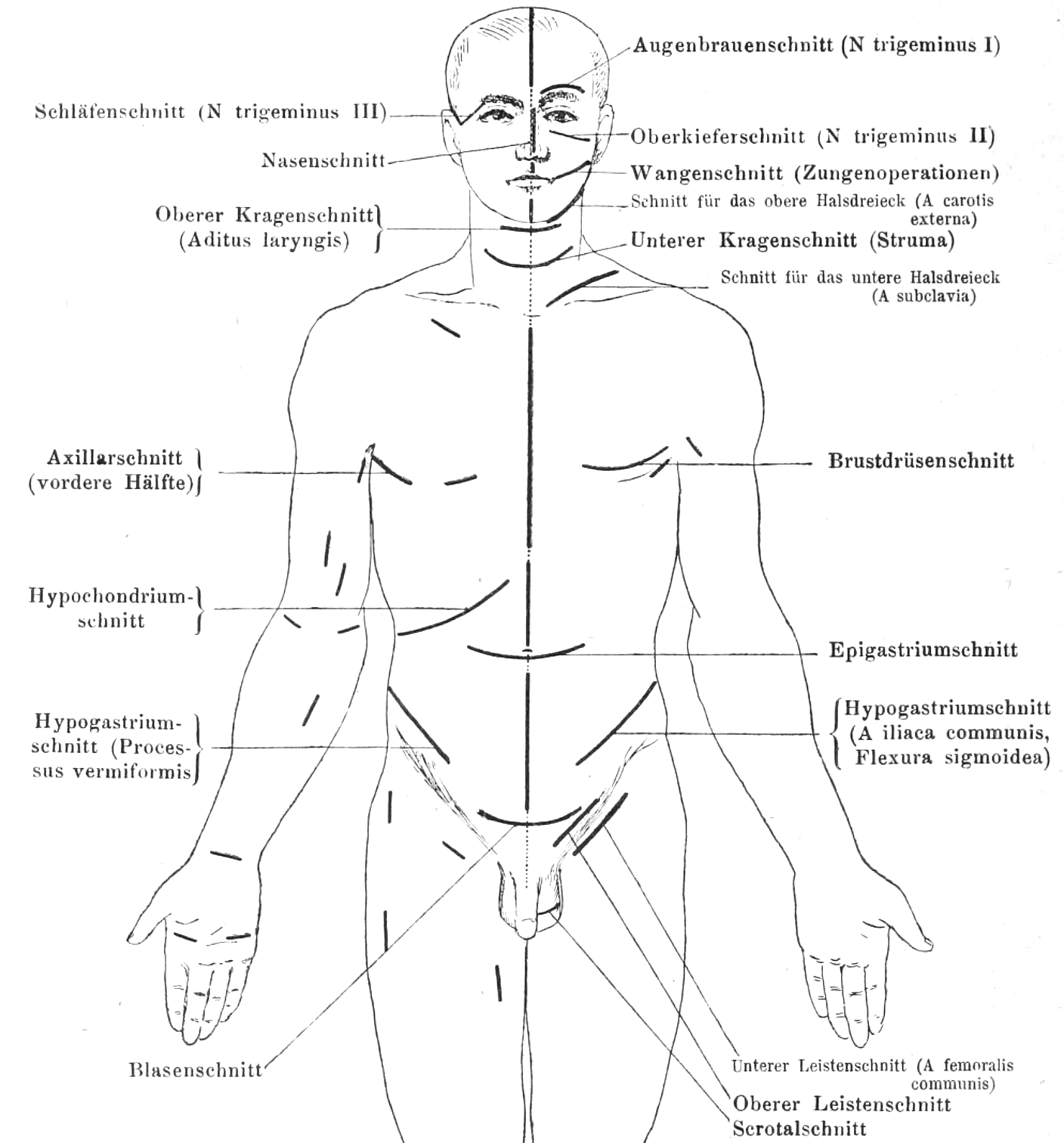
1893 – On December 18, McBurney performed his first documented operation using a new muscle-splitting incision at Roosevelt Hospital, New York, during interval appendicectomy for recurrent appendicitis.
1894 – In July, McBurney published The incision made in the abdominal wall in cases of appendicitis, with a description of a new method of operating. He distinguished his new technique from his earlier oblique incision, which divided the deeper abdominal muscles transversely. The modified operation separated the external oblique, internal oblique and transversus abdominis fibres along their natural directions, preserving the crossed arrangement of the abdominal wall.
The incision in the skin is an oblique one about four inches long. It crosses a line drawn from the anterior iliac spine to the umbilicus nearly at right angles about one inch from the iliac spine, and is so situated that its upper third lies above that line.
The section of the external oblique muscle and aponeurosis should correspond, great care being taken to separate these tissues in the same line, not cutting any fibres across…With a blunt instrument, such as the handle of a knife or closed scissors, the fibres of the internal oblique and transversalis muscles can now be separated, without cutting more than an occasional fibre, in a line parallel with their course
McBurney 1894
McBurney reported four interval appendicectomies and proposed that the technique would reduce haemorrhage, postoperative pain and incisional hernia.
1894 – In November, McArthur published Choice of incisions of abdominal wall; especially for appendicitis. He acknowledged McBurney’s July publication while reporting his own earlier experience with a comparable muscle-separating approach. His approach followed the direction of the external oblique fibres, with blunt separation of the internal oblique and transversus abdominis, to preserve abdominal wall musculature and innervation.
1895 – William Henry Battle (1855–1936) described a modified incision for appendicectomy, developed during an operation in late 1894. The approach involved opening the anterior rectus sheath, displacing the rectus muscle medially and entering the abdomen through the posterior sheath. It provided an alternative to McBurney’s lateral muscle-splitting incision.
1899 – George M. Edebohls (1853–1908) published A review of the history and literature of appendicitis. He described McBurney’s technique as the gridiron incision and advocated its use in both acute and chronic appendicitis, including suppurative cases requiring drainage. Edebohls identified Battle’s rectus incision as its principal rival.
1900 – Willy Meyer (1858–1932) described McBurney’s gridiron incision as an established approach for interval appendicectomy. He distinguished the requirements of interval operations from acute appendicitis, in which extensive inflammation, abscess or pelvic disease might require wider surgical access. Meyer proposed a hockey-stick incision to accommodate these more complicated operations.
1905 – Arthur E. Rockey and Gwilym G. Davis independently published transverse approaches to appendicectomy, continuing the development of abdominal incisions intended to preserve muscular integrity while improving operative access.
1905 – L. R. G. Crandon and David D. Scannell published The muscle-splitting or McBurney incision in acute appendicitis, with or without abscess; the course and result in 75 consecutive cases. They advocated the gridiron approach for acute and suppurative appendicitis, challenging objections concerning inadequate exposure, drainage and the difficulty of enlarging the incision.
The muscle-splitting or McBurney incision is desirable in all cases of appendicitis, unless an abscess is obviously pointing in a remote or unusual situation. This we conclude because: (1) It opens most often directlyover the appendix; (2) it can be enlarged by prolonging the split in each muscle-plane to whatever extent is desirable; (3) it can be drained for a short or a long time without danger of hernia
1915 – Rockey revisited his transverse incision and observed that the vertical right rectus incision remained in general use. His account demonstrates that multiple operative approaches continued to compete more than two decades after McBurney’s original publication.
Modern times – The McBurney gridiron incision became a conventional approach to open appendicectomy and was incorporated into surgical teaching. Its muscle-splitting technique offered a reproducible method of accessing the appendix while preserving the abdominal wall musculature. However, transverse, rectus-based and midline incisions continued to be employed according to the clinical circumstances and required operative exposure.
Eponymythology
McBurney versus McArthur – Although the muscle-splitting incision bears McBurney’s name, its priority is disputed. McBurney published his technique in July 1894, describing its first documented use on December 18, 1893. Louis L. McArthur published a comparable approach in November 1894 but claimed to have employed it for more than two years.
McBurney holds publication priority, while McArthur asserted earlier operative use. The available publications do not establish who first developed the technique.
The gridiron incision – The term gridiron refers to the crossed arrangement of the abdominal wall muscle fibres and the corresponding openings created during dissection. McBurney used the analogy in his original 1894 description. In 1899, George M. Edebohls used the term gridiron incision for McBurney’s operation and Willy Meyer in 1900 used the term McBurney’s gridiron incision.
McBurney point versus McBurney incision – The diagnostic McBurney point (1889) and the operative McBurney incision (1894) are distinct eponymous terms. One is the diagnostic point of maximal tenderness and the other an operative incision crossing the spinoumbilical line. They should not be regarded as interchangeable landmarks.
I believe that an every case the seat of greatest pain, determined by the pressure of one finger has been very exactly between exactly an inch and a half and two inches from the anterior spinous process of the ilium on a straight line drawn from that process to the umbilicus.
McBurney 1889
The incision in the skin is an oblique one about four inches long. It crosses a line drawn from the anterior iliac spine to the umbilicus nearly at right angles about one inch from the iliac spine, and is so situated that its upper third lies above that line.
McBurney 1894
Associated Persons
- Karl Langer (1819–1887)
- Willard Parker (1800–1884)
- Charles Heber McBurney (1845–1913)
- Emil Theodor Kocher (1841-1917)
- William Henry Battle (1855–1936)
Alternative names
- Gridiron incision
- McBurney muscle-splitting incision
References
Historical references
- Hancock H. Disease of the appendix caeci cured by operation. Lond Med Gazette 1848; 7: 547–550
- Langer K. Zur Anatomie und Physiologie der Haut. I. Über die Spaltbarkeit der Cutis. Sitzungsberichte der Kaiserlichen Akademie der Wissenschaften. 1861; 44: 19–46. [English translation 1978]
- Parker W. An operation for abscess of the appendix vermiformis cæci. Med Rec (NY) 1867; 2: 25–27
- McBurney C. Experience with early operative interference in cases of disease of the vermiform appendix. New York Medical Journal, 1889; 50: 676-684.
- McBurney C. The Indications for Early Laparotomy in Appendicitis. Annals of Surgery. 1891; 13(4): 233–254.
- Kocher T. Chirurgische Operationslehre [Operative surgery] Jena, Fischer, 1892.
- McBurney C. The incision made in the abdominal wall in cases of appendicitis, with a description of a new method of operating. Annals of Surgery 1894: 20: 38–43 [July]
- McArthur LL. Choice of incisions of abdominal wall; especially for appendicitis. Chicago medical recorder 1894; 7(1): 289-292. [November]
- Battle WH. Modified incision for removal of the vermiform appendix. Br Med J 1895;2:1360
- Battle WH. A Contribution to the Surgical Treatment of Diseases of the Appendix Vermiformis. Br Med J. 1897 Apr 17;1(1894):965-7.
- Edebohls GM. A review of the history and literature of appendicitis. Medical record 1899; 56(22): 773-784
- Meyer W. The hockey-stick incision. A typical mode of entering the abdominal cavity in certain complicated cases of appendicitis. JAMA 1900;XXXIV;(7):385-387.
- Crandon LRG, Scannell DD. The muscle-splitting or McBurney incision in acute appendicitis, with or without abscess; the course and result in 75 consecutive cases. NEJM. 1905; 153: 711–6
- Davis GG. XI. A Transverse Incision for the Removal of the Appendix. Ann Surg. 1906 Jan;43(1):106-10.
- Lanz O. Der McBurney’sche Punkt. Zentralblatt für Chirurgie 1908; 35(7): 185-190.
- Rockey AE. Transverse incision in operation for appendicitis. 1915;LXV;(11):939-941.
Eponymous term review
- Rondelli D. The early days in the history of appendectomy Hektoen International 2013
- Hamill JK, Hill AG. A history of the treatment of appendicitis in children: lessons learned. ANZ J Surg. 2016 Oct;86(10):762-767.
- Herrod PJJ, Kwok AT, Lobo DN. Three Centuries of Appendicectomy. World J Surg. 2023 Apr;47(4):928-936
- Selvaggi L, Pata F, Pellino G, Podda M, Di Saverio S, De Luca GM, Sperlongano P, Selvaggi F, Nardo B. Acute appendicitis and its treatment: a historical overview. Int J Colorectal Dis. 2025 Jan 30;40(1):28.
eponymictionary
the names behind the name

BA MA (Oxon) MBChB (Edin) FACEM FFSEM. Emergency physician, Sir Charles Gairdner Hospital. Passion for rugby, medical history, medical education, and asynchronous learning #FOAMed evangelist. Editor-in-Chief and Webmaster of Life in the Fast lane, LITFL | On Call 4e| Eponyms | Books | Horology |