

Coudé tip catheter
The coudé catheter has a curved tip and is derived from the French term “coudé” for “elbow.” Described by Louis Auguste Mercier in 1836

The coudé catheter has a curved tip and is derived from the French term “coudé” for “elbow.” Described by Louis Auguste Mercier in 1836

Network Five Emergency Medicine Conversations Episode 25 - an interview with Dr Kavita Varshney on medical education, leadership, and more!
Newton C Browder (1893-1969) was an American physician. Eponymously remembered for the Lund and Browder Chart estimating the total body surface area affected in the management of burns.
Charles Rufus Baxter (1929-2005) was an American physician. Baxter made significant advances in the treatment of burn victims and trauma procedures introducing the Parkland formula in 1968.

Hulusi Behçet (1889-1948) was a Turkish dermatologist. Behçet disease (1936) ‘triple symptom complex’ of mouth aphthous ulcers, genital ulcers, and recurrent iritis

Behçet disease: chronic, multisystemic inflammatory condition involving small and large vessels of unknown aetiology. Characterised by the triad of recurrent oral aphthous ulcers, genital ulcers, and iridocyclitis with or without hypopyon.
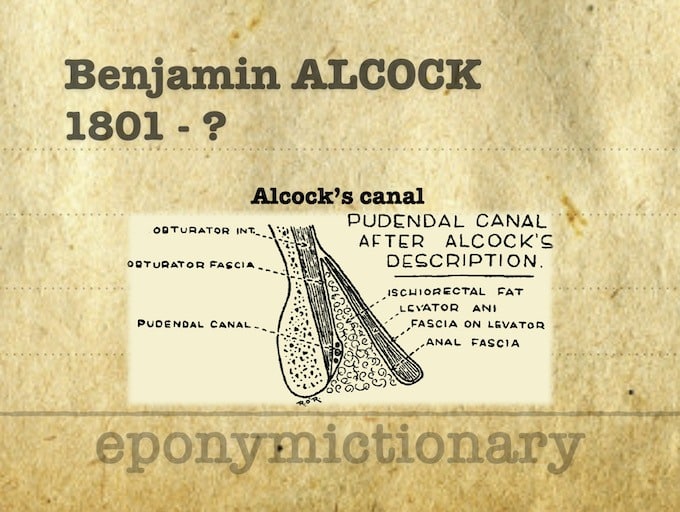
Benjamin Alcock (1801 - ? ) was an Irish anatomist. Alcock described the pudendal canal (Alcock’s canal) in 1836
Ralph Douglas Kenneth Reye (1912-1977) was an Australian pathologist.

William Peter Hort (1799-1852) was an English born, American physician; one of the earliest clinical case reports in America on the use of oral charcoal as an antidote for acute poisoning

Charles AHA Bertrand (1777-1849) was a French physician; Least recognised for his self-experimentation with charcoal as an antidote for ingested poisonings.
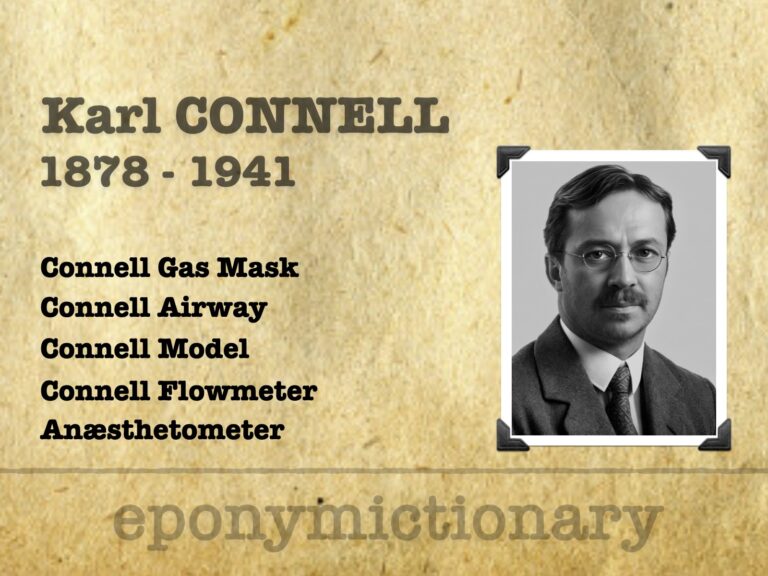
Major Karl Connell (1878-1941) was an American surgeon, serviceman and inventor. Connell Mask, Connell Model, Connell Flowmeter, Connell Airway

Ivor Lewis (1895–1982) was a Welsh surgeon. Eponymously remembered for 1946 description of Ivor Lewis Oesophagectomy