

Spinal cord infarction
Spinal cord infarction is necrosis of a portion of the spinal cord as a result of an interruption of the blood supply to the spine


Spinal cord infarction is necrosis of a portion of the spinal cord as a result of an interruption of the blood supply to the spine
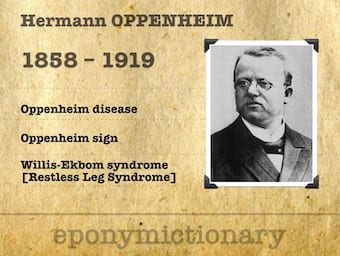
Hermann Oppenheim (1858-1919) was a German neurologist. Oppenheim sign/reflex (1902) and the archaic term Oppenheim disease (1900)
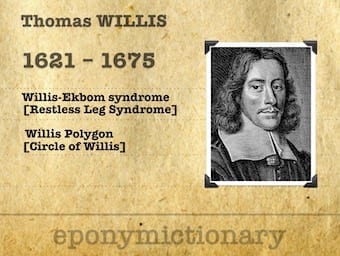
Thomas Willis (1621–1675) was an English physician.

Restless legs syndrome (RLS)/Willis-Ekbom disease (WED) is characterized by an urge to move the legs, usually associated with limb discomfort. The symptoms occur at rest, are relieved by movement, and are worst in the evening and at night.
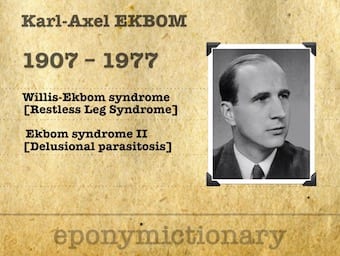
Karl-Axel Ekbom (1907-1977) Swedish neurologist. Eponym: Willis-Ekbom syndrome (Restless leg syndrome); Ekbom Syndrome II (Delusion of parasitosis)
A young woman is 'talking to voices' and is admitted to the psychiatric unit. Does she have a mental illness, or is something else going on?
A gun shot wound to the head provides the basis for a question-and-answer based discussion on penetrating traumatic brain injury and multi-modal monitoring.
An elderly woman had a fall. On examination she has an unusual constellation of eye movements. What's going on?
A man is about to intubated for coma. What can be learned from a rapid neurological exam that includes assessment of eye movements? Could this be a pseudocoma?
The spinal patient from Microbial Mystery 005 has returned from the operating theatre. Within 15 minutes she is unconscious. What's going on?
You have an emotionally labile patient in the department who sounds like 'Donald duck'. Before rounding up some students to 'pimp' you decide to test yourself on bulbar and pseudobulbar palsies so that you don't get caught out...
4 more scenarios for Peter Gates Brainstem Rule of 4. Neurological lesion identification and neuro examination quiz