


Chang sign
Chang sign describes transient enlargement of a previously normal right or left descending pulmonary artery on chest radiography during acute pulmonary embolism, particularly when associated with pulmonary infarction. The enlargement was attributed to acute pulmonary hypertension, develops early after embolisation, and may regress as the embolic episode resolves.
In Chang’s original description, the defining feature was change in descending pulmonary artery calibre on serial radiographs. Abrupt arterial termination or an “amputated” appearance was not part of the original sign. These features belong to the later Palla sign or knuckle-sign morphology.
Historical development
1962 – C. H. Joseph Chang published The normal roentgenographic measurement of the right descending pulmonary artery in 1,085 cases, establishing reference measurements for the vessel on PA chest radiography. He reported upper normal inspiratory measurements of 16 mm in adult men and 15 mm in adult women for the right descending pulmonary artery. The left descending pulmonary artery was slightly larger, with measurements below 17 mm considered normal. These reference values provided the basis for his subsequent investigation of pulmonary hypertension and pulmonary infarction
1965 April – Chang and W. Clayton Davis published A Roentgen sign of Pulmonary Infarction. They studied 23 consecutive patients with pulmonary infarction and found enlargement of a descending pulmonary artery in all cases : 17–22 mm in 19 right-sided infarcts and 17–26 mm in four left-sided infarcts.
The most constant roentgen signs of pulmonary embolism in our patients were dilatation of the descending pulmonary artery, parenchymal densities and pleural fluid. The earliest consistent sign was widening of a previously normal descending pulmonary artery. This sign usually appeared within 24 hours of the onset of chest pain and shows its maximal measurements within two to three days. Dilatation of the descending pulmonary artery persisted for a period of one to two weeks and usually returned to normal in three to four weeks. The elevation of diaphragm which was described by Fleischner (1962) was seen in 18 (78%) of our series.
Chang 1965
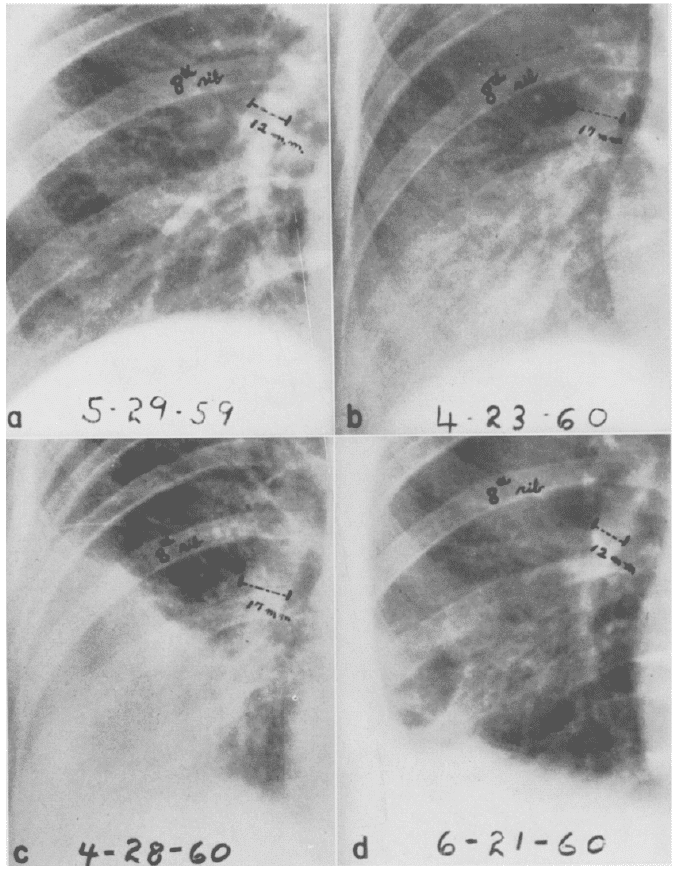
1965 December – Chang published Clinical application of the measurement of the right descending pulmonary artery in the radiological diagnosis of pulmonary hypertensions from various causes. This extended his measurement technique to pulmonary hypertension associated with chronic lung disease, valvular disease and other haemodynamic disorders. In its pulmonary-infarction section Chang explicitly stated that descending pulmonary arterial dilatation was the sign he and Davis had already reported and attributed the phenomenon to acute cor pulmonale
1983 – Antonio Palla et al. investigated the same vascular phenomenon for acute PE. Pall used Chang’s 1962 normal reference measurements and demonstrated significant enlargement of the proximal right descending pulmonary artery during acute embolisation. He described a distinctive plump “sausage” morphology with relatively abrupt distal tapering in about one-quarter of confirmed PE cases
Associated Persons
- Nils Westermark (1892-1980) [Westermark sign]
- Aubrey Otis Hampton (1900-1955) [Hampton hump]
- Benjamin Castleman (1906–1982)
- Felix George Fleischner (1893-1969) [Fleischner sign and Fleischner lines]
- C. H. Joseph Chang (1929-2017) [Chang sign]
- Antonio Palla [Palla sign]
Alternative names
- Chang’s sign
Related sign
Palla sign is a later and more specific morphological manifestation of right descending pulmonary arterial enlargement in acute PE. The sign is characterised by marked proximal dilatation with relatively abrupt distal tapering, producing the characteristic plump or “sausage-shaped” appearance. Unlike Chang sign, the Palla sign is restricted to the right descending pulmonary artery and incorporates vessel shape as part of its definition.
Eponymythology
Chang sign and Palla sign are frequently treated as synonymous, but the original descriptions are not identical.
Chang and Davis in 1965 described transient enlargement of a previously normal right or left descending pulmonary artery, demonstrated by serial radiographs in patients with pulmonary infarction. Their definition did not require abrupt arterial termination, an amputated appearance or a particular vessel shape.
Palla et al. in 1983 quantified enlargement of the right descending pulmonary artery in confirmed PE and described the more distinctive “sausage” appearance, produced by marked proximal enlargement with relatively abrupt distal tapering.
Palla cited Chang’s 1962 normal measurements but not the 1965 Chang–Davis report of transient arterial enlargement. Later literature has increasingly used Palla sign for right descending pulmonary arterial enlargement generally, which has contributed to overlap between the two eponyms.
References
Original articles
- Chang CH. The normal roentgenographic measurement of the right descending pulmonary artery in 1,085 cases. Am J Roentgenol Radium Ther Nucl Med. 1962; 87: 929-35.
- Chang CH, Davis WC. A Roentgen sign of Pulmonary Infarction. Clin Radiol. 1965 Apr;16:141-7. [Chang sign]
- Chang CH. The normal roentgenographic measurement of the right descending pulmonary artery in 1,085 cases and its clinical application. Part II. Clinical application of the measurement of the right descending pulmonary artery in the radiological diagnosis of pulmonary hypertensions from various causes. Nagoya J med. Sci. 1965;28:67-80.
Review articles
- Palla A, Donnamaria V, Petruzzelli S, Rossi G, Riccetti G, Giuntini C. Enlargement of the right descending pulmonary artery in pulmonary embolism. AJR Am J Roentgenol. 1983 Sep;141(3):513-7. [Palla sign]
- Bickle I. Plain Film Signs in Pulmonary Embolism (with CT correlate). Eurorad 2009, Case 7735
- Cadogan M. CXR eponyms in pulmonary embolism. LITFL
eponymictionary
the names behind the name

BA MA (Oxon) MBChB (Edin) FACEM FFSEM. Emergency physician, Sir Charles Gairdner Hospital. Passion for rugby, medical history, medical education, and asynchronous learning #FOAMed evangelist. Editor-in-Chief and Webmaster of Life in the Fast lane, LITFL | On Call 4e| Eponyms | Books | Horology |