


The Flagg laryngoscope is a portable direct laryngoscope developed by American anaesthetist Paluel J. Flagg for rapid examination of the pharynx and larynx, tracheal intubation and emergency airway management.
Flagg aimed to simplify direct laryngoscopy. He replaced the separate batteries, wires and delicate lamps of current bronchoscopic equipment with a more robust and portable instrument.
The original Flagg laryngoscope is now of historical interest and has been superseded by modern direct and video laryngoscopes. Its importance lies in the development of a portable, self-contained laryngoscope intended for anaesthetists and general practitioners rather than specialised bronchoscopists.
Flagg’s 1928 laryngoscope used a standard Welch Allyn battery handle with rheostat attached to a detachable, sterilizable laryngoscope blade. He proposed the practical laryngoscope would be used for
- direct examination of the pharynx and larynx
- removal of upper-airway foreign bodies
- tracheal intubation
- suction and clearance of an obstructed airway
- emergency and neonatal resuscitation
Description
Flagg identified several design features:
The standard Welch Allyn battery handle with rheostat is used as a base for the attachment of a specially designed detachable, sterilizable laryngoscope, embodying the following features: minimum vertical diameter, large lateral slot for intubation and instrumentation, waterproof wiring and lamp connection, which may be boiled, and a large lamp of a maximum durability.
Flagg, 1928
The design provided the convenience of an ordinary pocket flashlight while preserving sufficient working space for direct laryngoscopy and tracheal instrumentation.
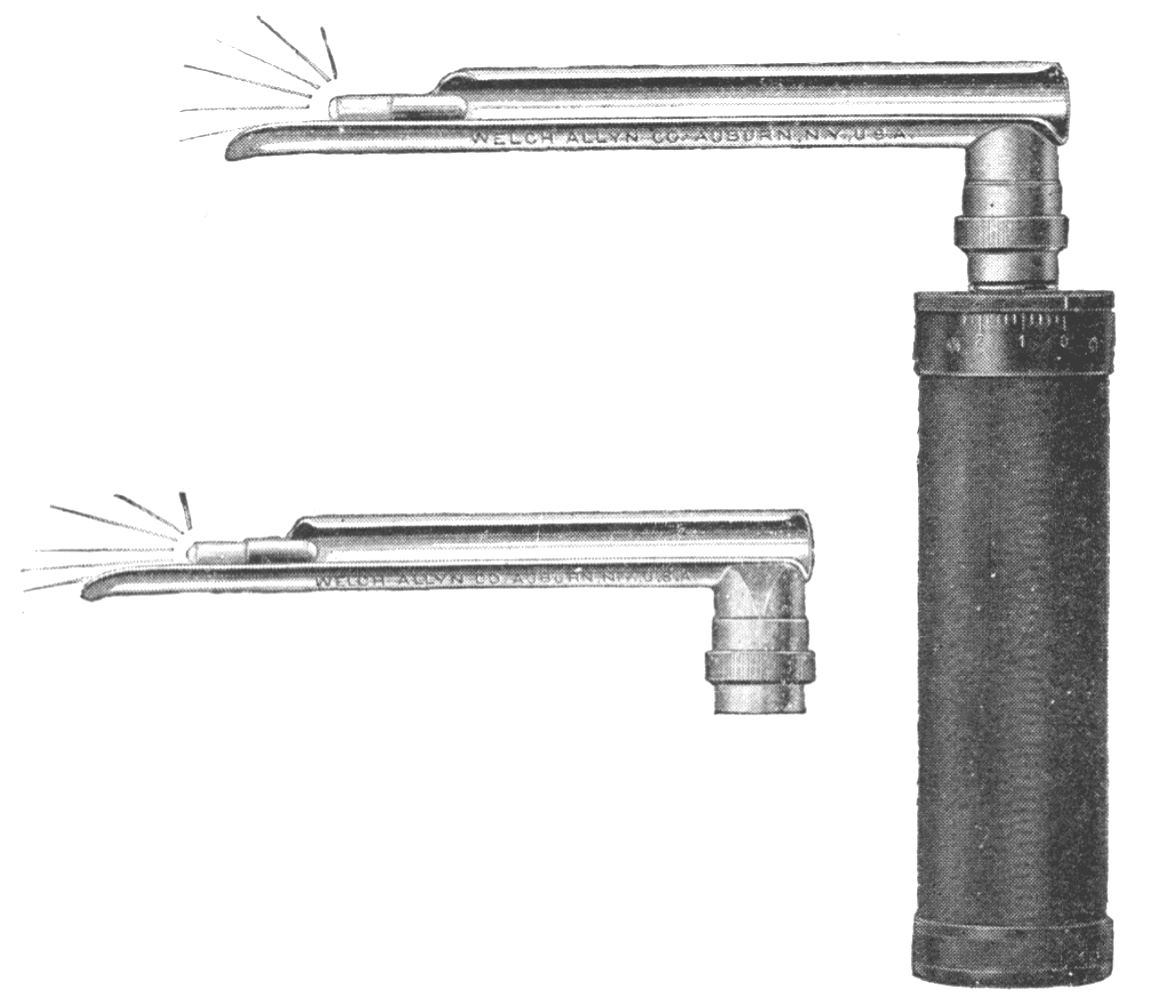
Commercial Flagg laryngoscopes retained the cylindrical battery handle and were supplied with interchangeable blades of different lengths.
Development of the Flagg laryngoscope
1913 – Henry Harrington Janeway described a laryngoscope designed for intratracheal anaesthesia. His instrument incorporated distal illumination powered by dry-cell batteries housed within the handle and a blade configuration designed to facilitate passage of an intratracheal catheter.
1916 – Paluel Joseph Flagg was familiar with battery-containing direct laryngoscopes more than a decade before designing his own instrument. He recommended the Jackson laryngoscope for intratracheal insufflation:
The Jackson laryngoscope has proven entirely efficient. This instrument affords a direct, electrically illuminated view of the glottis…The laryngoscope, which contains a small dry battery in the handle, is the most convenient pattern.
Flagg, 1916
1927 – Flagg published Intratracheal inhalation: preliminary report of a simplified method of intratracheal anesthesia developed under the supervision of Dr. Chevalier Jackson. His aim was to simplify tracheal anaesthesia by replacing complicated insufflation apparatus with a large-bore intratracheal tube through which normal respiration could continue. Direct visualisation and intubation remained central to the technique.
1928 – Flagg published Exposure and illumination of the pharynx and larynx by the general practitioner. A new laryngoscope designed to simplify the technic.
Flagg felt that the separate battery, wiring and small lamps used in bronchoscopy were overly cumbersome for use in brief laryngeal examination or emergency intubation. He wanted to create a device which enabled examination of the pharynx and larynx and was as readily available to the general physician as examination with a tongue depressor.
His solution was a detachable laryngoscope mounted on a standard Welch Allyn pocket-flashlight handle. Flagg reported using the instrument for the preceding year in his intratracheal work despite repeated transportation and “rough usage”, without failure.
1928 – In Treatment of asphyxia in the newborn, Flagg described his baby illuminated laryngoscope/speculum as part of an integrated neonatal resuscitation system.
The neonatal speculum was developed from anatomical measurements in stillborn and recently deceased newborn infants weighing 2.7–4.5 kg. Flagg measured an average distance of approximately 6.3 cm from the upper gums to the glottis.
He described placing the infant supine with moderate head extension, advancing the illuminated speculum over the tongue until the epiglottis was seen, clearing secretions by suction and then passing the lip of the instrument beneath the epiglottis to expose the glottis directly.
The Flagg neonatal laryngoscope was not just a smaller adult laryngoscope. It was a speculum designed around newborn airway dimensions and intended specifically for airway clearance and intubation during resuscitation.
1944 – In The Art of Resuscitation, Flagg described his “pocket flashlight” laryngoscope as an emergency airway instrument intended to replace the more cumbersome Jackson apparatus outside specialist bronchoscopy.
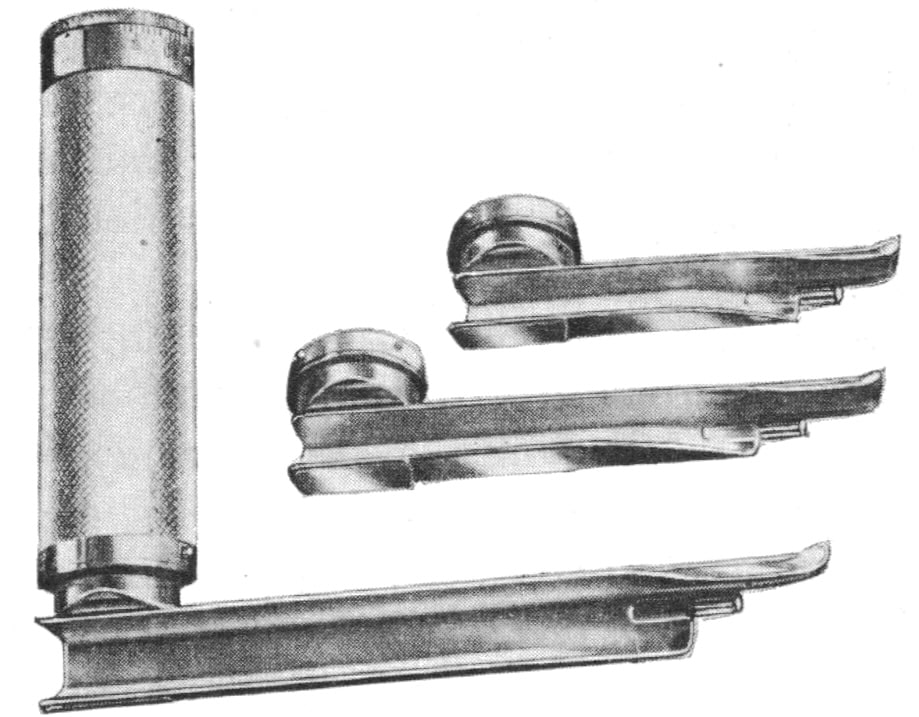
The first “pocket flashlight” laryngoscope to appear in the American market was that designed by the author. It was devised to replace the Jackson Laryngoscope for emergency work; it has been found so consistently satisfactory in the author’s hands that no changes of a radical nature have been made.
Flagg, 1944
Eponymythology
Flagg is sometimes credited with developing the first laryngoscope with batteries contained in the handle. This attribution is incorrect.
Flagg described a Jackson laryngoscope containing a small dry battery in the handle in 1916, twelve years before publication of his own instrument. Earlier battery-containing anaesthetic laryngoscopes, including the Janeway laryngoscope, also pre-dated Flagg.
Flagg’s innovation was the development of a simple, robust pocket-flashlight laryngoscope using dry cells and a detachable sterilizable blade, intended to make direct laryngoscopy practical outside the specialist bronchoscopic setting. William Allyn filed a patent for the laryngoscope with a detachable blade on October 6, 1933 (granted 1937)
Flagg’s purpose-built illuminated neonatal laryngoscope is regarded as the first laryngoscope specifically designed for neonatal intubation.
Associated Persons
- Henry Harrington Janeway (1873-1921)
- Chevalier Quixote Jackson (1865-1958)
- Paluel Joseph Flagg (1886–1970)
References
Historical references
- Flagg PJ. The art of anaesthesia. 1916
- Flagg PJ. Intratracheal inhalation: preliminary report of a simplified method of intratracheal anesthesia developed under the supervision of Dr. Chevalier Jackson Arch Otolaryngology. 1927;5;(5):394-399.
- Flagg PJ. Exposure and illumination of the pharynx and larynx by the general practitioner. A new laryngoscope designed to simplify the technic. Arch Otolaryngol 1928;8;(6):716-717.
- Flagg PJ. Treatment of asphyxia in the newborn: preliminary report of the practical application of modern scientific methods. JAMA. 1928;91;(11):788-791.
- Flagg PJ. The Art of Resuscitation. 1944: 85-86
Eponymous term review
- Sawyer T, Johnson K. Neonatal Intubation: Past, Present, and Future. Neoreviews 2020; 21(5): e335–e341
- Welch Allyn, Flagg Laryngoscope, c1933. Anesthesia Museum
eponymictionary
the names behind the name

MBChB - Liverpool. RMO in Emergency Medicine at Sir Charles Gairdner Hospital, currently soaking up the sun down under. Aiming to pursue a career in anaesthetics.

BA MA (Oxon) MBChB (Edin) FACEM FFSEM. Emergency physician, Sir Charles Gairdner Hospital. Passion for rugby, medical history, medical education, and asynchronous learning #FOAMed evangelist. Editor-in-Chief and Webmaster of Life in the Fast lane, LITFL | On Call 4e| Eponyms | Books | Horology |