


The Magill laryngoscope is a direct intubating laryngoscope designed by Sir Ivan Whiteside Magill and described in 1926.
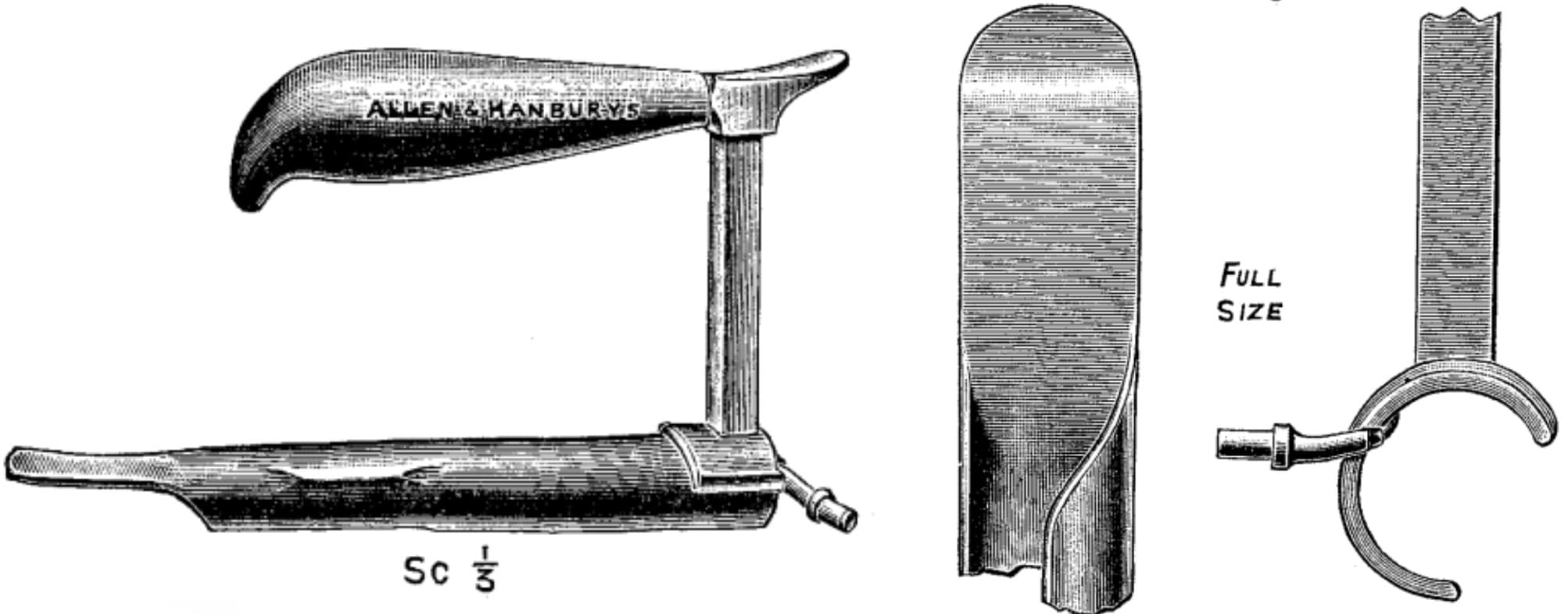
Magill developed the instrument to facilitate the passage of endotracheal catheters and expiratory tubes under direct vision. Its broad, slightly elevated distal end controlled the epiglottis, while the open lateral channel provided space for tube manipulation without obscuring the laryngeal view.
Modern use and significance
The original Magill laryngoscope is now primarily of historical interest. It has been superseded in airway management by detachable-blade laryngoscopes such as the Miller straight-blade and Macintosh curved blade, and video laryngoscopy.
Its significance lies in the development of the laryngoscope as a purpose-designed anaesthetic intubating instrument, rather than simply an instrument for examination of the larynx.
Key principles of Magill’s design remain in modern laryngoscopes. Direct illumination of the larynx, deliberate control of the epiglottis, preservation of the operator’s line of sight and sufficient working space for passage of an endotracheal tube.
Description
The Magill laryngoscope was a rigid, open-sided direct laryngoscope constructed from stainless steel. Magill identified four principal features:
- a lens-fronted distal electric bulb providing direct illumination
- a flat, broad distal end tilted slightly upwards to elevate and control the epiglottis
- an unusually wide lateral slot permitting passage of catheters and expiratory tubes without obstructing the visual field
- a proximal thumb lug to assist manipulation and positioning
The handle was fixed rather than detachable, and the barrel was polished internally and externally.
Rather than being simply a straight-blade laryngoscope, the original instrument is probably better described as an open-sided intubating speculum with a broad distal spatula.
History
1913 – Henry Harrington Janeway described a laryngoscope designed for intratracheal anaesthesia. His instrument incorporated distal illumination powered by dry-cell batteries housed within the handle and a blade configuration designed to facilitate passage of an intratracheal catheter.
1926 – On March 6, Ivan Magill published An improved laryngoscope for anaesthetists in the Lancet and stated the instrument “conform[ed] in general outline to other similar patterns”. Its design suited the requirements of Magill’s endotracheal anaesthetic technique. The broad distal end elevated the epiglottis, while the wide lateral opening provided room to pass catheters and expiratory tubes through the larynx without losing the direct view.
The instrument was manufactured by Allen & Hanburys and Down Bros.
The laryngoscope here illustrated, although conforming in general outline to other similar patterns, embodies certain features which have proved useful in passing catheters and their accompanying expiratory tubes through the larynx. These are: (1) efficient illumination from a lens-fronted electric bulb of the size usual in sigmoidoscopes; (2) the distal end of the speculum is flat, wide, and tilted slightly upwards-an advantage in elevating and controlling the epiglottis; (3) the unusual width of the slot at the side facilitates the passing of catheters and tubes for expiration without obscuring the visual field; (4) the lug at the proximal end of the handle affords a purchase for the thumb, which is of value in manipulating the instrument into position. The handle is not detachable, and the barrel, which is polished within as well as without, is constructed of stainless steel.
Magill 1926
1941 – Robert Arden Miller introduced A new laryngoscope. His instrument used a longer, narrower straight blade with a curved distal tip designed to lift the epiglottis and improve laryngeal exposure. It became the dominant straight-blade laryngoscope and remains in clinical use, particularly in infants and children.
Eponymythology
The self-contained battery claim
In his 1951 appreciation of Magill, Stanley Rowbotham stated that Magill was “the first to devise a laryngoscope with self-contained battery”. However, this priority claim is incorrect. Janeway described his laryngoscope in 1913 with two dry-cell batteries incorporated within its handle.
Magill versus Miller
The Magill laryngoscope predates the Miller laryngoscope by 15 years, and the two should not be treated as equivalent designs. Magill’s 1926 instrument was broader and more tubular, with a large open lateral channel specifically designed around the passage of insufflation catheters and expiratory tubes.
Associated Persons
- Henry Harrington Janeway (1873–1921)
- Sir Ivan Whiteside Magill (1888-1986)
- Robert Arden Miller (1906–1976)
References
Historical references
- Janeway HH. Intra‐tracheal anesthesia from the standpoint of the nose, throat and oral surgeon with a description of a new instrument for catheterizing the trachea. The Laryngoscope. 1913; 23(11): 1082-1090
- Magill I. An improved laryngoscope for anaesthetists. Lancet. 1926; 207(5349): 500
- Miller RA. A new laryngoscope. Anesthesiology 1941; 2: 317-320.
Eponymous term review
- Rowbotham S. Magill, Ivan W. Br J Anaesth. 1951 Jan;23(1):49-55.
- Pieters BM, Eindhoven GB, Acott C, van Zundert AA. Pioneers of laryngoscopy: indirect, direct and video laryngoscopy. Anaesth Intensive Care. 2015 Jul;43 Suppl:4-11.
eponymictionary
the names behind the name

MBChB - Liverpool. RMO in Emergency Medicine at Sir Charles Gairdner Hospital, currently soaking up the sun down under. Aiming to pursue a career in anaesthetics.

BA MA (Oxon) MBChB (Edin) FACEM FFSEM. Emergency physician, Sir Charles Gairdner Hospital. Passion for rugby, medical history, medical education, and asynchronous learning #FOAMed evangelist. Editor-in-Chief and Webmaster of Life in the Fast lane, LITFL | On Call 4e| Eponyms | Books | Horology |