


The Guedel laryngoscope is a straight-bladed direct laryngoscope developed by Arthur Ernest Guedel (1883–1956) in collaboration with instrument manufacturer Richard von Foregger during the early 1930s.
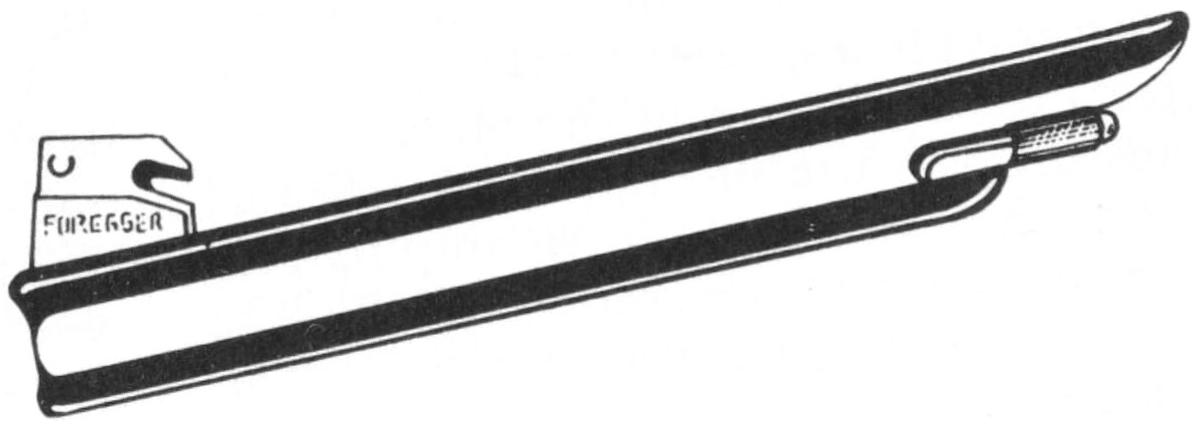
The large, channelled blade retained the C-shaped cross-section of earlier laryngoscopes but became flatter and narrower distally, providing working space for passage of the increasingly large cuffed endotracheal tubes. The unusually acute blade–handle relationship was intended to promote lifting of the larynx while reducing the tendency to use the upper teeth as a fulcrum.
Description
The original Guedel laryngoscope had a straight, fixed blade attached to a battery-containing handle. The blade was comparatively large, providing space for passage of an endotracheal tube within the channel. It incorporated distal illumination and was produced in several sizes from infant to large adult.
Wood Library documentation describes the blade as lying 72° to the handle, with a further 10° tilt at the distal tip. Contemporary advertising described the unusual geometry as helping to lift the larynx without levering against the upper teeth.
Historical development
1933–1935 – Guedel worked with Richard von Foregger to develop a laryngoscope specifically suited to endotracheal intubation. Unlike many modifications of the period, the instrument does not appear to have been introduced through a dedicated journal publication.
1935 – The Guedel laryngoscope appeared in the Foregger Company catalogue (No. 7) with a fixed handle. Ball and Westhorpe described the blade as retaining the C-shaped cross-section of the earlier Flagg pattern but flattening distally to facilitate passage of the larger cuffed tubes then entering widespread use.
The design was closely associated with the Guedel–Waters cuffed intratracheal technique and closed-circuit anaesthesia.
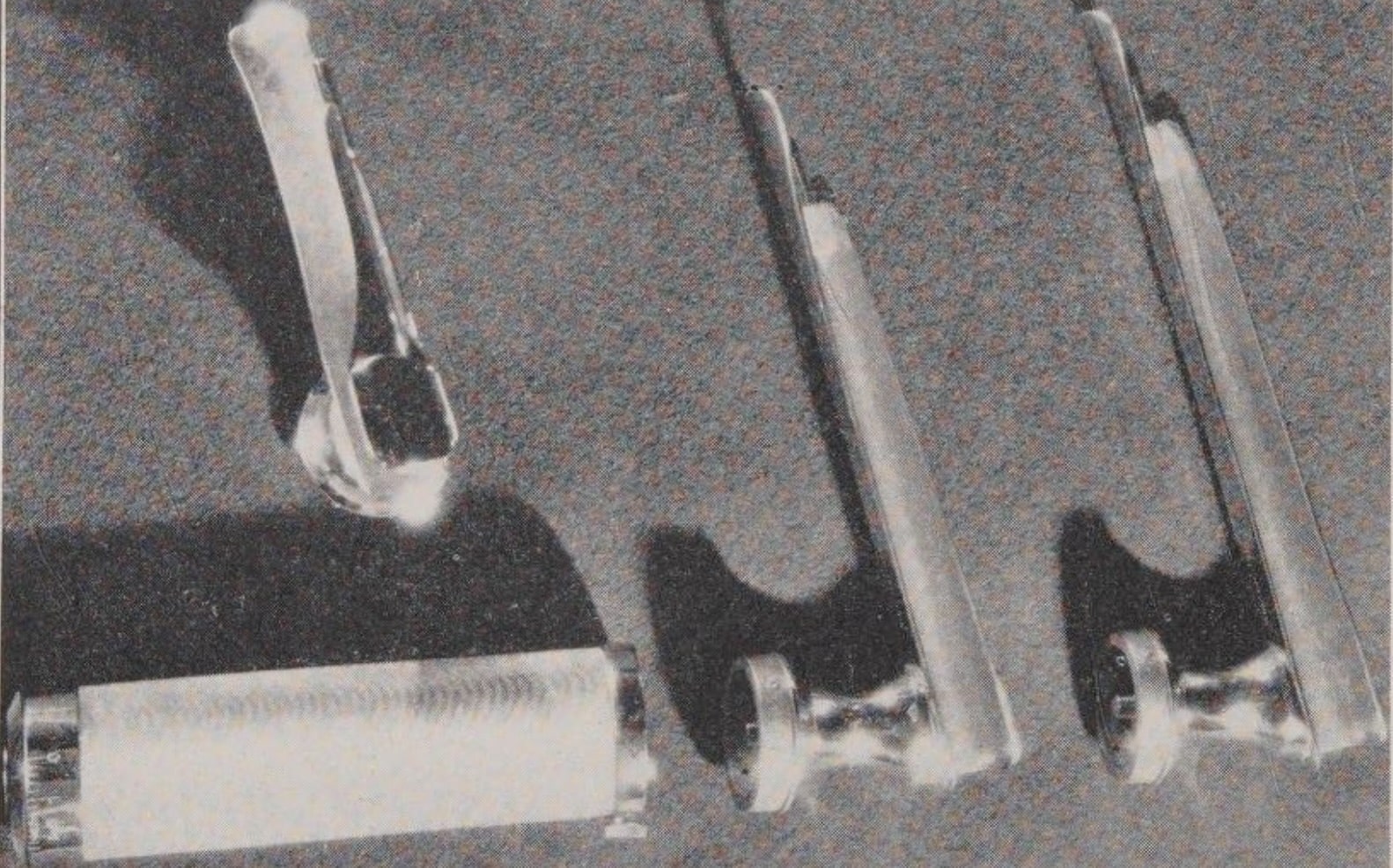
1941–1942 – Foregger developed and patented a folding-handle version. The patent concerned the folding mechanism and automatic electrical connection rather than Guedel’s original blade geometry. Guedel was not named as an inventor.
1949–1952 – Foregger catalogues document the transition from the earlier detachable blade secured by a thumb screw to the later folding/current-style blade attachment. The Guedel blade remained in Foregger literature for several decades.
Eponymythology
The Guedel laryngoscope appears to have entered anaesthetic practice through the Foregger instrument catalogue rather than a formal Guedel publication.
This was not unusual. Laryngoscopes evolved rapidly during the 1920s and 1930s, and many modifications were introduced commercially without accompanying discussion in the medical literature.
The eponymous term refers to Guedel laryngoscope blade which was the first designed specifically for use with a cuffed endotracheal tube.
Associated Persons
- Richard von Foregger (1872–1960)
- Arthur Ernest Guedel (1883-1956)
References
Historical references
- Foregger Company catalogue (No. 7), 1935
- Blumer G. Guedel laryngoscope for anesthetist’s use In: The Practitioners Library of Medicine and Surgery, 1938: 625
Eponymous term review
- Guedel Laryngoscope. Wood Library-Museum
- Ball CM, Westhorpe RN. The development of laryngoscopes for anaesthesia. Anaesth Intensive Care. 2015 Jan;43(1):3-4.
eponymictionary
the names behind the name

MB ChB, Edinburgh Medical school. F1/F2 in Bath, now in Australia, Perth preparing for a career in Emergency medicine. I have an interest in wilderness medicine and women’s health, but haven’t fully found my niche interest yet.

BA MA (Oxon) MBChB (Edin) FACEM FFSEM. Emergency physician, Sir Charles Gairdner Hospital. Passion for rugby, medical history, medical education, and asynchronous learning #FOAMed evangelist. Editor-in-Chief and Webmaster of Life in the Fast lane, LITFL | On Call 4e| Eponyms | Books | Horology |