
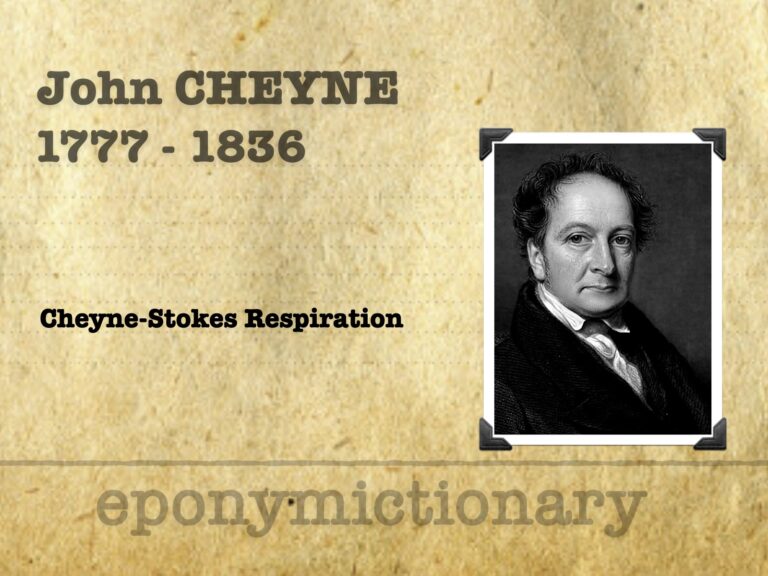
John Cheyne
John Cheyne (1777–1836), Irish physician, co-described Cheyne-Stokes respiration, advanced clinical neurology, and linked pupils to brain injury

John Cheyne (1777–1836), Irish physician, co-described Cheyne-Stokes respiration, advanced clinical neurology, and linked pupils to brain injury

Cheyne-Stokes respiration is a cyclical breathing pattern of apnoea and hyperpnoea, seen in heart failure, brain injury, and end-of-life settings.

American neurologist Francis Xavier Dercum (1856–1931), first described Dercum’s disease; pioneer in neurology, psychiatry, and medical education.

Rendu-Osler-Weber disease (aka Hereditary haemorrhagic telangiectasia (HHT)) is an autosomal dominant disorder characterised by epistaxis, cutaneous telangiectasia, and visceral arteriovenous malformations (AVMs).

Exophthalmos (proptosis) is abnormal eye protrusion, often from Graves disease or orbital lesions. Urgent assessment is needed to prevent vision loss.
Acute dacryocystitis is a painful infection of the nasolacrimal duct, often with swelling, discharge, and risk of abscess or orbital cellulitis.
May–Thurner syndrome (MTS). Venous compression syndrome causing left-sided iliofemoral DVT, first anatomically defined by May and Thurner in 1957.
Josef Thurner (b. 1927), Austrian pathologist and co-eponym of May–Thurner syndrome; led pathology in Salzburg and published widely on venous disease.
Robert May (1912–1984), pioneer of scientific phlebology; co-described May–Thurner syndrome and the May perforating vein, advancing venous diagnostics.
Overview of Dercum's disease: rare painful adipose‑tissue disorder, epidemiology, treatment strategies, and eponym history.

Alfred Lewis Galabin (1843-1913) English obstetric physician. Using an apexcardiogram he was documented atrioventricular (AV) block in humans.
Echocardiography and valve measurements. Comprehensive assessment requires measurements to be made from 2D images and the waveforms generated during Doppler investigations