


Performance errors in Video Laryngoscopy
Video laryngoscopy allows technical performance to be reviewed beyond the simple outcome of successful or failed intubation. Recognising specific performance errors provides a common language for teaching, feedback and quality improvement.
The required skills vary with laryngoscope geometry. Standard-geometry video laryngoscopy (SGVL) and hyperangulated video laryngoscopy (HAVL) have related but distinct performance-error taxonomies.
This page describes these recognised errors. A separate How to review a video laryngoscopy page applies the taxonomy during structured video analysis.
Importantly, a performance error does not necessarily result in failed intubation. Bryan et al found that 67% of successful HAVL intubations reviewed contained at least one error.
Standard-geometry video laryngoscopy (SGVL)
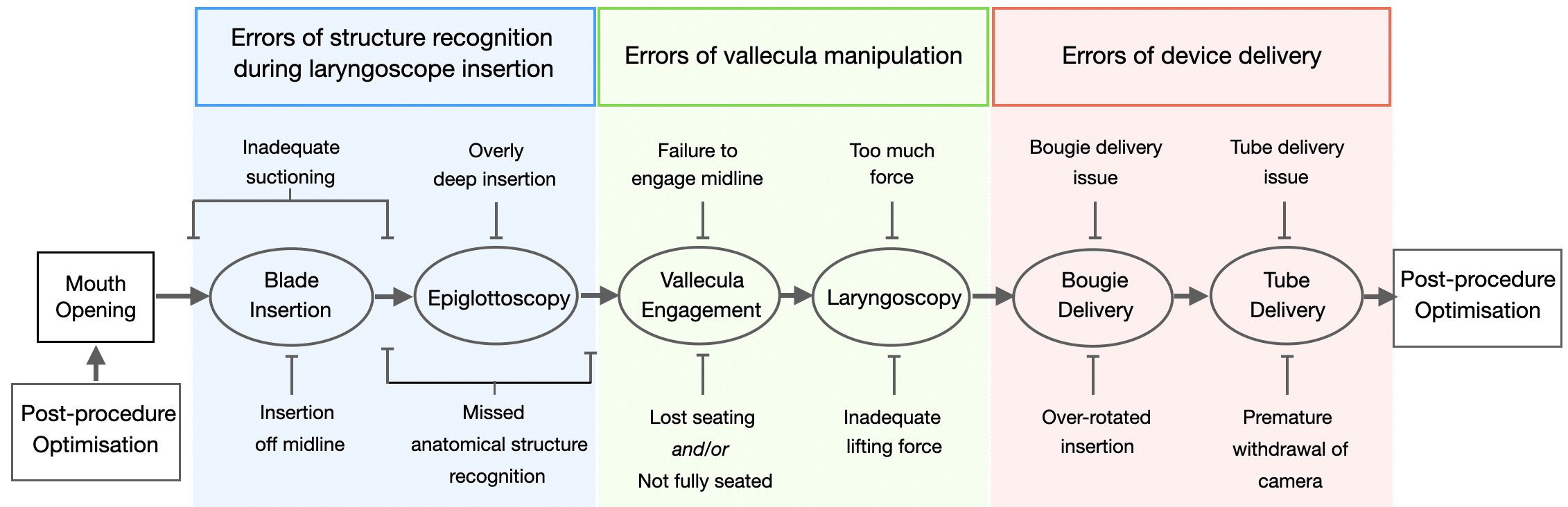
Standard-geometry video laryngoscopy (SGVL) formed the basis of the original published performance-error taxonomy. In 2023 Weingart et al published A taxonomy of key performance errors for emergency intubation. This included 13 discrete errors grouped into three procedural domains 1) Structure recognition during laryngoscope insertion, 2) Vallecular manipulation, and 3) Device delivery. This taxonomy provides a practical framework for recognising where a laryngoscopy attempt deviates from optimal technique and for giving specific, reproducible feedback.
| Structure recognition (4) | Vallecular manipulation (5) | Device delivery (4) |
|---|---|---|
| Inadequate suction | Inadequate lifting force | Bougie delivery issue |
| Insertion off midline | Failure to engage midline of vallecula | Over-rotated insertion (Kovacs sign) |
| Overly deep insertion | Lost seating in vallecula | Tube delivery issue |
| Missed anatomical structure recognition | Not fully seated in vallecula | Premature withdrawal of camera |
| Too much force in vallecula |
Structure-recognition errors occur during blade insertion and orientation. Off-midline and overly deep insertion may progress to oesophageal visualisation, while missed anatomical structure recognition occurs when relevant airway landmarks are visible but not recognised by the operator. Vallecular-manipulation and device-delivery errors then reflect problems with blade positioning, glottic exposure, and passage of the bougie or tube.
Hyperangulated video laryngoscopy (HAVL)
Hyperangulated video laryngoscopy (HAVL) provides an indirect view of the glottis and requires a different technical approach from SGVL. In 2025, Bryan published Hyperangulated video laryngoscopy in the emergency department and described blade-placement and tube-delivery problems during HAVL. In 2026, Bracey et al published A taxonomy of key performance errors associated with hyperangulated video laryngoscopy for emergency intubation. They formalised a 20-error HAVL taxonomy, incorporating shared, modified and technique-specific performance errors.
| Structure recognition (6) | Vallecular manipulation (7) | Device delivery (7) |
|---|---|---|
| Blade-tip entry error* | Failure to engage midline vallecula | Bougie delivery issue† |
| Insertion off midline | Not fully seated in vallecula | Translation rather than rotation of ETT with rigid stylet* |
| Inadequate suctioning | Lost seating in vallecula | Anterior tracheal-ring hang-up without immediate release* |
| Overly deep insertion | Over-rotation blade insertion* | Glottic structure trauma* |
| Missed anatomical structure recognition† | Overriding the epiglottis* | Dislodged ETT during stylet removal* |
| Poor tongue control* | Too much force in the vallecula | Premature balloon inflation* |
| Inadequate lifting force† | Premature withdrawal of camera |
* New performance error described in the HAVL taxonomy
The HAVL taxonomy preserves the same broad procedural domains as SGVL but contains more errors (20 vs 13) and more technique-specific delivery problems. HAVL places greater emphasis on controlled blade entry, tongue management, spatial orientation, and the rotation and advancement of a rigid-styleted tube. The additional errors in the HAVL taxonomy reflect technical differences rather than simple relabelling of SGVL mistakes.
Recognising a performance error is only the first step. During video review, the clinician must also describe the sequence of events, identify any corrective manoeuvres, and decide whether a deviation reflects an error, a recovery strategy, or a necessary adaptation to anatomy. These principles are explored further in How to review a video laryngoscopy.
References
Workshops and courses
- Nelson B. Advanced Airway Management. Medmastery course
Video laryngoscopy library
- Airway Glossary
- Stepwise Approach to Video Laryngoscopy
- Performance Errors in Video Laryngoscopy
- How to Review a Laryngoscopy Video
- Laryngoscopic Airway Anatomy
- Airway Video Cases
FOAMed
- Long N. Adult Intubation Checklist. LITFL
- Long N. Paediatric Intubation Checklist. LITFL
- Weingart S. EMCrit 176 – Updated EMCrit Rapid Sequence Intubation Checklist
- Weingart S. EMCrit 300 – Airway Continuous Quality Improvement and the Resus Airway Bundle
- Weingart S. EMCrit 360 – A Taxonomy of Key Performance Errors for Emergency Intubation (Primer)
Journal articles
- Weingart SD, Barnicle RN, Janke A, Bhagwan SD, Tanzi M, McKenna PJ, Bracey A; Resuscitationists Research Group. A taxonomy of key performance errors for emergency intubation. Am J Emerg Med. 2023 Nov;73:137-144.
- Bryan A, Feltes J, Sweetser PW, Winsten S, Hunter I, Yamane D. Hyperangulated video laryngoscopy in the emergency department: An analysis of errors and factors leading to prolonged apnea time. Am J Emerg Med. 2025 Sep;95:153-158.
- Weingart SD et al. The Airway Lead and the Creation of a Comprehensive Emergency Airway Quality Program. J Emerg Med. 2025 May;72:104-111.
- Bracey A, Lacy AJ, Weingart SD, Ata A, Giuliano AS, Lewis JC, Mantas J, Bayly B, Doyle M, Barnicle RN. A taxonomy of key performance errors associated with hyperangulated video laryngoscopy for emergency intubation. Am J Emerg Med. 2026 Mar;101:152-158.

Dr. Tim Friedmann, MD is an Assistant Professor in the Department of Emergency Medicine at the Icahn School of Medicine at Mount Sinai. He is an Assistant Program Director for the residency program and works clinically at Mount Sinai Hospital and Elmhurst Hospital | Sinai EM |
BA MA (Oxon) MBChB (Edin) FACEM FFSEM. Emergency physician, Sir Charles Gairdner Hospital. Passion for rugby, medical history, medical education, and asynchronous learning #FOAMed evangelist. Editor-in-Chief and Webmaster of Life in the Fast lane, LITFL | On Call 4e| Eponyms | Books | Horology |