


Stage before the number
Stage Before the Number: Recognising Advanced HIV at the Bedside
A 42-year-old presents with three weeks of progressive dyspnoea, dry cough, weight loss, and fatigue. HIV status is unknown. They desaturate on exertion, and the chest radiograph is surprisingly unimpressive. A CD4 count has been sent, but it will not come back before you have to make decisions.
What counts as advanced HIV disease?
WHO defines advanced HIV disease in adults and adolescents as a CD4 count <200 cells/mm³ or a WHO stage 3 or 4 clinical event. ED pearl: the clinical event can establish advanced disease before the CD4 result returns.
Can you recognize advanced HIV before the number comes back?
You can, and most of the time you have to. The CD4 count is the number everyone quotes and almost no one has in the moment. In most EDs it is a send-out that returns long after the patient is admitted or discharged. Four passes over information you already have can help you recognise advanced HIV at the bedside: the history, the exam, the FBC (CBC), and the syndrome in front of you.
First pass: the history
Start by placing the patient on the HIV timeline.
- Antiretroviral Therapy (ART) interruptions. On or off treatment is too blunt. A patient prescribed ART who has missed weeks to months of therapy can lose virologic suppression and again become vulnerable to disease progression. Treatment interruption increases the risk of AIDS-defining events.
- Untreated, newly diagnosed, or lost to follow-up. Treat these histories as red flags for advanced disease until immune status is known. This is the late-presenter group, and a meaningful share of them are diagnosed for the first time in an acute-care setting.
- Prior Opportunistic Infections (OIs) or prophylaxis. A history of an opportunistic infection, or current trimethoprim-sulfamethoxazole or azithromycin, may indicate prior significant immunosuppression.
- Last known CD4 and nadir. Grab both if available. The nadir shows how profound the immunosuppression has previously been. The current CD4 and treatment status are more relevant to today’s OI risk.
Our patient has never tested for HIV and has no previous CD4 count to retrieve. The history gives us nothing to lean on, which pushes all the weight onto the exam, the FBC, and the syndrome.
Second pass: look for immune failure
A head-to-toe look is the fastest read on immune status. The findings that matter cluster in the eyes, mouth, skin, and general appearance
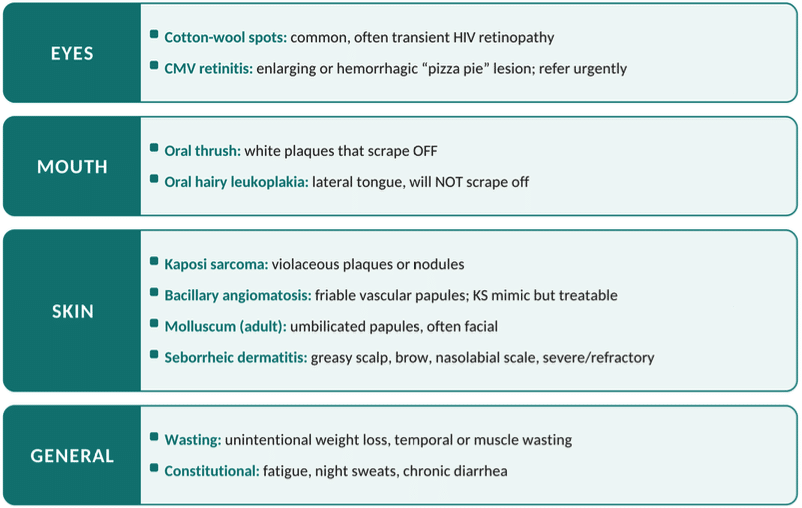
Two oral findings are worthy of note. Firstly, thrush scrapes off with a tongue blade, whereas oral hairy leukoplakia does not. Secondly, bacillary angiomatosis can look identical to Kaposi sarcoma. However as it is Bartonella rather than cancer, it is antibiotic-treatable and worth a biopsy when the distinction changes management.
Examination shows oral thrush and temporal wasting, two bedside clues to significant immunosuppression.
Third pass: the blood count re-evaluated
The absolute lymphocyte count (ALC), which is WBC × lymphocyte fraction (or WBC × lymphocyte % ÷ 100) and can give a rough bedside clue to immune status. It is back in minutes, and it tracks loosely with CD4. This value can be treated as an adjunct, not a substitute for a CD4 measurement.
An ALC below roughly 1000 cells/mm³ increases concern for a CD4 below 200, but a normal ALC cannot exclude advanced disease.
Read the ALC as a nudge, not a gate. A low ALC, an opportunistic infection, a mouthful of thrush, or an untreated or unknown HIV status should each raise concern that the patient may have advanced HIV right now. Let the clinical picture override a reassuring number.
Fourth pass: when the syndrome is the stage
You do not need a CD4 to stage someone who walks in with an AIDS-defining illness. The AIDS-defining illness in front of you is not a surrogate for the stage, it is the stage.
- Dyspnoea, dry cough, hypoxaemia out of proportion to the chest film → Pneumocystis pneumonia.
- Subacute headache, with or without fever, little meningism → cryptococcal meningitis.
- Focal deficit, seizure, or altered mental status → cerebral toxoplasmosis.
- Odynophagia → oesophageal candidiasis.
- Floaters or visual loss → CMV retinitis.
In our patient, progressive dyspnoea, dry cough, exertional desaturation, and relatively subtle radiographic change make Pneumocystis pneumonia the immediate concern.
This is the advanced-HIV phenotype we met in The Mono That Wasn’t. Here, the question is how much of the staging can be done before the CD4 returns. Status unknown, thrush, wasting and a syndrome that fits. Manage this as suspected advanced HIV while confirming both HIV and the opportunistic infection. The CD4 has not moved a single immediate decision.
Use the CD4 strata as a mental map
You may not have the CD4 result yet, but the pattern of illness can still suggest the range of immune suppression you should be thinking about. These are associations, not diagnostic thresholds; opportunistic disease does not always respect the boundaries.
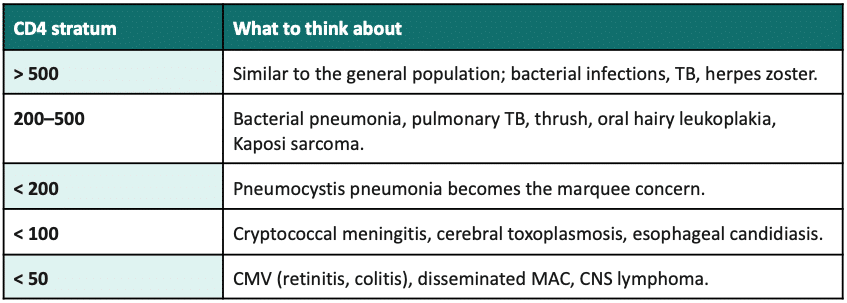
TB ignores the gradient. Tuberculosis can occur at any CD4 count and is frequently the presenting illness. Do not let a higher estimated CD4 talk you out of it.
Next steps
Once advanced HIV is on the table. Isolate, test, treat, admit
- Keep TB in the differential at every CD4 count. If pulmonary or laryngeal TB is clinically plausible, institute airborne precautions before the work-up proceeds.
- Do not discharge reflexively. Advanced HIV with a possible opportunistic infection is not a well-appearing viral syndrome.
- Send the CD4 and viral load. Order them now so the admitting or outpatient team has them, even though they will not return on your shift. If HIV status is unknown, send a laboratory Ag/Ab screen. A reactive screen proceeds through the diagnostic algorithm. If acute HIV remains clinically plausible despite a non-reactive screen, order HIV RNA separately (see the window-period lesson from The Mono That Wasn’t)
- Treat the syndrome in front of you. In an unwell patient with a high-probability, time-critical opportunistic infection, do not delay appropriate empiric therapy solely while waiting for confirmatory testing.
- Involve ID or HIV expertise early. Consultation, or a service like the National Clinician Consultation Center, helps with OI management and ART timing.
Bottom line
Do not wait on a number you will not get in time. A low ALC, an opportunistic infection, a mouthful of thrush, or an untreated or unknown status each tells you the patient may have advanced HIV right now. Work the four passes, estimate the stratum, and act before the CD4 returns.

Caveat: clinical staging is imperfect. In a systematic review, WHO stage 3/4 had roughly 60% sensitivity and 73% specificity against a CD4 under 200, good enough to raise your suspicion and act, not good enough to exclude advanced disease when clinical judgment says otherwise.
This article is part of a series developed to accompany the Medmastery course HIV in Primary Care by Dakota Price, MD. For the full approach to screening, diagnosis, staging, and antiretroviral therapy in the primary care and acute-care setting, see the course and the companion articles on LITFL
References
HIV specific clinical cases
- Price D. The Mono That Wasn’t. LITFL
- Price D. Spit, Scratch, Splash, Stick. LITFL
- Price D. Stage before the number. LITFL
Guidelines and recommendations
- World Health Organization. Guidelines for managing advanced HIV disease and rapid initiation of antiretroviral therapy. 2017
- World Health Organization. WHO guidelines on the management of advanced HIV disease 2025
- Twabi HH et al. Diagnostic accuracy of the WHO clinical staging system for detection of immunologically defined advanced HIV disease: A systematic review and meta-analysis. HIV Med. 2026 Jan;27(1):120-135.
- Shapiro NI, Karras DJ, Leech SH, Heilpern KL. Absolute lymphocyte count as a predictor of CD4 count. Ann Emerg Med. 1998 Sep;32(3 Pt 1):323-8.
- National Institutes of Health; HIV Medicine Association of the Infectious Diseases Society of America Panel on Opportunistic Infections in Adults and Adolescents With HIV— A Working Group of the Office of AIDS Research Advisory Council (OARAC). Guidelines for the Prevention and Treatment of Opportunistic Infections in Adults and Adolescents With HIV. [Updated 2026 May 27]
- Chapple IL, Hamburger J. The significance of oral health in HIV disease. Sex Transm Infect. 2000 Aug;76(4):236-43.
- Forrestel AK et al. Bacillary angiomatosis masquerading as Kaposi’s sarcoma in East Africa. J Int Assoc Provid AIDS Care. 2015 Jan-Feb;14(1):21-5.
- Kestelyn PG, Cunningham ET Jr. HIV/AIDS and blindness. Bull World Health Organ. 2001;79(3):208-13.
- Strategies for Management of Antiretroviral Therapy (SMART) Study Group; El-Sadr WM, Lundgren J et al. CD4+ count-guided interruption of antiretroviral treatment. N Engl J Med. 2006 Nov 30;355(22):2283-96.

CLINICAL CASES
Microbial Mystery

Dakota Price MD is a Family Medicine Faculty Physician and Family Medicine Residency Clinical Director of HIV Care for Cahaba Medical Care and the University of Alabama at Birmingham. He is also the Project Director for the HIV Clinical Training Tracks in Primary Care Residency Programs for the AETC Program, which provides clinical training and support. He has dedicated his career to bridging the gap in primary care for individuals living with HIV. | HIV Medmastery Course |