
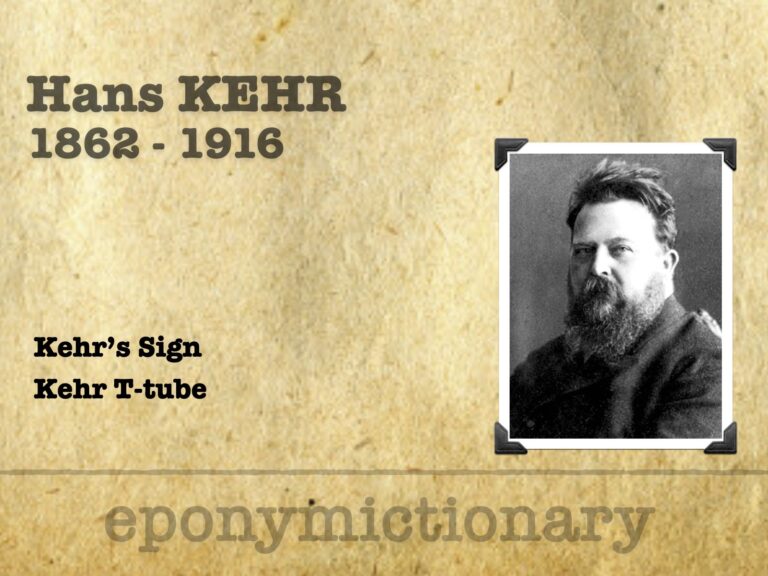
Hans Kehr
Hans Kehr (1862–1916), pioneer of gallbladder surgery, introduced the T-tube for bile duct drainage; eponymously linked to Kehr’s sign of splenic rupture.


Hans Kehr (1862–1916), pioneer of gallbladder surgery, introduced the T-tube for bile duct drainage; eponymously linked to Kehr’s sign of splenic rupture.

Berkeley George Andrew Moynihan, Lord Moynihan of Leeds (1865-1936) was an English General surgeon. Eponymously associated with the Moynihan sign (1905), an adaptation of Murphy's sign, a method used to differentiate pain in the right upper quadrant.
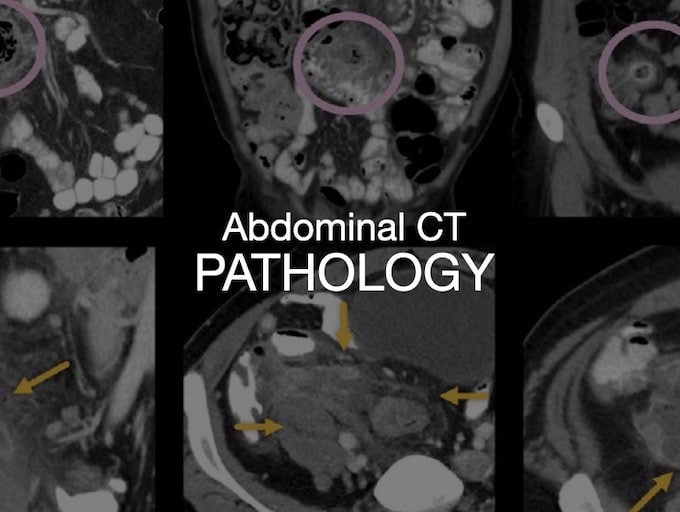
Abdominal CT: cholecystitis. Cholecystitis is inflammation of the gallbladder commonly caused by an obstruction of the cystic duct by a gallstone

A 90-year-old man is brought in to ED from his nursing home with lethargy, confusion and fever. He is very tender in the right upper quadrant.

Dr Nikolaus Mayr demonstrates ultrasound examination of the biliary system with emphasis on the diagnosis of cholecystitis.
A 24 year old man present with right loin pain. He has recently been on a keto diet (high in protein and fat, no carboydrates) and has had dramatic weight loss.
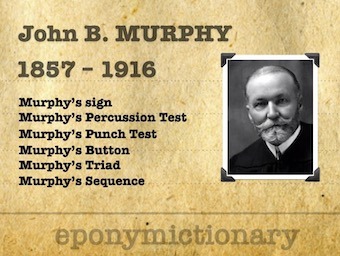
John Benjamin Murphy (1857-1916) was an American physician and abdominal surgeon. Eponymously remembered for Murphy’s Sign (...but not as you know it); Murphy's triad; Murphy's punch test and many more
Patrick Gerard Collins (1923 - 1999) was an Irish general surgeon specialising in biliary tract surgery. Collins sign (2009)

Ismar Isidor Boas (1858 - 1938) was a German gastroenterologist. Boas sign and Boas point (1894) Boas algesimeter (1891)
Carl Johann August Langenbuch (1846 - 1901) was a German surgeon. Pioneer in hepatobiliary surgery and performed the first cholecystectomy at the Lazarus Hospital in Berlin in July 1882
A 70 year old male presents with fever and right upper quadrant pain. Describe the findings on ultrasound
63 yr old female who presented with a 3 day history of colicky right upper quadrant abdominal pain. She is normally fit and well and has no prior past medical history. Describe and interpret this ECG. LITFL Top 100 ECG