


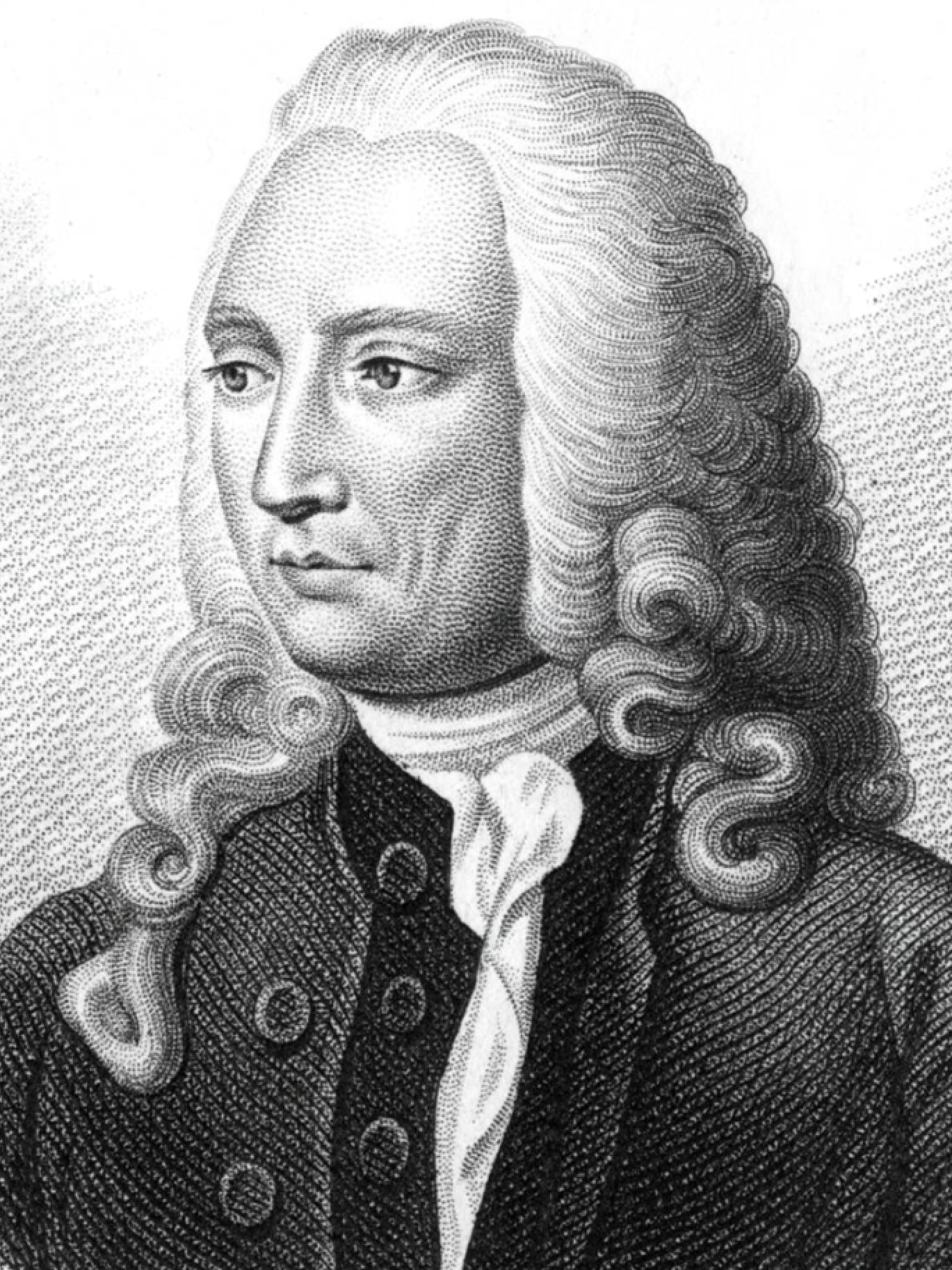
André Levret (1703-1780) was a French surgeon and obstetrician
Levret is recognised for his contributions to instrumental delivery and the study of difficult childbirth. He became one of the leading French obstetricians of the eighteenth century and served as accoucheur to the Dauphine of France.
Levret is remembered for his improvements to obstetric forceps, particularly the introduction of a pelvic curve designed to accommodate the anatomy of the maternal birth canal. He contributed to the study of pelvic mechanics, placenta praevia and obstetric haemorrhage, with an emphasis on practical teaching and the critical examination of established obstetric practices.
Levret developed instruments for the treatment of polyps. His reflecting speculum oris, described in 1743, combined surgical exposure with reflected illumination of the pharynx. Although not a true laryngoscope, the instrument established an early precedent for the use of reflected light in examining otherwise inaccessible anatomical structures.
Biographical Timeline
- Born January 6, 1703 in Paris, France.
- c.1720 – At seventeen, entered surgical apprenticeship under Jean-Louis Petit (1674–1750). Trained at the Hôtel-Dieu and La Charité in Paris.
- c.1736–1739 – Became physician and surgeon to the financier Samuel Bernard (1651–1739). Bernard patronage enabled Levret to pursue anatomical investigation, obstetrics and private teaching.
- 1742 – Qualified as a master surgeon and was admitted to the Académie royale de chirurgie in February. In November, presented an observation concerning venereal disease complicated by gangrene of the vagina and internal uterine orifice.
- 1743 – Demonstrated instruments for the ligature of deeply situated tumours at a public session of the Académie royale de chirurgie, reported in the November Mercure de France. Among them was a new speculum oris.
- 1745 – Appointed to the Academy’s permanent committee (comité perpétuel) on July 27.
- 1746 – Demonstrated a three-branched tire-tête designed to extract a foetal head retained within the uterus following separation from the body.
- 1747 – Presented his curved obstetric forceps to the Académie royale de chirurgie on January 2, introducing the pelvic curve to improve the application of forceps during difficult childbirth. Published Observations sur les causes et les accidens de plusieurs accouchemens laborieux.
- 1749 – Published Observations sur la cure radicale de plusieurs polypes de la matrice, de la gorge et du nez, describing instruments and techniques for ligature and removal of uterine, nasal and pharyngeal polyps.
- 1750 – Inherited 40,000 livres from his former surgical master, Jean-Louis Petit
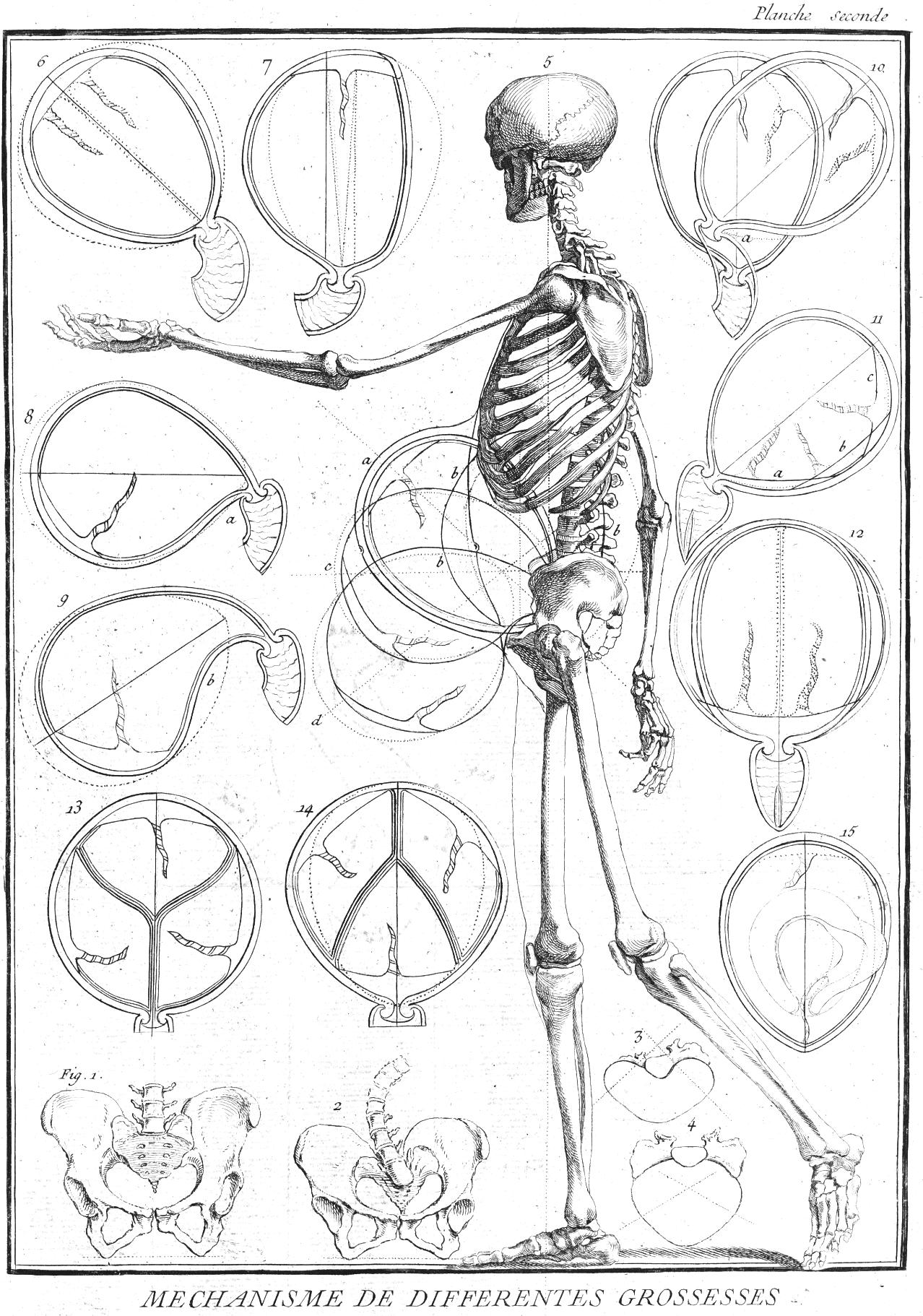
- 1751–1753 – Published further observations on difficult childbirth (1751), illustrations of the mechanics of pregnancy and delivery (1752), and L’Art des accouchemens démontré par des principes de physique et de mécanique (1753).
- 1756 – With César Verdier, examined and reported on the obstetric teaching mannequin developed by Angélique du Coudray (1712–1794), following its demonstration to the Paris surgical establishment.
- 1759 – Appointed accoucheur to Maria Josepha of Saxony (1731–1767), Dauphine of France and mother of the future Louis XVI.
- 1766 – Published Essai sur l’abus des régles générales, et contre les préjugés qui s’opposent aux progres de l’art des accouchemens.
- 1771 – Published a revised and expanded edition of his treatise on polyps of the uterus, throat and nose.
- Died in Paris on January 22, 1780 aged 77.
- 1781 – Observations sur l’allaitement des enfans published posthumously.
Medical Eponyms
Levret forceps (1747)
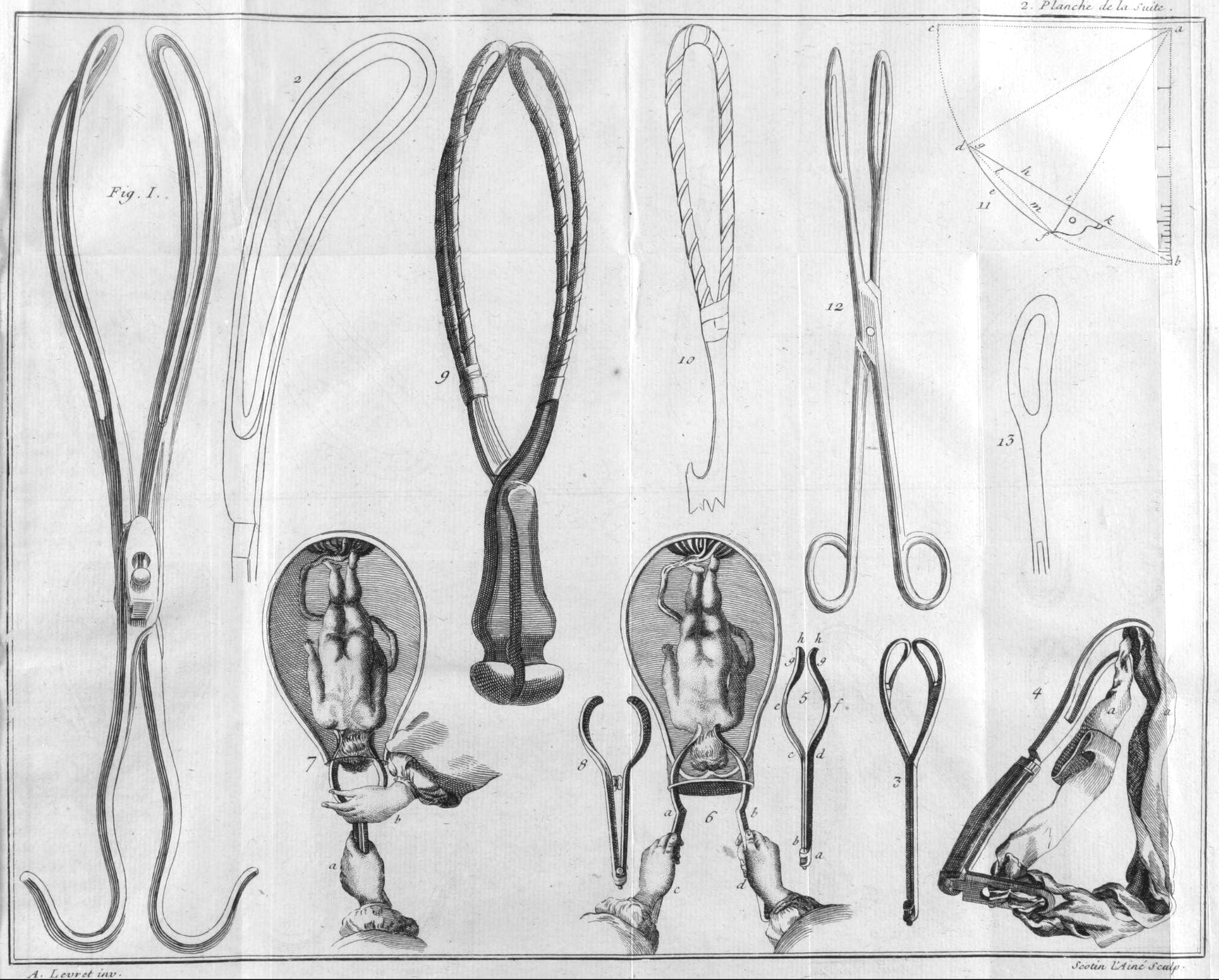
1747 – Levret published Observations sur les causes et les accidens de plusieurs accouchemens laborieux, describing improvements to existing obstetric forceps. He introduced a pelvic curve (courbure pelvienne) to accommodate the curvature of the maternal birth canal, facilitate extraction of an impacted foetal head and reduce perineal trauma. Levret also modified the blades and locking mechanism to improve application and grip during difficult childbirth.
Presented to the Académie royale de chirurgie on January 2, 1747, the instrument became known as the Levret forceps, and its pelvic curvature referred to as the Levret curve. British obstetricians, William Smellie (1697-1763) and Benjamin Pugh (1715–1798) independently developed similar curved forceps giving rise to continuing disputes over priority.
1751 – Levret responded to anonymous criticism, reproduced the Academy’s certificate confirming its presentation and documented further clinical applications.
Mauriceau–Levret manoeuvre (1753)
The Mauriceau–Levret manoeuvre describes assisted delivery of the aftercoming fetal head during breech birth, using fingers in the infant’s mouth and the opposite hand to support the neck and shoulders.
1681 – François Mauriceau (1637–1709) provided a detailed account in the third edition of Traité des maladies des femmes grosses et de celles qui sont accouchées. Earlier descriptions of similar techniques existed, including observations by Paul Portal (1630–1703).
1753 – Levret described the manoeuvre in L’Art des accouchemens, §§714–715, specifying the placement of the fingers and supporting hand, and advocating gentle, controlled traction.
§714. Lorsqu’on y est parvenu, il faut aider sa sortie, en plaçant un ou deux doigts dans la bouche de l’enfant, afin de le tirer par le menton, tandis qu’avec la paume de l’autre main, on tient les épaules assujetties, le col placé entre le doigt indicateur et celui du milieu, le pouce sous une aisselle, et les autres doigts sous l’aisselle opposée de l’enfant.
§715. On observera de ne jamais tirer l’enfant par secousses, mais seulement par des mouvements doux, répétés successivement et en différents sens, ou en forme de rotation, et d’éviter les mouvements de l’axe sur lui-même. Levret 1753
§714. Delivery of the head should be assisted by placing one or two fingers in the child’s mouth to draw it forwards by the chin. Meanwhile, the palm of the other hand supports the shoulders, with the neck positioned between the index and middle fingers, the thumb beneath one armpit, and the remaining fingers beneath the opposite armpit.
§715. Care should be taken never to pull the child with sudden jerks, but only with gentle, repeated movements in different directions, or with rotational movements, while avoiding twisting about its own axis. Levret 1753
1887 – Carl Conrad Theodor Litzmann (1815–1890) reviewed the historical development and disputed attribution of the technique in Der Mauriceau-Levret’sche Handgrif. The manoeuvre later appeared under alternative names, such as Mauriceau–Smellie–Veit.
Levret tire-tête (1746–1747)
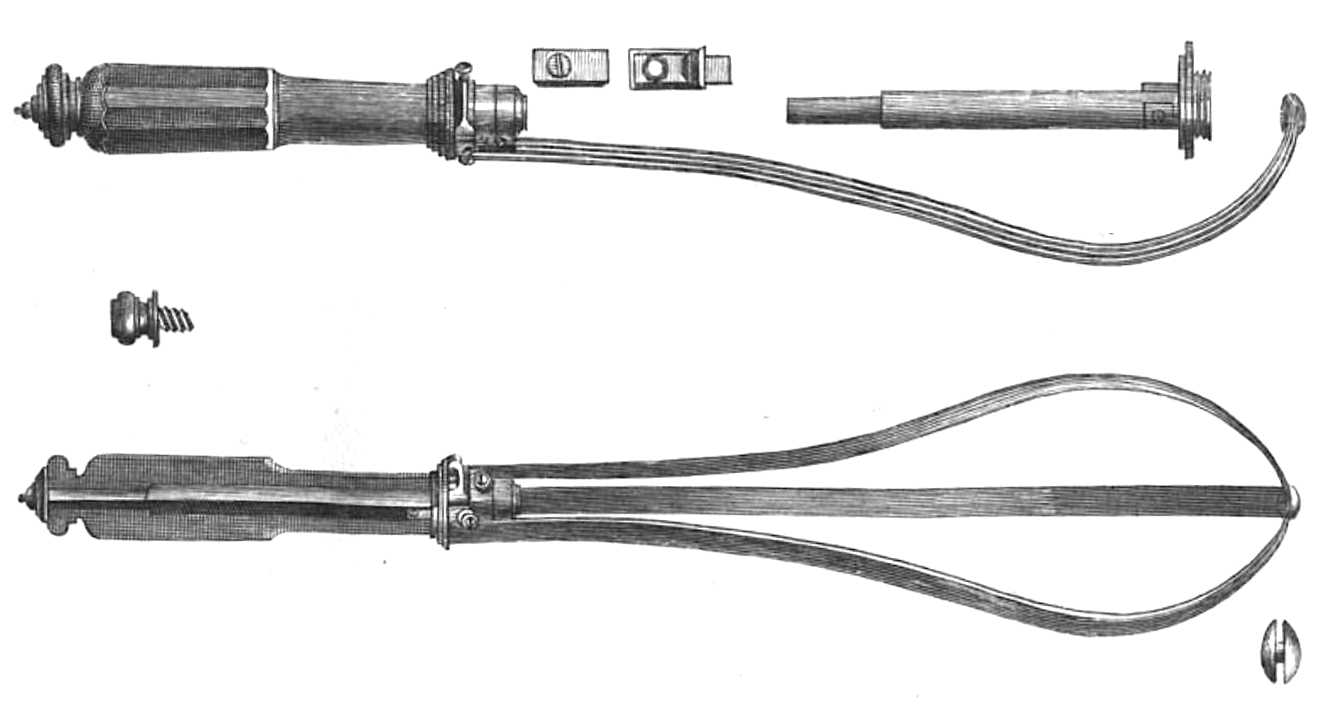
The Levret tire-tête was a mechanical obstetric instrument designed primarily for extracting a fetal head retained within the uterus following separation from the body. It incorporated three branches, one fixed and two movable, which expanded around the head to provide a grip for extraction.
1746 – Levret demonstrated his three-branched tire-tête at a public session of the Académie royale de chirurgie. He published a detailed description of its construction and application in Observations sur les causes et les accidens de plusieurs accouchemens laborieux (pp. 12–38).
1770 – The Encyclopédie, Chirurgie illustrated the instrument and reported that Levret had subsequently abandoned it in favour of a double hook.
Key Medical Contributions
Surgical treatment of polyps and reflecting instruments (1743–1749)
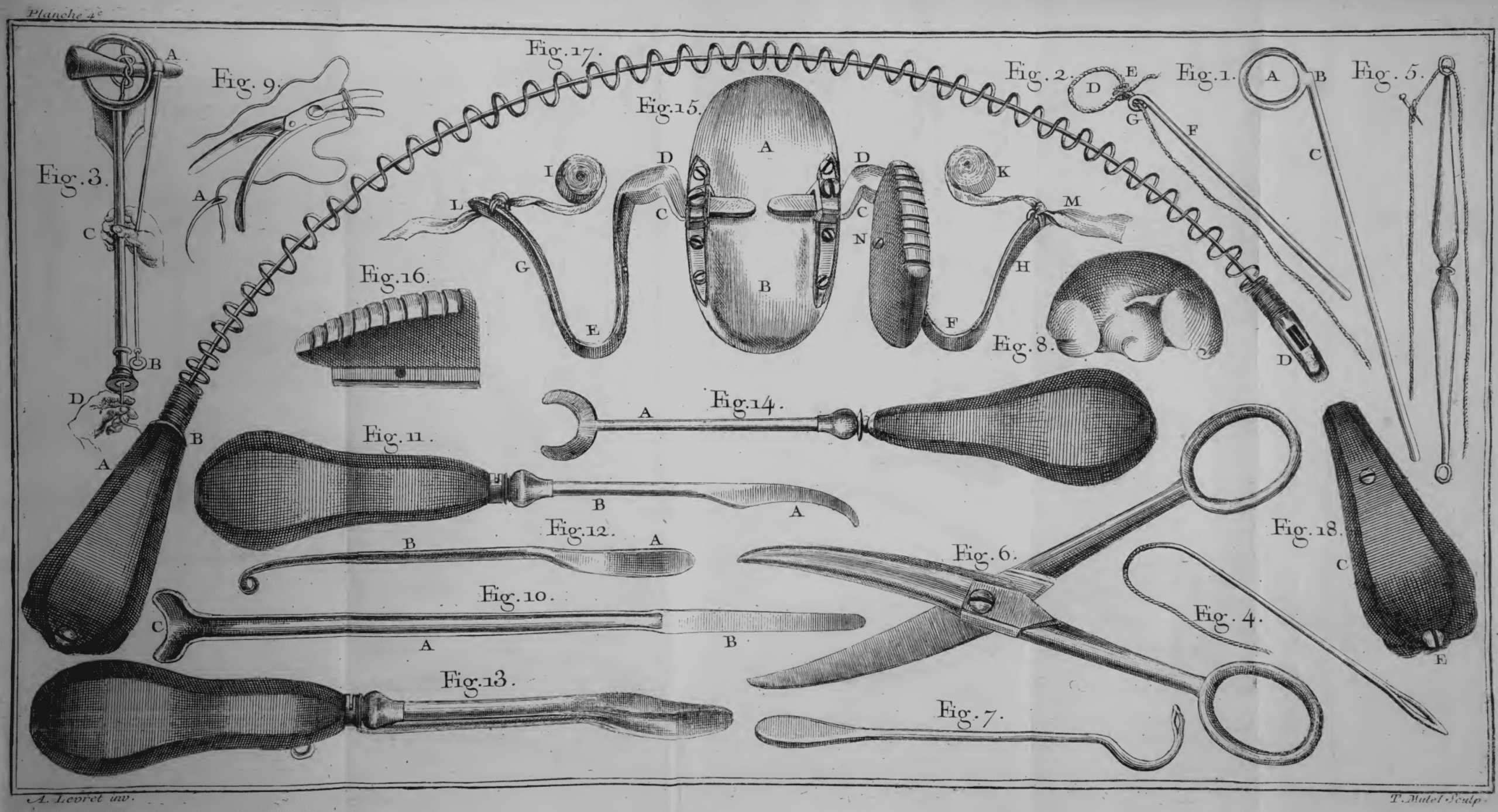
1743 – Levret developed the Levret serre-nœud (knot-tightener), also described as a porte-anse (ligature carrier), to position and tighten ligatures around polyps situated deep within the uterus, nose and pharynx. He also introduced a speculum oris that maintained mouth opening, restrained the tongue and directed light towards pharyngeal lesions by means of a polished metallic plate.
..par le moyen d’une plaque polie, qui fait son corps, réfléchit les rayons lumineux dans le lieu qu’occupe la tumeur. Levrette, 1743
..by means of a polished plate forming the body of the instrument, it reflects rays of light towards the location of the tumour. Levrette, 1743
1749 – Levret published Observations sur la cure radicale de plusieurs polypes de la matrice, de la gorge et du nez. He included a diagram of his speculum oris, combining a mouth gag, tongue depressor and polished metallic reflecting surface. The apparatus maintained oral exposure without an assistant while directing light towards lesions in the pharynx.
The speculum oris has been described as an early attempt to integrate illumination and operative access in for pharyngeal surgery. Levret did not document visualisation of the vocal cords.
Obstetric pelvic mechanics (1747–1753)
1753 – In L’art des accouchemens (1753), Levret described the inclination of the pelvis, successive axes of foetal descent and the relationship between foetal position and difficult delivery. This provided an approach to instrumental obstetrics, combining anatomical observation, mechanical reasoning and clinical experience.
Placenta praevia and obstetric haemorrhage (1747–1753)
1747 – Levret described the association between low placental implantation, abnormal uterine position and difficult childbirth. He challenged that prevailing belief that the placenta could attach only to the uterine fundus and proposed that implantation near the cervical opening could alter uterine mechanics and contribute to obstructed labour.
In Suite des observations (1751), Levret developed a more detailed account of placenta praevia and associated haemorrhage. Levret acknowledged the observations of Paul Portal, Mauriceau and others. He reviewed the evidence for placental attachment over the internal cervical opening and described seven clinical observations to assist diagnosis. He included his own case from June 1748, involving severe antepartum haemorrhage and a placenta presenting through the cervix.
Levret related haemorrhage to separation of the abnormally implanted placenta during cervical dilatation and advised prompt delivery to prevent maternal death.
Obstetric teaching and criticism of conventional practice (1753–1766)
1753 – Levret published L’art des accouchemens to accompany his private obstetric lectures and organised as a collection of aphorisms supported by anatomical and mechanical principles. The text included practical demonstrations using mechanical obstetric models (phantômes mécaniques), allowing students to rehearse delivery manoeuvres before attending women in labour.
1756 – Levret and César Verdier reviewed the obstetric teaching mannequin developed by Angélique Marguerite Le Boursier du Coudray (1712–1794), subsequently approved by the Paris surgical establishment.
1766 – In Essai sur l’abus des régles générales, Levret challenged the indiscriminate application of established obstetric practices. He criticised routine bloodletting during pregnancy and questioned prohibitions against bathing. Levret also rejected traditional beliefs concerning the survival of infants born at seven versus eight months, and opposed the routine use of cordials and vapour baths to accelerate labour.
Major Publications
- Mercure de France. November 1743: 2434–2436. Report of instruments demonstrated by André Levret (named Levrette in the original) at a public session of the Académie royale de chirurgie.
- Levret A. Observations sur les causes et les accidens de plusieurs accouchemens laborieux. 1747
- Levret A. Observations sur la cure radicale de plusieurs polypes de la matrice, de la gorge et du nez, opérée par de nouveaux moyens inventés. 1749
- Levret A. Suite des Observations sur les causes et les accidens de plusieurs accouchemens laborieux. 1751
- Levret A. L’art des accouchemens, démontré par des principes de physique et de mechanique. 1753
- Levret A. Essai sur l’abus des régles générales, et contre les préjugés qui s’opposent aux progres de l’art des accouchemens. 1766
- Levret A. Observations sur les causes et les accidens de plusieurs accouchemens laborieux, avec des remarques sur ce qui a été proposé ou mis en usage pour les terminer. 1770
- Levret A. Observations sur la cure radicale de plusieurs polypes de la matrice, de la gorge et du nez, opérée par de nouveaux moyens inventés. 1771
- Levret A. Observations sur l’alaitement des enfans, dans lesquelles on indique plusieurs précautions également intéressantes pour la mère et pour l’enfant. 1781
References
Biography
- Levret, André. Dictionaire des Sciences Médicales – Biographie Médicale. 1824; 6: 34-37.
- D’Aubinais. Revue bibliographique – Levret. Journal de la section de medecine 1860; 36: 35-40
- Tarnier S. Levret. Conférences historiques faites pendant l’année 1865, Paris, Germer Baillière, 1866: 309-337
- Huard P. André Levret (1705-1780). Concours médical 1962;84:2035-2044.
- Rihner F. André Levret Zum 200. Todestag. Die Medizinische Welt. 1981 May 8;32(19):764-5.
- Rihner F. André Levret Zum 200. Todestag MMW Munch Med Wochenschr. 1980 Aug 22;122(34):1163-4.
Eponymous terms
- Mauriceau F. Des maladies des femmes grosses et accouchées. 1668 [English translation Chamerlan: The diseases of women with child, and in child-bed 1672] [3e 1681]
- Plate XXXV in Encyclopédie. Chirurgie Tome II, 1779
- Litzmann. Der Mauriceau-Levret’sche Handgriff. Archiv für Gynäkologie. 1887; 31: 102–118
- James P. Lessons in laryngoscopy. 1873
- Dumont M. André Levret et la “fièvre de lait”. La Nouvelle presse médicale. 1981 Mar 14;70(12):935-6.
- Dumont M. La fièvre de lait [Milk fever]. Rev Fr Gynecol Obstet. 1989 May;84(5):451-3
- Dunn PM. Francois Mauriceau (1637-1709) and maternal posture for parturition. Arch Dis Child. 1991 Jan;66(1 Spec No):78-9.
- Tsoucalas G, Kousoulis AA, Karamanou M, Androutsos G. Scotland’s “wooden operator” William Smellie (1697-1763) and his counterpart in France André Levret (1703-1780): two great obstetricians and anatomists. Ital J Anat Embryol. 2011;116(3):148-52.
- Segal A. Les progrès de l’exploration visuelle des organes aux XVIIe et XVIIIe siècles Société française d’histoire de la médecine. 1979
Eponym
the person behind the name

BA MA (Oxon) MBChB (Edin) FACEM FFSEM. Emergency physician, Sir Charles Gairdner Hospital. Passion for rugby, medical history, medical education, and asynchronous learning #FOAMed evangelist. Editor-in-Chief and Webmaster of Life in the Fast lane, LITFL | On Call 4e| Eponyms | Books | Horology |