
ST Elevation in aVR
ST elevation in aVR indicates subendocardial ischaemia due to O2 supply/demand mismatch - causes can be cardiac and non-cardiac

ST elevation in aVR indicates subendocardial ischaemia due to O2 supply/demand mismatch - causes can be cardiac and non-cardiac
Myocardial infarction diagnosis in the presence of left bundle branch block (LBBB) or ventricular paced rhythm. Sgarbossa Criteria
ECG features of Idiopathic Fascicular Ventricular Tachycardia. AKA Belhassen-type VT, verapamil-sensitive VT or infrafascicular tachycardia.
Massive pericardial effusion produces a characteristic ECG triad of low QRS voltage, tachycardia, and electrical alternans. LITFL ECG Library

Thomas Hodgkin (1798 – 1866) was an English physician and pathologist. Eponym: Hodgkin disease (1832); Key-Hodgkin murmur (1827)
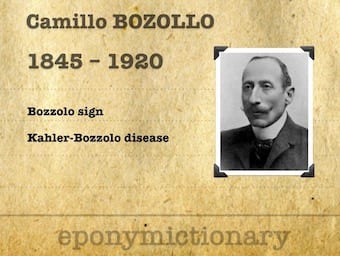
Camillo Bozzolo (1845-1920) was an Italian pathologist and physician. Bozzolo sign (1887) Visible pulsation of the arteries within the nasal mucosa.

Giulio Ceradini (1844 - 1894) was an Italian physiologist. illustrated the mechanism of closure of the semilunar valves
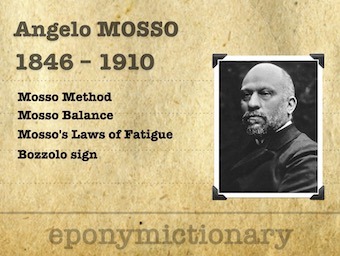
Angelo Mosso (1846-1910) was an Italian physiologist, archaeologist, politician, mountain climber and teacher.
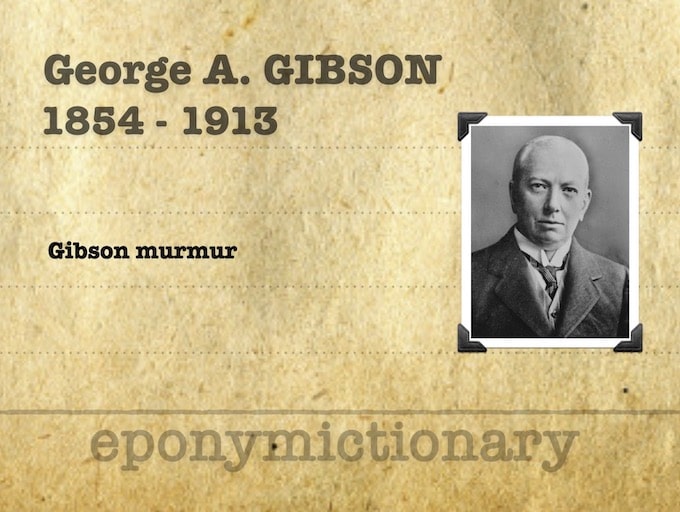
George Alexander Gibson (1854 – 1913) was a Scottish physician. Eponymously affiliated with the Gibson murmur (1906)
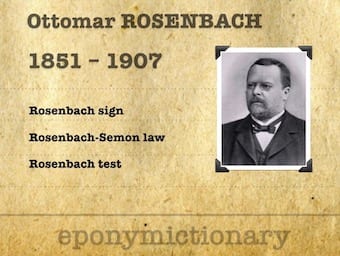
Ottomar Ernst Felix Rosenbach (1851 - 1907) was a German physician. Rosenbach sign of aortic regurgitation (1878), Rosenbach sign of autoimmune hyperthyroidism, Rosenbach-Semon Law (1880), and Rosenbach test (1880).

Still's Murmur ejection systolic murmur first described in 1909 by English pediatrician Sir George Frederic Still KCVO (1868 – 1941)
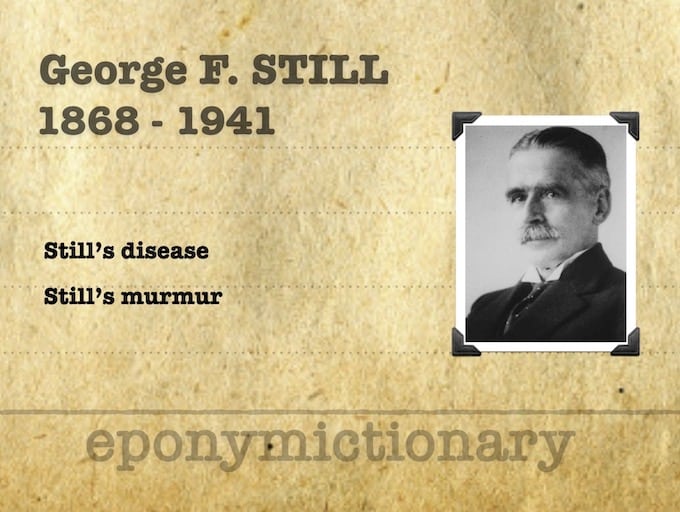
Sir George Frederic Still (1868-1941) English paediatrician. Described as the 'father of British paediatrics'. Still's disease, Still's murmur